 |
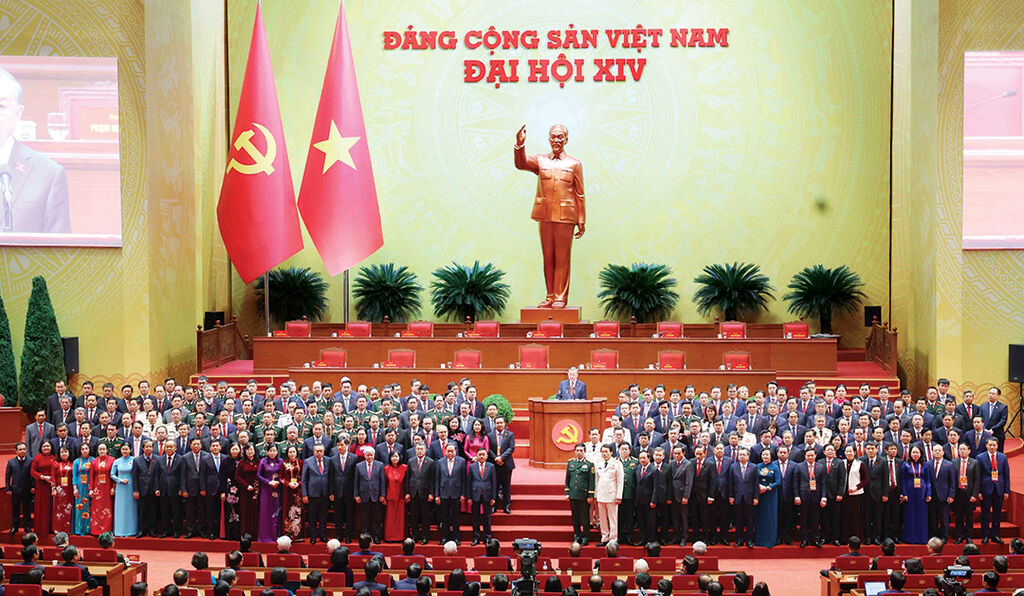
| The 14th Party Central Committee makes its debut at the closing ceremony of the National Party Congress in Hanoi on January 23, 2026__Photo VNA |
After the 14th National Party Congress, Tran Thanh Man, member of the Politburo, Secretary of the Party Committee of the National Assembly, and Chairman of the National Assembly, wrote an article entitled: “The National Assembly is determined to institutionalise the Resolution of the 14th National Party Congress, swiftly translating the Party’s guidelines into practice.” Vietnam Law and Legal Forum respectfully introduces the article of the top legislator.
The 14th National Congress of the Communist Party of Vietnam concluded with great success. This is a political milestone of special strategic significance, ushering in a new stage of national development. The congress reaffirmed the overall goal of achieving rapid and sustainable national development, striving for the target that Vietnam will become a developing country with a modern industry and upper-middle income by 2030, and a developed, high-income country oriented towards socialism by 2045.
In this process, the National Assembly plays a particularly important role in translating the will and determination of the Party into a legal framework and development policies, ensuring that the Party’s will harmonises with the people’s aspirations and that the entire political system and the entire society act in unity and coordination.
The 14th Party Central Committee unanimously elected To Lam, General Secretary of the 13th Party Central Committee, to continue acting as the General Secretary of the 14th Party Central Committee.
Institutionalising the Resolution of the 14th National Party Congress - a pivotal, consistent political task of the National Assembly
More than 80 years of formation and development of the National Assembly of Vietnam demonstrates a consistent principle: every stage of growth and every contribution of the National Assembly have been closely associated with the leadership of the Party and deep-rooted connection with the people. In the new stage of development, the Resolution of the 14th National Party Congress sets higher requirements for the National Assembly. Accordingly, the National Assembly should continue building itself into a truly supreme state authority, representing the will and aspirations of the people. It should promote democracy, the rule of law, modernity, professionalism, scientificity, openness, transparency, effectiveness and efficiency in its organisation and operation; decide on important issues of the country; and exercise the supreme oversight over the State’s operation. The National Assembly should also bring into play the role and responsibility of its Standing Committee to interpret laws; change the way of thinking and refine law-making methodologies and processes to ensure professionalism, scientificity, promptness and efficiency, thus meeting the requirements of the rapid and sustainable national development in the new era.
The Resolution of the 14th National Party Congress clearly sets out strategic orientations: continuing to build and comprehensively improve institutions for the rapid and sustainable national development, in which political institutions are pivotal, economic institutions are central, and other institutions are highly important. The resolution calls for formulating a new growth model; restructuring the economy; accelerating industrialisation and modernisation, and taking science, technology, innovation and digital transformation as primary driving forces. It aims at strongly and comprehensively developing Vietnamese culture and people; building a modern national education system up to regional and global standards; creating breakthroughs in science and technology development, innovation and national digital transformation; ensuring sustainable social development management with progress and equity; and improving the people’s living standards. Other orientations include effectively managing and utilising natural resources; protecting the environment; proactively adapting to climate change; strengthening national defence and security; and building revolutionary, regular, elite and modern People’s Army and People’s Public Security forces to firmly safeguard the Fatherland of the Socialist Republic of Vietnam.
The resolution also emphasizes promoting synchronous and innovative foreign affairs activities and deep, comprehensive and effective international integration; strongly promoting the people’s role as the central subject, socialist democracy, the people’s strength, and the great national unity bloc; continuing to build and improve the socialist law-ruled state of Vietnam; and further strengthening Party building and rectification in order to enhance the Party’s leadership capacity and combat strength.
All these orientations must be translated by the National Assembly into a unified, coherent, feasible and stable legal system. The National Assembly clearly determines that the quality and timing of institutionalising the Resolution of the 14th National Party Congress is the most important measure of its efficiency and effectiveness in the upcoming tenure. All legislative programmes and all decisions on socio-economic development, state budget, public investment, national defence, security and foreign affairs, etc., must directly serve the implementation of the goals and tasks set forth by the congress.
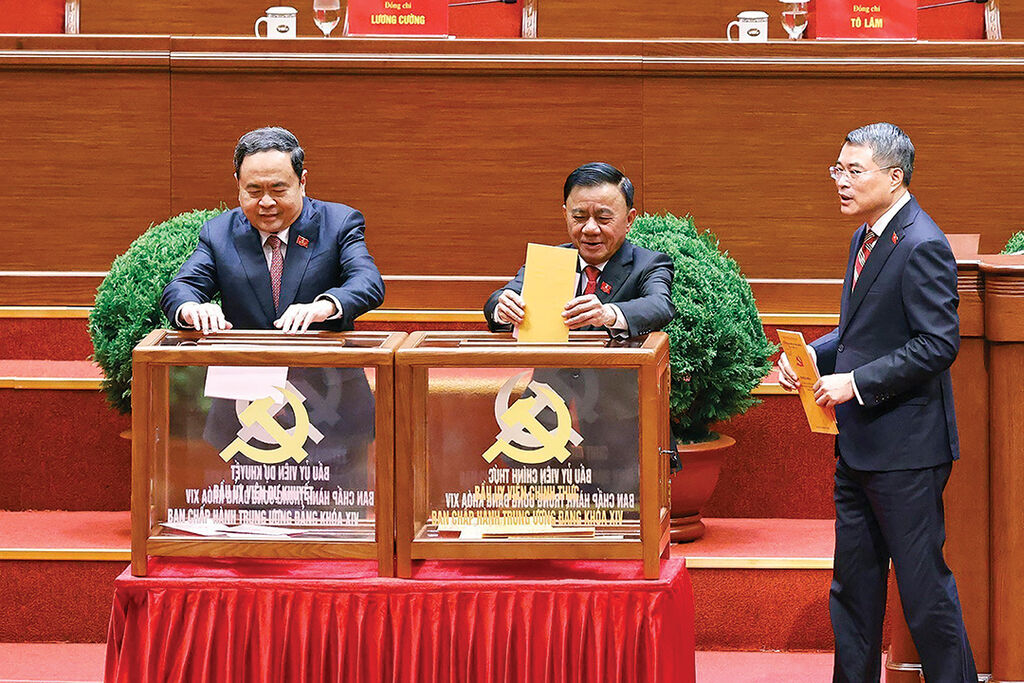 |
| Party and State leaders cast their ballots to elect the 14th Party Central Committee on January 22, 2026__Photo: VNA |
Key tasks following the 14th National Party Congress
The Party Committee of the National Assembly has identified several key tasks that need to be properly implemented following the 14th National Party Congress.
Firstly, it is required to closely adhere to the directions of the Party Central Committee, the Politburo, and the Resolution of the 14th National Party Congress in formulating, and effectively organising the implementation of, the Action Programme of the Party Committee of the National Assembly, and the Legislative Programme and the Oversight Programme of the entire tenure of the 16th National Assembly. It is also necessary to enhance oversight and inspection of the institutionalisation and implementation of the Party’s resolutions and guidelines as directed by the Party General Secretary at the congress: “improve development institutions and the socialist law-ruled state, taking implementation as the yardstick”; resolutely put an end to such situations as “laws are correct but infeasible to implement,” “consensus is reached during parliamentary deliberations but implementation at the grassroots level encounters obstacles,” “much talk, little action,” and “decisions are sound but delayed in implementation,” causing waste of resources and erosion of public trust. It is necessary to improve a power control mechanism so that power is always exercised within the framework of law, ethics, culture, national traditions and the people’s trust.
Secondly, thorough preparations should be made to successfully organise the elections of deputies to the 16th National Assembly and People’s Councils at all levels for the 2026-31 term, ensuring sufficient number and proper structure while giving top priority to the quality of deputies so that persons with good moral qualities and competence will be selected and nominated. At the same time, through parliamentary activities, to enhance political courage, promote the role and responsibility of National Assembly deputies, especially Party members who must truly be exemplary, show dedication, dare to think, dare to do, dare to practice innovation and dare to bear responsibility, place the common interest above all, and genuinely represent the will and aspirations of the people. They must also possess strong political stance, good moral qualities, high qualifications and good skills; have vision and policy analysis and policymaking capacity in favour of national development in the new era. In addition, National Assembly agencies should make proactive preparations for the first session of the 16th National Assembly.
Thirdly, the National Assembly should continue to innovate its organisation and operation and promote professionalism and modernization to better meet the demands of the new era. It should also renew working style according to the Party General Secretary’s directions: “we should do what we say and do it in a rapid, proper and effective manner to success.” It is proposed to robustly change legislative thinking towards facilitating and leading development; promote strategic breakthroughs and create a new development ecosystem, and concentrate efforts on improving and synchronising institutions to ensure the rapid and sustainable national development. The National Assembly and its Committees need to effectively implement the “Digital National Assembly” model, regarding digital transformation as a routine activity. Meanwhile, the “digital literacy” initiative should be widely implemented so that every National Assembly deputy has proficient digital skills. Additionally, it is necessary to promote the application of artificial intelligence and virtual assistants in legislative and oversight activities to raise quality and efficiency.
Improving the socialist law-ruled state, an institutional pillar of the new era
The Resolution of the 14th National Party Congress emphasises the requirement of continuing to build and improve the socialist law-ruled state of Vietnam of the people, by the people and for the people under the leadership of the Communist Party of Vietnam as a central task of political system reform and a foundational institutional pillar to ensure rapid and sustainable national development in the new era. This is not merely a requirement for improving the legal framework, but a process of shaping the organisational model of the state power and a modern national governance approach to meet national development requirements in the new context.
Grasping the instructions of Party General Secretary To Lam, the task of building a socialist law-ruled state must be placed in the general work of Party building and rectification and political system building; and associated with the building of a modern, effective and efficient national governance system, with a complete, consistent and strict legal system, thereby guaranteeing and protecting human rights and citizens’ rights.
The National Assembly plays a central role in refining the institutions on the organisation and operation of the state apparatus, ensuring unified state power with clear assignment, coordination and close control; substantially innovating national governance, shifting from a purely administrative management model to a development-facilitating governance model that serves the people and businesses, and regarding service efficiency and quality as the primary measures of the state apparatus. The National Assembly will continue to complete the regulations on the functions, tasks, powers, organisational apparatus, payroll and working relations of administrations at all levels; promote power decentralisation in adherence to the principles that “local authorities decide, local authorities implement and local authorities take responsibility”. At the same time, it is necessary to establish a strict and effective power control mechanism; strengthen accountability, discipline and order in the official duty performance; and build a modern and effective state management and national governance system that serves and facilitates development, in parallel with building a digital government and digital administrations.
In particular, the Resolution of the 14th National Party Congress underscores promoting socialist democracy and substantially guaranteeing the people’s right to mastery; strengthening mechanisms for public participation in policy making, oversight and criticism; and tightening the close bond between the Party, the State and the people. This is not only the substance but also the solid socio-political foundation of the socialist law-ruled state of Vietnam. With that spirit, the National Assembly will enhance openness and transparency, improve policy discussion and decision and strengthen supreme oversight, and bring into full play the role and accountability of National Assembly deputies in representing the will and aspirations of the people.
Alongside the legislative work, the National Assembly will continue innovating oversight work and improving the quality of supreme oversight, regarding oversight as a crucial stage to ensure that laws and resolutions are strictly, consistently and effectively implemented. Oversight aims not merely to detect violations but, more importantly, to remove bottlenecks and improve policies so that laws are truly translated into reality. Through oversight activities, the National Assembly will contribute to improving policies, raising the effectiveness and efficiency of national governance and consolidating the people’s trust in the State.
Completing the socialist law-ruled state is understood as establishing a sustainable institutional foundation for the aspiration of national development towards 2045, and for the purpose that all guidelines of the Party are promptly institutionalized, all policies of the State strictly implemented, and all lawful rights and interests of the people respected and safeguarded. Right after the 14th National Party Congress, the Party Committee of the National Assembly will include the debated and decided issues in its Action Programme so as to effectively implement the congress’s resolution right from the first months and first years of the tenure of the National Assembly, with clear responsibilities, roadmaps and resources for implementation and inspection, as well as supervision mechanisms. It is necessary to ensure the adequate and prompt institutionalisation of all guidelines and policies of the Party and upholding of the sense of discipline and order.
With major requirements and honourable tasks in the new stage of development, the National Assembly deeply recognises its responsibility before the Party, the people and history. With its tradition of unity, innovation and responsibility, under the direct and comprehensive leadership of the Party, and with the support and trust of the people, the National Assembly is determined to successfully implement the Resolution of the 14th National Party Congress, contributing to the realisation of the aspiration for a strong, prosperous and happy Vietnam in the new era.
Each National Assembly deputy, as a representative of the people’s will and aspirations, must uphold a high sense of responsibility before voters and the Fatherland; change the way of thinking; enhance political courage, intellect and integrity; and actively and substantively participate in legislative, oversight and decision-making activities. Every law enacted and every policy adopted must truly originate from the common interest, meet the country’s development requirements, reflect the legitimate aspirations of the people, and align with the spirit and objectives of the Resolution of the 14th National Party Congress.
The National Assembly looks forwards to and firmly believes it will continue to receive the trust and support of voters and the people nationwide; the regular and comprehensive leadership of the Party Central Committee, the Politburo and the Secretariat; the effective coordination of the President, the Government, the Vietnam Fatherland Front, and other agencies within the political system; and the dedicated participation of National Assembly deputies as well as of all cadres, civil servants, public employees and workers of the Office of the National Assembly, the Ethnic Council, Committees of the National Assembly, Offices of National Assembly Deputies’ Delegations and People’s Councils, related ministries, sectors and agencies, news and press agencies, and local authorities. Consensus, trust and the great national unity bloc constitute the firm foundation for the National Assembly to fulfil its mission entrusted by the Party, the State and the people, quickly translating the Resolution of the 14th National Party Congress into practice. The National Assembly will join the entire Party, the entire people and the entire army in realising the aspiration of building a peaceful, independent, democratic, prosperous, civilised and happy Vietnam, steadfastly advancing towards socialism.- (VLLLF)