 |
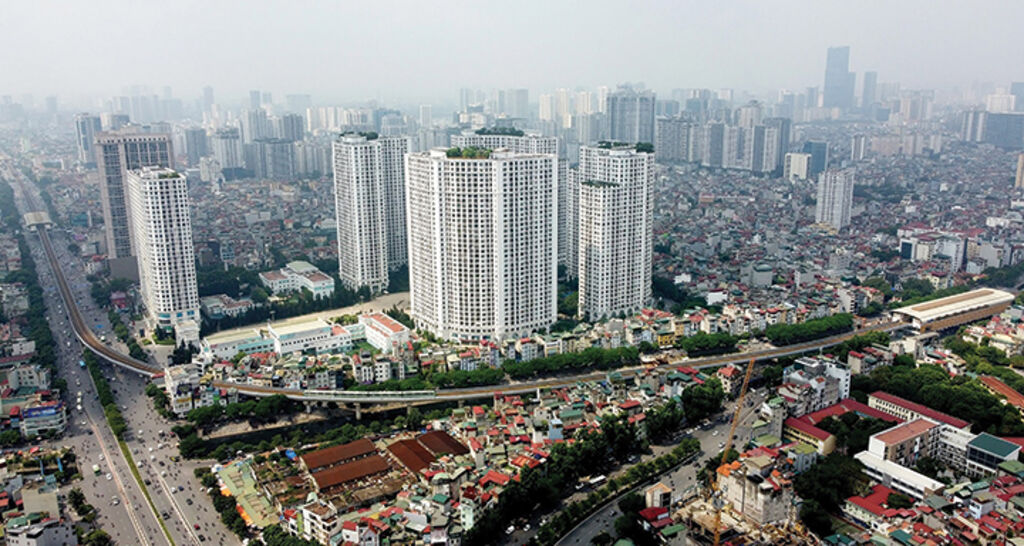
| A view of Hanoi, with the Cat Linh–Ha Dong metro line running along Nguyen Trai street__Photo: VNA |
Taking effect on July 1 this year, the 2026 Capital Law (the Law) establishes a favourable legal framework for Hanoi to capitalise on its potential and advantages, and develop into a green, smart and liveable capital city worthy of its stature as a special urban area and national centre.
Compared to the 2024 version, the Law grants more powers to the municipal authorities, strengthens the urban management, creates new development spaces for better access to public services, and introduces breakthrough social welfare policies aimed at improving residents’ quality of life.
The new mechanisms and policies are intended not only to address existing challenges but also to open up new development spaces, lay foundations for modern urban governance models, and enhance the Capital’s long-term competitiveness.
Greater autonomy for the Hanoi authorities
A notable feature of the Law is its strong emphasis on decentralisation and delegation of powers, accompanied by mechanisms for controlling the exercise of authority, ensuring accountability, and performing inspection, supervision and performance assessment.
With 199 special and exceptional powers, Hanoi now has the greater autonomy to adjust certain administrative procedures to be carried out by state agencies within the city. The Capital may also adopt a range of special mechanisms in terms of governance, administration and socio-economic development.
The Law permits Hanoi to decide on pilot mechanisms and policies that differ from laws and resolutions of the National Assembly or cover matters not yet regulated by law.
The areas subject to pilot policy implementation cover the organisation of the local apparatus and governance; new economic models driven by science, technology, innovation and digital transformation; education, training, healthcare, and ecological, high-tech and urban agriculture.
Hanoi may introduce new methods of exploiting, mobilising and using resources for its development and governance. It may also adopt solutions to tackle problems that directly and seriously affect residents’ quality of life or the local socio-economic development, as well as other mechanisms and policies under the direction of the competent authorities.
In addition, the municipal authorities are also granted the power to approve investment policies, adjust projects and address long-delayed projects, thereby helping to remove difficulties and promote the local socio-economic development.
The delegation of additional powers to Hanoi is aimed to enable the Capital to respond promptly to the particular challenges facing a major city that serves as the country’s political and administrative centre and a national hub of culture, education, science, economic development and international integration.
Enhanced urban management and development of new spaces
Hanoi is empowered to determine the list of production facilities and non-business offices that must be relocated because they are no longer consistent with the city’s development orientations, and decide on the relocation roadmap.
Beyond the regulation of land-based development, the Law also expands the scope of urban governance to include underground, low-altitude and high-altitude spaces.
As per Article 11 of the Law, Hanoi may plan and designate functional zones for the use of underground spaces, including public underground facilities, underground transport, urban logistics, technical infrastructure, car parks and trade centres. These moves are intended to address land shortage and improve traffic organisation models.
At low altitudes, the Law prioritises the management and improvement of public spaces, pavements, greeneries, water bodies and squares, which play a vital role in shaping Hanoi’s urban identity and quality of life.
At high altitudes, appropriate management and use of airspace must be carefully aligned with architectural, landscape, safety and energy-efficiency standards. The objective is to promote the development of the Capital into a modern city while preserving its cultural heritage and protecting its environment.
To ease the traffic congestion, promote more efficient land use, and improve residents’ quality of life, the Law establishes a framework for transit-oriented development (TOD) centred on urban railways and other mass transit modes.
Within this framework, Hanoi may adopt special policies on planning, infrastructure, land use, and the utilisation of land added value, and mobilise other resources to develop a modern and integrated mass transit system.
For the first time, the Law explicitly provides for the establishment of low-emission zones, enabling Hanoi to gradually restrict polluting vehicles, promote the shift to clean-energy means of transport, impose congestion charges, and develop high-capacity mass transit, low-altitude air transport, and modern logistics infrastructure.
Breakthrough social welfare policies
The Law also puts forth favourable financial and budgetary mechanisms to enable the Capital to mobilise and use investment resources more proactively and efficiently to develop infrastructure, improve quality of public services and residents’ living standards.
The Law permits the Hanoi People’s Council to adopt, according to an appropriate roadmap, policies to support the payment of medical examination and treatment costs not covered by the health insurance fund. The Capital may also intensify investment in mobile healthcare, telemedicine, and digitally enabled healthcare.
In addition, the out-of-hospital emergency care and medical transport system will operate under standardised procedures, with clearly defined service charge rates and patient co-payment rates.
Significantly, Hanoi residents will be entitled to free-of-charge periodic health examinations and screening under programmes financed by the municipal budget and non-state resources, enabling city residents to take a more proactive approach to disease prevention and benefit from more comprehensive healthcare.
The Hanoi People’s Council is also allowed to enact social security and welfare policies that expand beneficiaries and raise benefit levels. The aim is to build a diverse, comprehensive, modern and sustainable social security system for all residents, with priority given to disadvantaged and vulnerable groups, people living in ethnic minority and mountainous areas, and those in need of emergency assistance.- (VLLF)