 |
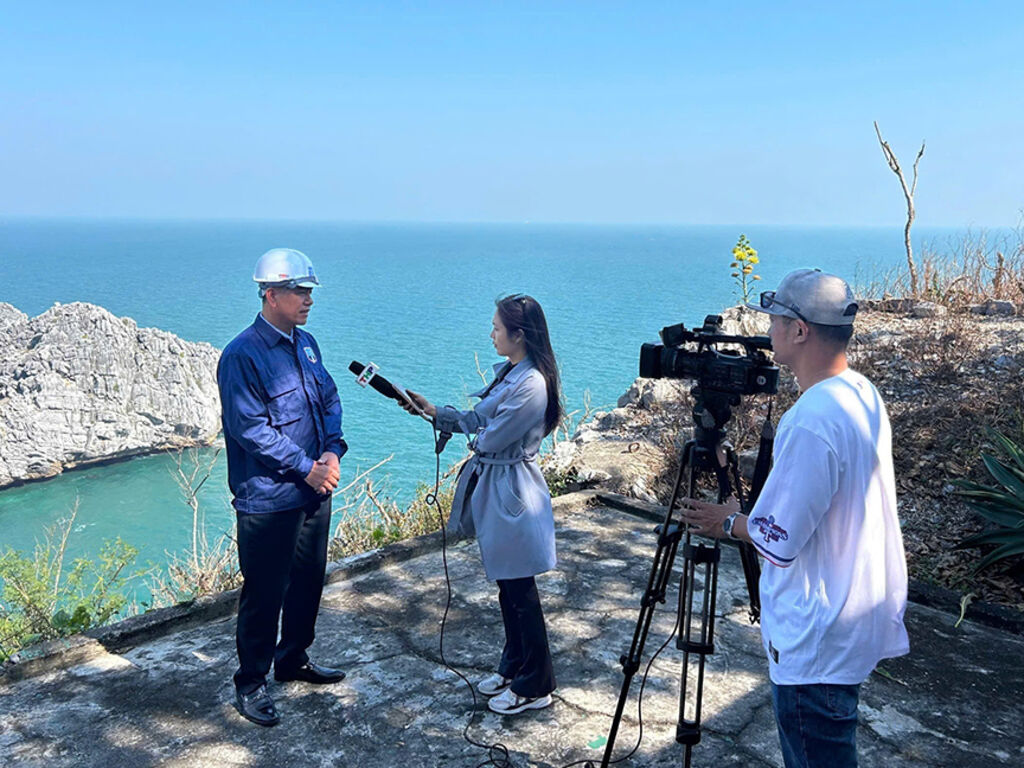
| Reporter Phuong Linh and her colleague from Hai Phong Newspaper and Radio-Television agency conduct an interview on Long Chau island, Hai Phong city__Photo: VNA |
Coming into force on July 1 this year, the 2025 Press Law (the Law) marks a significant step forward in completing the legal framework for digital journalism, the development of key multimedia press agencies, and the transformation of the pool of journalists in the new context.
With 51 articles arranged in four chapters, the Law continues to affirm the special position and role of Vietnam’s revolutionary press as an essential source of information, an important ideological instrument of the Party and the State, and a trustworthy forum for the people.
The Law reaffirms that the press operates under the Party’s direct and comprehensive leadership and the State’s management, within the framework of laws while guaranteeing citizens’ freedom of speech and freedom of the press in accordance with the Constitution.
The Law also calls for accelerated administrative procedure reform and greater decentralisation and delegation of powers in press management, thereby enhancing the effect and efficiency of the state management of the sector, while creating a more favourable environment for press agencies to take greater initiative in innovation and development.
Expanding the development space for journalism
The Law broadens its scope of regulation to cover journalistic activities in the digital environment. It officially introduces such concepts as “publishing press publications in cyberspace”, “content channels of press agencies in cyberspace”, “the national digital press platform”, and a range of other concepts relating to digital media activities.
As per the draft, the State will invest in the national digital press platform, digital press data infrastructure and human resources for digital transformation in the press. Press agencies will be permitted to not only publish and broadcast journalistic contents but also provide online services in the press.
The Law allows press agencies to coordinate with partners in producing journalistic contents, except those relating to political current affairs, national defence, security, and foreign affairs. Such provision strikes a balance between the requirement of information security assurance and the need for social resources for press development.
Notably, as generative AI is developing at an unprecedented pace and is increasingly capable of participating directly in the production of news, stories, images, and video and audio contents, the Law lays the initial legal foundation for AI application in press activities. The Government is empowered to issue detailed regulations on responsibilities of press agencies when using this technology to ensure the accuracy and objectivity of information and prevent the dissemination of false information and protect copyright and privacy of organisations and individuals.
Developing the model of key multimedia press agencies
Under the Law, key multimedia press agencies are defined as those engaged in multiple types of press and having multiple subordinate press units. They are entitled to apply specific financial mechanisms and are established in accordance with the Prime Minister-approved strategy for development and management of the press.
In the context of ever-increasing global competition in the domain of information, the development of large-scale press agencies equipped with modern technologies and operating across multiple platforms will help strengthen the national communication capacity, provide a more proactive approach to guiding public opinion, counter false and hostile information, and promote Vietnam’s image in the international arena.
This model will also facilitate the concentration of investment in the development of human resources, technology and finance, thereby fostering press agencies with better competitiveness in the international media market.
Breakthrough in journalism’s economics
The Law formally provides a range of lawful sources of income for press agencies. These include revenue from the sale of journalistic work viewing and listening rights; licensing rights to exploit journalistic contents; press joint-activities; the provision of public services commissioned by the State; and services relating to the peer review and appraisal of scientific research papers.
Diversifying revenue sources will not only strengthen the financial autonomy of press agencies but also create incentives for investment in technology, improvements in content quality, and the development of high-value digital press products.
The Law also adds mechanisms to strengthen copyright protection for journalistic works. Press agencies are entitled to request the correction, removal or blocking of the unauthorised dissemination of their contents on digital platforms, including cross-border platforms.
These provisions will help create a fairer competitive environment between the mainstream press and information circulating on the social media, while protecting the creative output of reporters, editors and press agencies.
Providing the professional code of ethics for journalists
The Law also provides regulations to ensure that journalistic activities are conducted in accordance with press agencies’ functions and purposes, thereby promoting the healthy and civilised development of the press.
A number of prohibited acts in external information activities are additionally specified, including the dissemination of information that can damage the country’s reputation and image or adversely affect international cooperation relations. The role of the Vietnam Journalists Association will be strengthened to determine violations of professional ethics by its members, discipline violators, and recommend sanctions against non-member journalists.
In order to further standardise and professionalise the journalism profession, the Law provides another noteworthy amendment concerning press cards. Accordingly, press cards will remain valid for five years. However, first-time applicants are required to complete professional and ethical training programmes to obtain a press card meanwhile personnel working for scientific journals will no longer be eligible for press cards.
In addition, the State will invest in digital tools to monitor journalistic activities in cyberspace. The use of journalistic works will require the consent of the relevant press agencies, while both press agencies and authors applying AI in their professional activities must comply with the law on intellectual property and professional code of ethics.- (VLLF)