 |
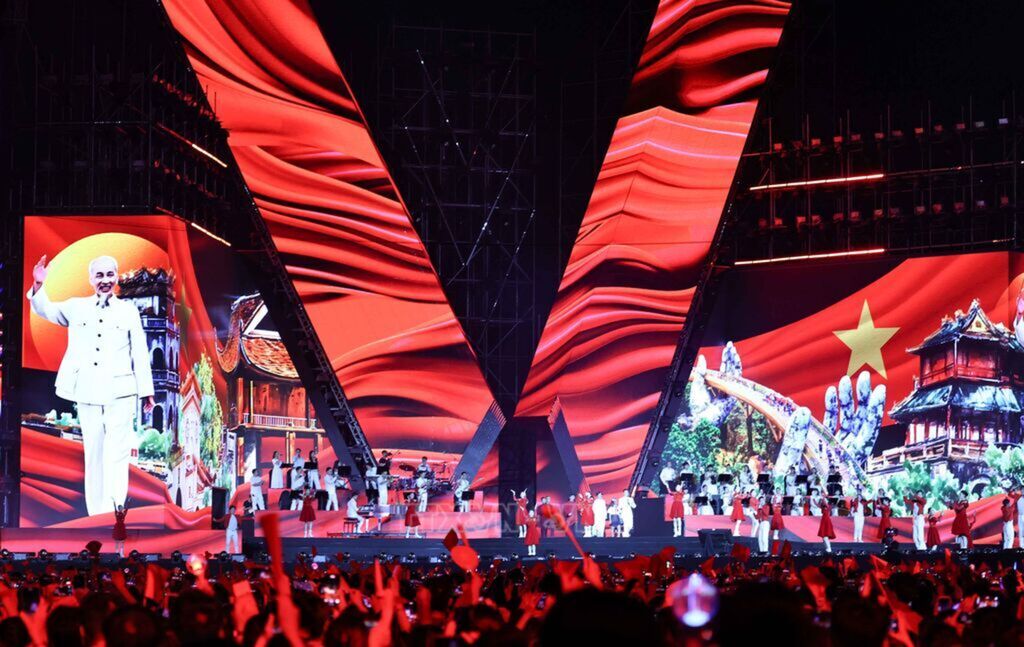
| Music concerts are not merely entertainment 'feasts'; they also serve as a catalyst for the growth of cultural industries__Photo: Thanh Tung/VNA |
Party General Secretary To Lam on January 7 signed Politburo Resolution 80 on development of Vietnamese culture which designates November 24 every year as “Viet Nam Culture Day”, a paid public holiday, to enhance cultural enjoyment, encourage creativity, promote a civilised lifestyle, and contribute to building a humane society.
Resolution 80 affirms that culture and people constitute the foundation, vital endogenous resource, powerful driving force, and a regulatory system for the country’s rapid and sustainable development.
The Resolution states that cultural values must be closely and harmoniously integrated into all aspects of social life, including politics, economy, society, the environment, national defence and security, and foreign affairs, and should become the nation’s soft power in the new era.
It stresses that culture is the cause of the entire people under the leadership of the Party and the management of the State, with the people as the creative subjects and beneficiaries alongside the core role of intellectuals, artists, writers, cultural workers and entrepreneurs and the exemplary role of cadres and Party members.
Investment in culture is investment in the country’s sustainable development and the nation’s future, whereas the State plays a leading role, and state resources are combined with mobilized social resources.
Vision towards 2030 and 2045
The Resolution sets out a series of specific targets, with a long-term vision towards 2030 and 2045.
By 2030, the nation aims to accelerate the building and development of an advanced Vietnamese culture imbued with national identity, create a healthy cultural environment from families and schools to the society and the digital space, and develop literature and the arts to be commensurate with the nation’s cultural tradition and stature in the new era.
Besides the development of the cultural industries and the formation of a start-up ecosystem for cultural industries and creative arts, the Politburo has called for the establishment of several internationally competitive cultural industry groups based on high technology and innovative business models.
Specific targets include completing the system of national cultural institutions, ensuring that all two-tier local administrations and the armed forces have cultural facilities that meet the needs of grassroots communities, officials and soldiers, and 90 per cent of grassroots cultural institutions operate regularly and effectively.
It requires resources commensurate with the cultural development with at least two per cent of total annual state budget expenditure allocated for cultural development which will be increased gradually to meet practical needs.
In addition, the cultural industries are expected to contribute seven per cent of GDP with five to 10 national brands in these industries to be formed in areas with great potential such as cinematography, performing arts, cultural tourism, design and fashion.
Under the Resolution, the nation plans to open one to three new Vietnamese Cultural Centres abroad, prioritizing nations with comprehensive strategic partnership with Vietnam and secure UNESCO inscription for five more cultural heritages.
Towards 2045, the Resolution sets the goal of affirming Vietnam’s cultural standing as a high-income, socialist-oriented developed country. The country is expected to be an attractive destination for regional and international cultural and artistic events and emerge as one of the dynamic centres of cultural and creative industries.
The nation plans to have ten internationally recognised art festivals and cultural events and an additional eight to ten cultural heritage sites recognized by UNESCO.
The country strives to be ranked among the top three in ASEAN and the top 30 globally in the soft power index and in the export value of cultural products.
Tasks and solutions to realize targets
Regarding tasks and solutions to elevate Vietnam’s cultural standing, promote its image and harness national cultural values, the Resolution calls for a fundamental renewal of thinking and a high degree of unity in awareness and action to develop culture in the new era, alongside institutional improvements to create strategic breakthroughs and unlock resources for cultural development.
The resolution also calls for an effective and efficient cultural governance apparatus; shifting from management to governance with clear decentralization and delegation of powers while intensifying the application of artificial intelligence (AI), big data, virtual reality (VR), and blockchain in culture, marking a big stride forward to help culture adapt to the digital era.- (VLLF)