 |
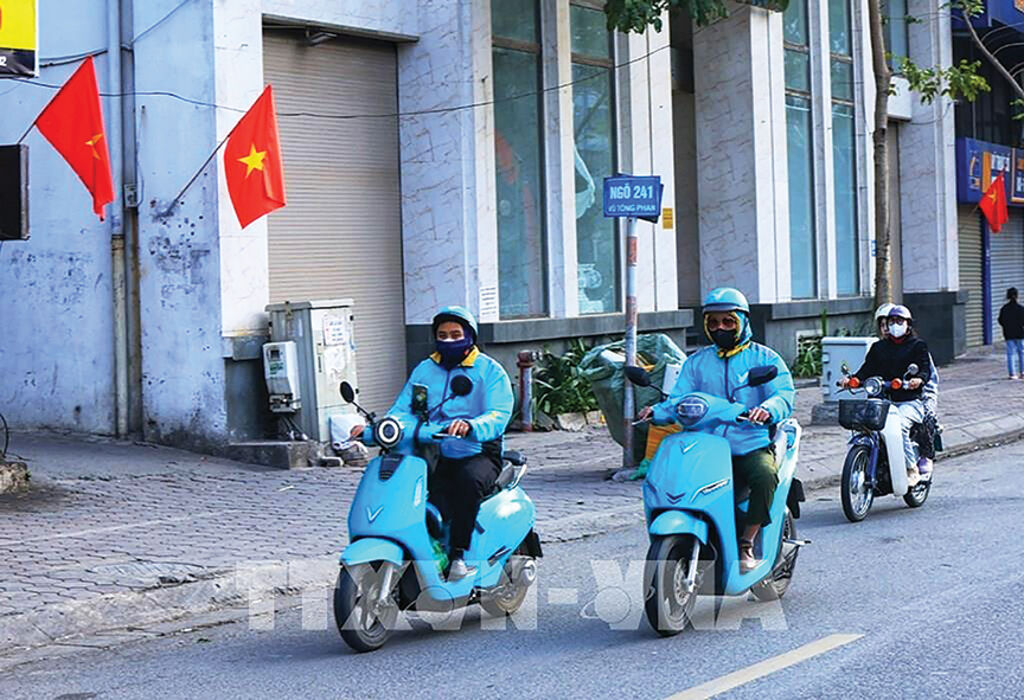
| Ride-hailing services have become popular in Vietnam__Photo: VNA |
Ride-hailing and delivery platforms have become a familiar part of urban life in Vietnam. In large cities, app-based drivers are no longer seen merely as people doing occasional work for extra income. For many, the job has become their main livelihood, built around long hours on the road, unstable earnings and constant exposure to traffic, weather and health risks.
According to a study by the Ho Chi Minh City Institute for Development Studies, Ho Chi Minh City alone has around 400,000 technology-based drivers and deliverymen working on ride-hailing and delivery platforms, equivalent to 7-8 per cent of its labour force.
However, this growing workforce remains largely outside the compulsory social insurance system. Because ride-hailing drivers do not sign labour contracts with platform companies or receive fixed salaries, they are commonly treated as business partners rather than employees. As a result, they are generally not entitled to enterprise-funded compulsory social insurance contributions, even when they work regularly and depend on platforms for income.
For Nguyen Ha Chien, a resident of An Lac ward, app-based work has become a full-time job. As a former construction worker, Chien has spent the past two years working as both a deliveryman and a ride-hailing driver. He keeps the app on almost all day, spending most of his time on the road and stopping only for meals or to charge his motorbike. With monthly income of around VND 10 million, he said, supporting his child’s education and helping his wife pay the rent leave him almost no money to cope with illness or other risks.
Le Tan Luu, Chairman of the Binh Tan App-Based Motorbike and Taxi Drivers’ Union, said the union now has 1,265 members, 60 per cent of whom are aged 45 or older. Their income remains unstable because of the nature of the job, while many lack access to social protection, healthcare, pension and survivorship benefits. “The State should pay greater attention to this group and ensure that their rights are protected in line with those of other workers,” Luu told Nhan Dan (People) newspaper.
These figures and personal accounts explain why the debate over social insurance for ride-hailing drivers has become increasingly relevant. The issue is no longer whether these workers need protection, but how the social protection system should respond when such job has become a regular livelihood for hundreds of thousands of people.
Should ride-hailing drivers be brought under compulsory social insurance?
The question has recently been raised during consultations on the draft law amending and supplementing a number of articles of the Law on Social Insurance, which is expected to be submitted to the National Assembly this year.
Ho Chi Minh City Social Security, together with authorities in Hai Phong, Da Nang, Cao Bang, Bac Ninh and Thai Nguyen, has proposed amending Article 2 of the Law on Social Insurance by adding technology-based drivers to the group subject to compulsory social insurance. The proposal also covers online sellers on e-commerce platforms, reflecting broader concern over workers who earn regular income through digital platforms but are not linked to enterprises by conventional labour contracts.
According to Ho Chi Minh City Social Security, this group has expanded rapidly with the growth of new business models. Many platform workers have jobs, income and regular working patterns, but remain outside the compulsory social insurance system because their relationship with platform companies is usually defined as cooperation or partnership rather than employment.
Nguyen Quoc Thanh, Deputy Director of Ho Chi Minh City Social Security, said the proposal was in line with the Party Central Committee’s Resolution 28 of 2018 on social insurance policy reform, which sets a target that by 2030 around 60 per cent of the working-age labour force will be covered by social insurance.
“Technology-based drivers face daily risks, from traffic accidents and robbery to financial pressure and health problems. Yet, because they are generally treated as partners of digital platforms, they remain outside compulsory social insurance. When accidents occur or their working capacity is reduced, most have to rely on their own savings and family support,” Thanh told VnExpress, adding that bringing this group into compulsory social insurance was primarily aimed at protecting them against health and old-age risks.
The proposal, however, raises a legal problem. Under Article 13 of the 2019 Labour Code, a relationship is considered an employment relationship when it contains the essential elements of an agreement on paid job and wages, together with the management, administration and supervision by one party over the other. Ride-hailing platforms generally do not fix drivers’ working hours or guaranteed income, nor do they require drivers to remain permanently within their networks.
Speaking to Nguoi Lao Dong (Workers) online newspaper, lawyer Truong Thanh Duc from ANVI Law Firm said this made it difficult to identify the entity responsible for social insurance obligations.
“The nature of the relationship involving technology-based drivers or online sellers is not an employment relationship, because an employment relationship requires management of quality and working time. In this case, it is only a form of cooperation. If understood in that way, compulsory social insurance cannot be imposed,” he said.
Another difficulty lies in the contribution base. In principle, compulsory social insurance is calculated on the basis of a worker’s monthly salary. Ride-hailing drivers’ income is not fixed. It depends on the number of trips completed, working hours and bonuses. The matter is further complicated by rules governing the economic relationship between drivers and managing entities, such as transport enterprises or transport cooperatives.
For now, however, the Ministry of Home Affairs has decided not to include ride-hailing drivers and similar platform workers in the scope of compulsory social insurance when amending the Law on Social Insurance.
Explaining this, the ministry said informal-sector and digital-platform workers who are not subject to compulsory social insurance may participate in voluntary social insurance. This mechanism, it said, is more suitable for people with flexible jobs and unstable income because it allows more flexible payment methods.
Towards a more practical protection mechanism
As the digital economy continues to expand, extending social protection to those who create value within it has become an increasingly practical policy question. For ride-hailing drivers, the issue should not be reduced to a choice between immediate compulsory social insurance and the existing voluntary scheme. What is needed is a more workable model that reflects the realities of platform-based work while keeping workers within reach of the social security system.
In the immediate term, voluntary social insurance should be made easier and more attractive for these workers. Many drivers have irregular daily income and must cover fuel, vehicle maintenance and family expenses before thinking about long-term protection. Flexible payment schedules, simpler digital registration and reminders through app-based channels could help them participate more regularly. Higher or better-targeted support from the State for low-income participants may also be needed if voluntary social insurance is to become a real option rather than a formal possibility.
At the same time, policy revision should focus not merely on Article 2 of the Law on Social Insurance. The issue involves a wider legal framework, including labour regulations, social insurance procedures, digital transaction mechanisms, and the responsibilities of platform enterprises and transport cooperatives.
Lawyer Le Dinh Quang, former head of the Industrial Relations Department under the Vietnam General Confederation of Labour, suggested that a tiered model could be considered in the long run.
“Full-time drivers who earn their main and regular income from platforms, he said, may need a mechanism based on shared contributions between workers and platform-related entities. Part-time drivers could be required or encouraged to participate once they reach certain thresholds in income, working hours or number of trips. Those who only work occasionally could initially be encouraged to join health insurance and accident insurance, which address their most immediate risks,” Quang told Quan doi Nhan dan (People’s Army) e-newspaper.
In the longer term, the 2019 Labour Code could be reviewed to consider whether “platform workers” should be recognised as a specific category. Such recognition would not necessarily mean treating every driver as a traditional employee. But it could provide more specific criteria based on actual working conditions, income dependence, platform control and the economic relationship between the parties.
This direction is also consistent with emerging international standards. The International Labour Organization’s Decent Work in the Platform Economy Convention, 2026, adopted recently in June, reflects growing global recognition that platform workers need appropriate protection in areas such as social security, occupational safety and health, and fair treatment in digital labour systems.
For Vietnam, the task is to design a model that is both protective and feasible. Ride-hailing drivers value flexibility, but flexibility should not mean being left without support when they face illness, accidents or old age. Whether through improved voluntary social insurance, a tiered contribution mechanism or future recognition of platform workers in the labour law, the goal should be to build a safety net that matches the way work is actually changing.- (VLLF)