 |
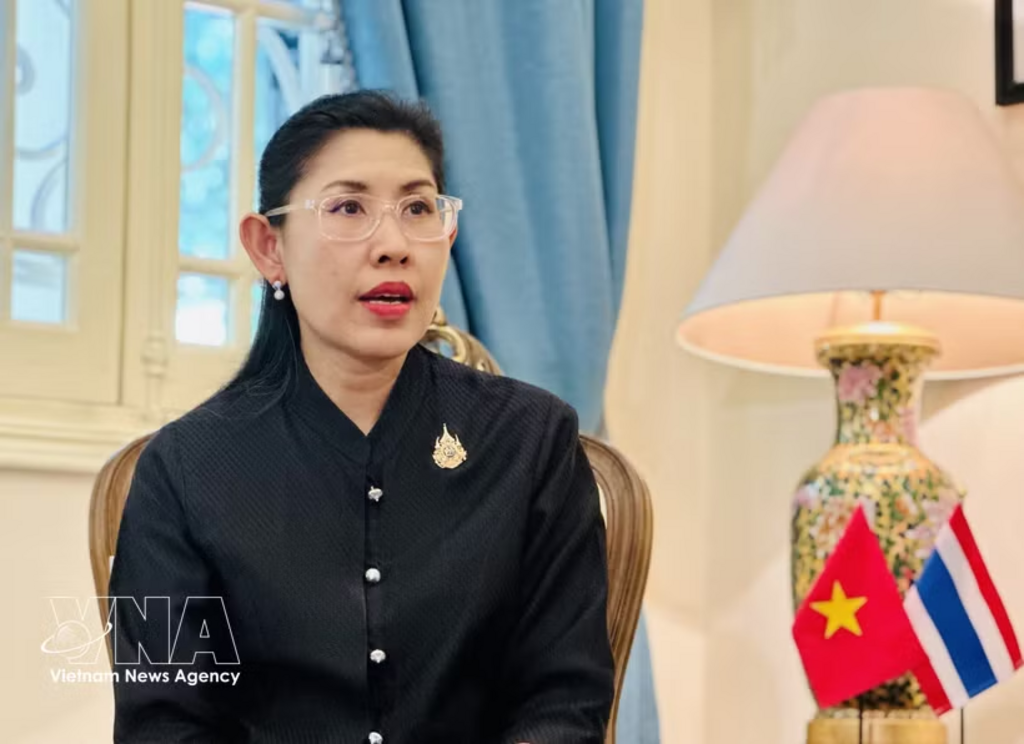
| Thai Ambassador to Vietnam Urawadee Sriphiromya__Photo: VNA |
The upcoming official visit to Thailand by General Secretary of the Communist Party of Vietnam Central Committee and State President To Lam from May 27 to 29 will further deepen the enduring friendship between the two countries and elevate the Vietnam–Thailand Comprehensive Strategic Partnership to new heights, contributing meaningfully to a resilient and prosperous ASEAN, according to Thai Ambassador to Vietnam Urawadee Sriphiromya.
In an interview with the press ahead of the visit, Urawadee described the trip as highly symbolic and strategically important, noting that it will be the first official visit to Thailand by Vietnam’s Party and State leader following the 14th National Party Congress and the consolidation of the country’s new leadership apparatus. She added that Thailand is honoured to be the first ASEAN country selected for the leader’s official visit before his further regional engagements.
The visit carried additional significance as the two countries are celebrating the 50th anniversary of their diplomatic relations this year, she stated, emphasising that the occasion reflected the deep trust, mutual respect and warm sentiments shared by the two nations and peoples, including the Thai-Vietnamese community.
According to the ambassador, one of the key expected outcomes of the visit will be discussions on the adoption of a 2026–2031 Plan of Action aimed at implementing the Vietnam–Thailand Comprehensive Strategic Partnership framework. The plan, she said, will encompass broad areas of cooperation to promote shared security, peace and prosperity.
In the context of an increasingly uncertain global environment, she noted that direct exchanges between high-ranking leaders will help strengthen confidence and coordination in addressing challenges such as energy security, food security and transnational crime. The ambassador also praised Vietnam’s proactive role at multilateral forums, including its hosting of the signing ceremony for the United Nations Convention against Cybercrime, also known as the Hanoi Convention, its role as the President of the 11th Review Conference of the Treaty on the Non-Proliferation of Nuclear Weapons (NPT RevCon 11), as well as its contributions to the United Nations and UNESCO.
Reviewing bilateral achievements in recent years, Urawadee described Vietnam–Thailand relations as entering their strongest phase to date. She recalled that the two countries upgraded ties to a Comprehensive Strategic Partnership last year - the highest level of diplomatic relations established by Vietnam with partner countries.
Economic cooperation, she observed, has remained robust despite global economic headwinds. Bilateral trade has already surpassed USD 23 billion and is moving toward the target of USD 25 billion. Thailand has also risen from ninth to eighth place among Vietnam’s largest foreign investors, reflecting strong confidence among Thai businesses in Vietnam’s investment environment.
The diplomat further highlighted the importance of people-to-people exchanges as a solid foundation for bilateral ties. Tourism flows between the two countries have increased significantly, while cultural activities such as the Thailand Festival in Hanoi have attracted tens of thousands of visitors and enhanced mutual understanding between the two peoples.
Security and defence cooperation has also recorded a notable milestone, as a Royal Thai Navy vessel paid a visit to Ho Chi Minh City after an 11-year hiatus to commemorate the 50th anniversary of diplomatic relations, demonstrating the growing level of strategic trust between the two countries.
On regional issues, the ambassador stressed that Vietnam and Thailand share a commitment to promoting a peaceful, stable and rules-based ASEAN, preserving ASEAN unity, and maintaining balanced relations with major powers to safeguard regional stability and support socio-economic development.
As maritime nations, Vietnam and Thailand are also coordinating closely to strengthen maritime security, uphold freedom of navigation and promote respect for international law, including the United Nations Convention on the Law of the Sea (UNCLOS) 1982.
Looking ahead, the ambassador identified emerging areas such as semiconductors, digital transformation, fintech, green energy and smart agriculture as promising drivers of future cooperation. She noted that Thai enterprises have already invested around USD 3 billion in energy projects in Vietnam, spanning solar, wind and thermal power generation.
On climate change and sustainable development, Urawadee said both countries are committed to achieving net-zero emissions and transitioning toward greener economic models. She underlined the importance of cooperation in water resource management, climate adaptation and smart farming, particularly through regional mechanisms such as the Mekong River Commission and Mekong–Lancang Cooperation.- (VNA/VLLF)