 |
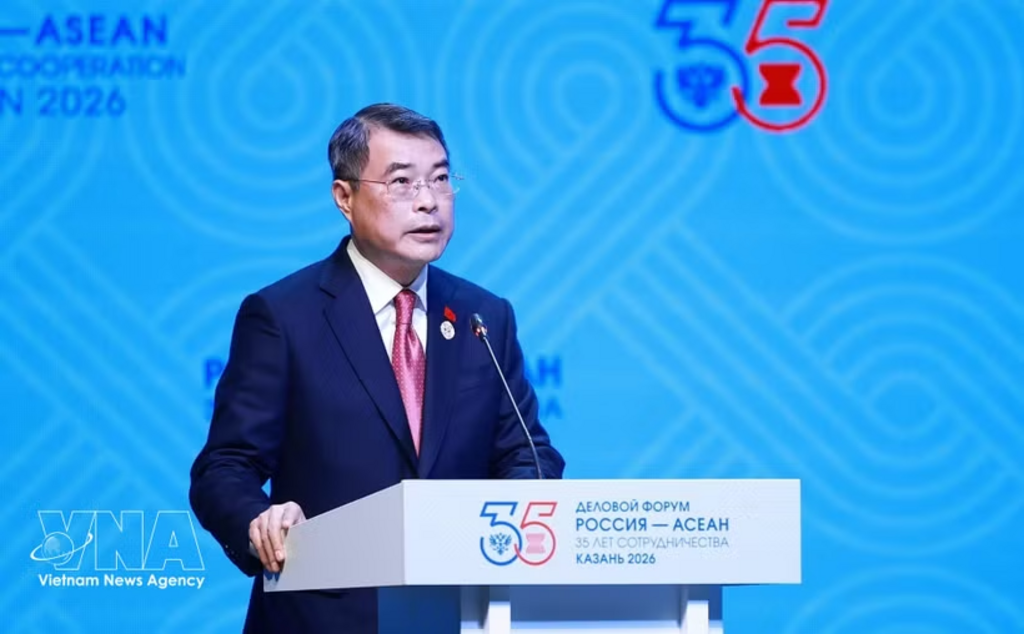
| Prime Minister Le Minh Hung addresses the opening session of the ASEAN-Russia Business Forum in Kazan, Russia on June 17__Photo: VNA |
Vietnam has increasingly affirmed its role as a strategic gateway for Russia to access the Southeast Asian market, according to Russian Minister of Economic Development Maxim Reshetnikov.
In an interview with the Vietnam News Agency on the occasion of Prime Minister Le Minh Hung’s trip to Russia to attend the ASEAN-Russia Commemorative Summit and conduct important bilateral and multilateral activities, Reshetnikov highlighted Vietnam’s growing importance in Russia’s long-term strategy toward Southeast Asia.
Vietnam today is one of the most dynamic economies in the world, he said, noting that Russian businesses increasingly view the country as a gateway to the broader ASEAN market of more than 680 million consumers.
According to the minister, the Free Trade Agreement (FTA) between Vietnam and the Eurasian Economic Union (EAEU) has played a crucial role in facilitating bilateral trade and investment. Tariffs on about 90 per cent of goods have been reduced or eliminated, helping maintain Vietnam-Russia trade growth despite a challenging international environment.
Bilateral trade expanded by 6 per cent in 2025, with Russian exports of fertilisers and pork reaching record levels and liquefied natural gas (LNG) beginning to enter the Vietnamese market. At the same time, Vietnamese products such as coffee, nuts, fruits, electronics and garments have gained popularity among Russian consumers.
Reshetnikov said the Vietnam-EAEU FTA has also created a model for broader economic engagement between Eurasia and ASEAN. The agreement signed between the EAEU and Indonesia last year was a notable example of this trend.
Beyond trade, Vietnam has emerged as an important logistics hub linking Russia with Southeast Asia. Russian logistics companies have established distribution networks in Vietnam that connect to markets across ASEAN, including Malaysia, Thailand, Laos and Cambodia. Cargo routes linking Vietnamese ports with Russia and railway services running through China have further strengthened connectivity between the two countries.
Energy cooperation continues to be another cornerstone of bilateral relations. Reshetnikov pointed to the long-standing success of the Vietsovpetro joint venture and described the Ninh Thuan 1 Nuclear Power Plant project as a new milestone in bilateral cooperation.
He suggested that the project could serve as a model for broader cooperation between Russia and ASEAN members in the field of nuclear energy.
The minister also highlighted Vietnam’s active role within ASEAN, describing it as one of the grouping’s most active members.
According to him, Vietnam has consistently promoted regional priorities such as open trade, connectivity, digital transformation, resilient supply chains, innovation-driven growth and human resource development. Those priorities closely align with areas where Russia is ready to cooperate, he said.
Reshetnikov cited the recognition of EAEU pharmaceutical certificates by Vietnam as a practical example of how regulatory cooperation can help remove barriers and improve access to essential products, including medicines for cancer treatment.
He also praised Vietnam’s achievements in developing e-commerce and the digital economy. Russia, he noted, has accumulated extensive experience in building digital ecosystems and platform economies, creating opportunities for both sides to exchange expertise on digital governance, consumer protection, digital identification and e-commerce.
Looking ahead, the minister identified several sectors with particularly strong potential for Vietnam-Russia cooperation, both bilaterally and within the broader ASEAN framework.
Food security remains one of the most promising areas. Vietnam imported more than 970,000 tonnes of meat and meat products worth around 2 billion USD in 2025, an increase of 12 per cent year-on-year. Russia is already among the leading suppliers of several meat products to Vietnam and sees further opportunities in grains, processed foods, baby food and agricultural products.
Digital technology and innovation are also emerging as major pillars of cooperation. Reshetnikov said both countries share a common interest in strengthening digital sovereignty, technological independence and cybersecurity.
Russian companies have already established a presence in Vietnam. Software provider 1C offers enterprise management solutions, while VisionLabs supplies digital identification technologies for traffic management systems. Earlier this year, cybersecurity company Kaspersky Lab signed a cooperation agreement with Vietnam’s G-Group, opening up new opportunities in digital security and critical infrastructure protection.
Digital technologies and joint efforts to strengthen digital sovereignty will become one of the most dynamic areas of the Russia-Vietnam partnership in the coming years, he said.
Other promising areas include urban development, education and workforce training, and tourism.
Reshetnikov expressed confidence that the complementary nature of the two economies, combined with their shared commitment to sustainable development, technological progress and expanding trade and investment ties, would provide a solid foundation for deeper cooperation between Russia and Vietnam as well as between Russia and ASEAN in the years ahead.- (VNA/VLLF)