Hai Chau - Quang Phuc
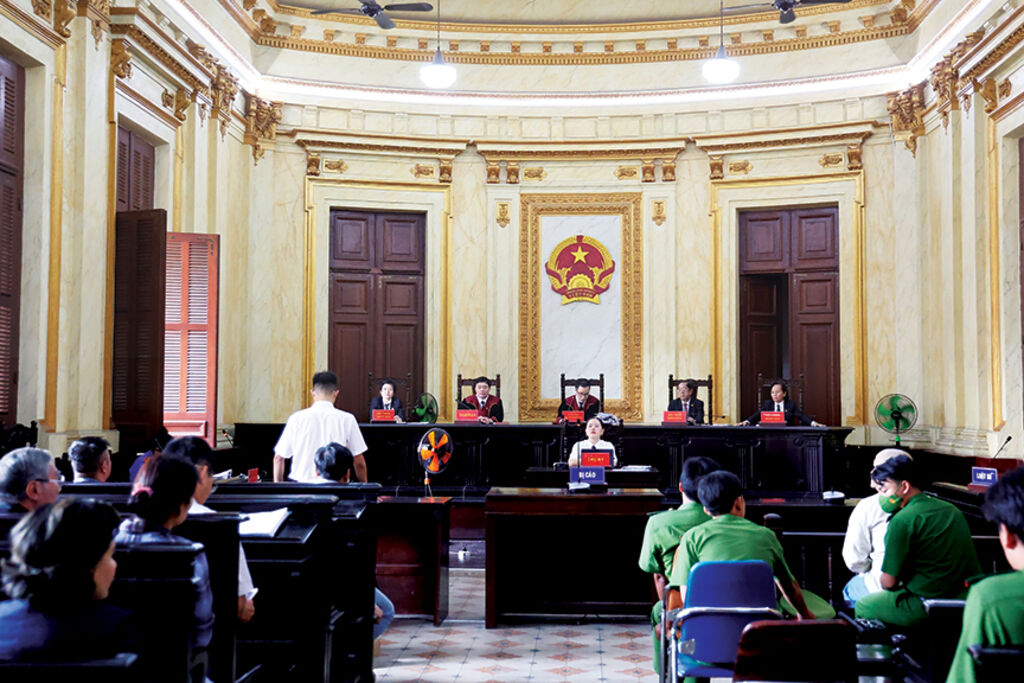 |
| A criminal trial at the Ho Chi Minh City People’s Court__Photo: Hong Dat/VNA |
Introduction
Vietnam has begun implementing the judicial reform policy since early 2016 in the spirit of the Resolutions of the 12th, 13th and 14th National Party Congresses as well as Politburo Resolution 27-NQ/TW dated November 9, 2022, on further building and improvement of the socialist law-ruled state in the new period, and Resolution 66-NQ/TW dated April 30, 2025, on renewal of law-making and law enforcement activities to meet national development requirements in the new era. Concerning this issue, the Politburo also provided directions on the Scheme on review and assessment of inadequacies in the Penal Code, the Criminal Procedure Code, and the Law on Execution of Criminal Judgments related to the application of the death penalty and intensification of the application of measures to commute the death penalty to imprisonment. In the process of building and improving the socialist law-ruled Vietnamese State under the Party’s above guidelines, further improving the criminal law into a more modern, complete, transparent and humane code has become a task of particularly important significance, especially in the context of the emergence of non-traditional crimes, hi-tech crimes and transnational crimes, along with the requirement to protect human rights and citizens’ rights under the 2013 Constitution of Vietnam.
Through reviewing 10 years’ implementation of the 2015 Penal Code, as revised in 2017 (the Code), it is apparent that many provisions have failed to keep pace with the development of emerging social relations, or are even overlapped or inconsistent with specialised laws. At the same time, there are not commensurate mechanisms for handling numerous acts dangerous to society, while the law-making technique used in many articles lacks logicality, transparency and predictability. Therefore, revising the Code is aimed not only at improving the tool for crime prevention and combat but also at meeting the requirements of fully institutionalising the Party’s guidelines on judicial reform, developing a socialist-oriented market economy, facilitating international integration, and protecting human rights.
Renewing punishment policies towards humanity, modernity and less reliance on custodial sentences
One of the major orientations for revising the Code is to continue renovating the punishment policies towards gradually reducing reliance on imprisonment, increasing non-custodial penalties and measures, and enhancing the rehabilitation and social reintegration capabilities of offenders[2].
The practice of executing criminal judgments shows that the popular application of short-term imprisonment penalties does not always yield high preventive efficiency. In many cases, isolating offenders from society causes negative social consequences such as the disruption of family relationships, job loss, reduced reintegration capabilities, an increased risk of recidivism, and heavy pressure on the prison system. For this reason, modern trends of the criminal law reform are all oriented towards the imposition of non-custodial penalties, viewing this as a tool to balance the strictness and humanism of the criminal law.
The addition of a mechanism to decide on monetary fines instead of imprisonment in certain cases has demonstrated this trend. The new policy not only emphasises the differentiation of penal liability and individualisation of punishment but also contributes to changing the mindset from “pure punishment” to “rehabilitation and reintegration”. In economic and commercial cases or first-time offences in which the danger posed to society is minor, the imposition of monetary fines will exert a direct impact on economic benefits sought by offenders, while easing the burden on the criminal judgment execution system. Along with this, the increased imposition of non-custodial reform or the addition of “community service” as a penalty, and the application of electronic monitoring against persons serving community-based sentences has demonstrated a strong shift from a “detention” model to a “community-based management” model.
However, the expansive imposition of non-custodial penalties requires a comprehensive improvement of the mechanisms for judgment execution management and supervision, and social safety assurance. Without an effective control mechanism, these measures may reduce the deterrent effect or create a psychology of disregarding the law. Therefore, revising the Code should go in parallel with amending the Law on Execution of Criminal Judgments, building a data system for management of persons serving community-based sentences, and improving the capacity of local authorities and judgment enforcement agencies.
Notably, the proposed addition of provisions aimed at mitigating penalties for offenders who make honest declarations, show repentance, and fully remedy consequences also reflects the trend of taking damage recovery as the core approach. This is not only to promote procedural cooperation and asset recovery but also to help reduce confrontation between the State and offenders, promoting restorative justice in modern criminal procedure.
Improving circumstances for determining crimes and sentencing frames to ensure legal transparency and predictability
The existence of qualitative indicators that are hard to quantify, leading to inconsistent interpretation and application, constitutes limitations of the Code. Phrases such as “causing serious consequences”, “adversely affecting security and order”, “earning large illicit profits”, “on a large scale”, etc., in many cases create different interpretations, posing the risk of arbitrary law application.
Making amendments towards quantifying qualitative circumstances is of particular importance to ensure adherence to the principle that criminal law must be clear, transparent and predictable. When circumstances for determining crimes and penalty frames are more clearly specified, the legal awareness of citizens and businesses will be enhanced, while reducing miscarriage of justice and variations in law application among proceedings-conducting bodies.
Another noteworthy point is the elimination of certain personal history circumstances such as “repeating the violation though having been administratively sanctioned”, or “repeating the violation though having a previous conviction not yet expunged” from the basic constituents of certain crimes. This aims to decriminalise acts whose danger to society is minor, in line with the trend of limiting criminal intervention in social relations that can be handled by administrative, civil or disciplinary measures.
The quantitative thresholds serving as the basis for criminal prosecution in the Code, which have become outdated and no longer suitable to reality, also need to be adjusted. Specifically, increasing the quantitative property thresholds for certain crimes against property ownership and economic crimes is necessary to avoid criminalising minor infractions. Conversely, reducing the quantitative thresholds for environmental crimes clearly demonstrates the guideline of “not trading the environment for economic growth”, consistent with the sustainable development orientations set forth in the Documents of the 13th and 14th National Party Congresses.
Adding new crimes to meet crime prevention and combat requirements in the current period
In order to meet the requirements of modernising Vietnamese criminal law, authorities propose adding new crimes and criminal acts to the Code. These include: cyber espionage, cyber terrorism, dissemination of deepfakes, manipulation of social media data for illicit gains, money laundering via cryptocurrency, infringement of personal data, abuse of artificial intelligence to commit crimes, violation of trade secrets, illegal fishing in foreign waters, financing the proliferation of weapons of mass destruction, etc.
This is not merely an expansion of the scope of regulation of the criminal law, but also aims to internalise treaties and international recommendations to which Vietnam is a contracting party. Under pressure from international evaluation mechanisms such as FATF, APG, IUU, etc., improving provisions on anti-money laundering, counter-terrorism financing, and combat of the financing of proliferation of weapons of mass destruction is to meet not only legal requirements but also strategic requirements regarding economy, finance and foreign affairs.
In particular, provisions concerning the prevention of hi-tech crimes and personal data protection show that Vietnamese criminal law is step by step adapting to the digital society. In the era of data, personal information, digital assets and national data systems have become particularly important legal subjects that need to be protected by fairly fierce criminal penalties.
Regarding social life, the addition of provisions on the trade of foetuses; the eradication of animals using electric shocks or chemicals; and acts causing noise, vibration, or odour pollution exceeding permissible levels, etc., reflects a shift in criminal thinking from protecting traditional interests to safeguarding new social values such as the living environment, personal data, cyber security and biosafety.
Increasing the penal liability of commercial legal persons
Further expanding the scope of the penal liability of commercial legal persons is an inevitable development stage of the modern criminal law. Reality shows that many acts dangerous to society today are committed through corporate organisational structures with large financial resources, having a serious impact far greater than criminal acts committed by individuals.
The Code only regulates the penal liability of commercial legal persons for 33 crimes, mainly focusing on environmental and economic fields. Meanhwile, there are no commensurate mechanism for handling viollations in other fields such as tax, labour, finance, insurance, land, credit, data, usury, and fraudulent appropriation of property.
Broadening the scope of the penal liability of commercial legal persons helps not only improve the effectiveness of corporate crime prevention but also ensure the principle of fairness in criminal handling. In many cases, if only individuals but not legal persons are handled, it will lead to the fact that individuals take responsibility on behalf of enterprises, while the benefits derived from the crimes belong to the enterprises.
Also, it is the improvement of the provisions on the penal liability of commercial legal persons that contributes to making the investment and business environment healthier, creating a level playing field for law-abiding enterprises. This is an inevitable requirement as Vietnam participates deeply in global supply chains, where standards of law compliance, anti-money laundering, anti-corruption, and corporate responsibility are becoming mandatory conditions.
Improving law-making techniques to ensure understandability, applicability and predictability
Among the expected revisions, a foundational issue is improving law-making techniques to ensure the logicality, consistency and scientificity of the Code, focusing on crimes, penalties, grounds for examining penal liability, and policies for handling crimes.
The application of the Code shows that many provisions remain overlapped and inconsistent with specialised laws and procedural laws; many sentencing frames are too broad or overlapped; and many crimes have not had their objective constituents fully described, making it difficult to determine crimes in practice. Revising the Code towards clearly defining the constituents of crimes, differentiating between crimes, and narrowing down the overlap among articles is important in ensuring adherence to the principle that “one act shall only be handled as one crime”. This not only improves the efficiency of law application but also helps prevent negative practices in procedural activities.
In addition, transferring the “formal” provisions from the Code to the Criminal Procedure Code and the Law on Execution of Criminal Judgments is a move consistent with the principle of separating substantive law from procedural law in modern law-making techniques.
Conclusion
It can be seen that the proposed amendments to the Code are aimed not only at enhancing the efficiency of crime prevention and combat but also at building a modern, humane and transparent criminal justice system that is conformable with international standards.
Theoretically, this is a further step to improve the mechanism for protecting the socialist legality, and safeguarding human rights and citizens’ rights in the process of building the socialist law-ruled Vietnamese State. From a practical perspective, the amendments will help improve the national governance efficiency, ensuring a safe investment environment, promoting socio-economic development, increasing the capacity for international integration, and adapting to non-traditional security challenges in the digital era.
However, for the revised provisions to truly come into life, it is necessary to ensure the consistency between the Penal Code and other specialised laws, heighten the quality of policy impact assessments, and raise the capacity of proceedings-conducting bodies, while strengthening law dissemination and education in order to create social consensus during the implementation process.-
[1] The full text of the Vietnamese version of this article is published on https://tapchitoaan.vn/hoan-thien-bo-luat-hinh-su-dap-ung-yeu-cau-xay-dung-nha-nuoc-phap-quyen-xhcn-viet-nam-trong-giai-doan-moi15491.html
[2] The judicial reform orientations set in the Documents of the 13th National Party Congress.