 |
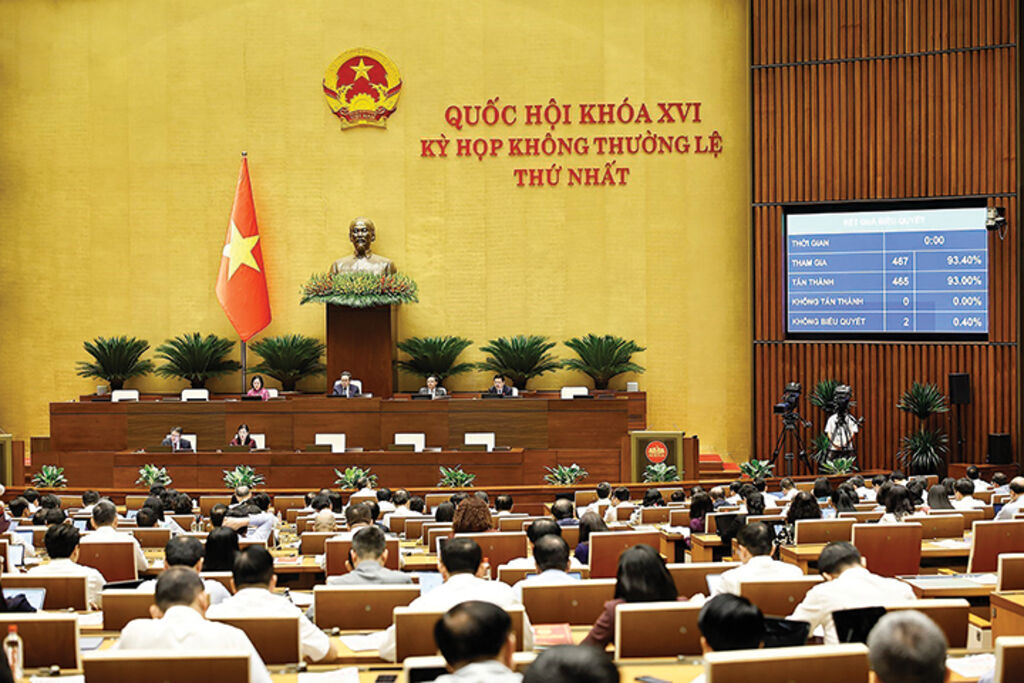
| The National Assembly votes to adopt the Law Amending 10 Laws Related to Administrative Procedures and Business Conditions in the Agriculture and Environment Sector__Photo: Doan Tan/VNA |
Against the backdrop of the country’s institutional reforms and ambitious push for double-digit growth, the first extraordinary session of the 16th National Assembly (NA) convened in Hanoi to address urgent legislative matters and issues of national importance.
Held in two phases, from August 3-13 and August 19-24, the session took place as the country reviewed the first year of its administrative restructuring and the operation of the two-tier local government model, while advancing development priorities for 2026 and beyond.
During the 17-day session, the NA adopted 15 laws, six legal resolutions, and seven resolutions of strategic importance to national development. Lawmakers also gave initial opinions on seven draft laws with a view to removing barriers, further improving legal institutions, stepping up decentralisation, unlocking resources and creating favourable conditions for citizens and businesses.
In his closing remarks, NA Chairman Tran Thanh Man said the policies approved at the session provide an important legal foundation for the Government, ministries, sectors and local authorities to perform their tasks in the final months of 2026, striving to achieve double-digit growth and other development goals for 2026-30.
Major laws facilitating urban development, sending of Vietnamese workers abroad
A notable highlight of the session was the first-time passage of two landmark laws, i.e., the Law on Urban Development and the Law on Combating the Proliferation of Weapons of Mass Destruction.
The Law on Urban Development establishes a framework for comprehensive decentralisation and more clearly defines the authority of local administrations, particularly Ho Chi Minh City and other special-class cities, while Hanoi authorities have to abide by the Law on the Capital.
Under the new law, municipal People’s Councils will have greater autonomy to decide on an additional payroll not exceeding 20 per cent of quotas assigned by central authorities, with salaries to be paid wholly from the municipal budgets. They may also decide on the number, establishment, reorganisation and dissolution of specialised agencies and other administrative organisations under their management. At the same time, the municipal authorities are allowed to implement new mechanisms and policies that are different from laws and resolutions of the NA or matters not yet regulated by law (except national defence, security, external affairs and religion) for a pilot period of no more than five years.
The law states that only one integrated overall master plan will be formulated for a city, replacing both provincial and general master plans. This sole master plan will provide a framework for the management and development of underground, low-altitude and high-altitude urban spaces.
The law also provides a legal basis for reclaimed urban areas, free trade zones and integrated logistics zones. Strategic investors may develop modern, green and smart reclamation projects for up to 70 years, while qualifying transactions in non-tariff areas may enjoy outstanding tax incentives.
Notably, the law devotes a chapter to “special economic zones” in which local administrations will be granted strong autonomy in investment, land and planning management.
The Law on Combating the Proliferation of Weapons of Mass Destruction is intended to institutionalise the Party and State’s guidelines and policies on proactively safeguarding the Fatherland from an early stage, strengthening international integration, and participating in multilateral mechanisms to counter the proliferation of weapons of mass destruction.
The law would also provide a more comprehensive legal framework for Vietnam to fulfil its international commitments and obligations concerning prevention of the proliferation of weapons of mass destruction.
The session also saw the adoption of the Law Amending a Number of Articles of the Law on Vietnamese Guest Workers.
Under the amendments, service enterprises will be prohibited from collecting training fees before workers are selected and sign contracts with foreign partners.
Enterprises must also ensure that the exit-awaiting period for selected workers does not exceed 180 days; otherwise, they will be required to pay compensation and refund the collected service charges.
As for workers, they will not have to pay social insurance premiums or personal income tax twice if Vietnam and the worker-receiving country have concluded bilateral agreements on the matter.
Other laws passed during the session are those in the fields of oil and gas, conciliation at the grassroots level, law dissemination and education, administrative procedures and business conditions in the field of agriculture and environment, military and national defence, banking, anti-money laundering and credit institutions, radio frequency, telecommunications, e-transactions and technology transfer, investment, customs, architecture, state compensation liability, and publishing.
Legal resolution easing income tax burden for individuals, businesses
A notable legal resolution among those adopted at the session offers reduction of personal income tax and corporate income tax for eligible individuals and businesses.
Accordingly, from August 24, a reduction equal to 30 per cent of payable personal income tax amounts for the tax periods of 2026 and 2027 will be granted for resident individuals earning an annual revenue not exceeding VND 10 billion from business activities in those years.
Similarly, this reduction level will also apply to payable corporate income tax amounts of enterprises and organisations established under Vietnam’s law with an annual revenue not exceeding VND 10 billion in 2026 and 2027 for the respective tax periods. However, the incentive will not apply to enterprises formed through the division or splitting of existing businesses after the resolution takes effect if the combined annual revenue of those businesses exceeds VND 10 billion in 2026 or 2027.
For enterprises currently enjoying tax incentives under the Law on Corporate Income Tax or other laws and resolutions of the NA, the to-be-reduced tax amount will be calculated on the tax amount payable after the tax incentives have been deducted.
NA deputies also resolved on matters concerning specific mechanisms and policies to address violations involving state and private economic sectors, as well as issues related to science and technology, innovation and digital transformation; and removal of obstacles facing projects serving the 2027 APEC Economic Leaders’ Week in Phu Quoc special zone, An Giang province.
Other resolved issues include those on prevention and combat of crime and law violations, and the operation of People’s Procuracies and People’s Courts, and judgment enforcement, and specific mechanisms and policies designed to resolve longstanding difficulties facing wind and solar power projects.
Draft laws receiving first-round consideration
Seven draft laws receiving initial consideration during the session include a consolidated Law on the State Budget and six revisions to the Penal Code, the Criminal Procedure Code, the Law on Real Estate Business, the Land Law, the Housing Law, and the Law on Organisation of Criminal Investigation Bodies.
A key proposal in the draft revised Penal Code is to reduce the number of offences subject to death penalty from 10 to four, including treason, murder, terrorism, and illegal production of narcotics.
The draft also proposes imposing non-custodial reform of up to three years or imprisonment of between six months and three years for those using artificial intelligence or other technologies to impersonate voices, images, biometric data or authentication information for fraudulent purposes.
In addition, courts would be allowed to impose a suspended sentence with a probation period of one year to two years in replacement of imprisonment in certain cases involving prison sentences of up to five years, and determine a payable amount as an alternative to imprisonment.
The draft expands the scope of criminal liability exclusion in research, testing and application of new technologies, application of regulatory sandboxes for new technologies, processes, solutions, products, services and business models in technology development and innovation. The exclusion also applies to members of the armed forces performing national defence, security and crime combat duties.
Regarding the proposed revisions to the Law on Real Estate Business, the Land Law and the Housing Law, NA deputies agreed that the policy directions therein should help make administrative procedures more convenient for all citizens and enterprises. Moreover, the broader objective is to turn land resources and housing and real estate market development policies into genuine drivers of development, while better protecting the legitimate rights and interests of citizens, improving the business environment and contributing to socio-economic growth at both local and national levels.
Decisions on issues of national importance
In addition to the legislative work, NA deputies discussed and made decisions on several major national projects and administrative matters.
Lawmakers approved the investment policy for the project to build Ring Road No. 5 - Hanoi Capital Region, spanning approximately 349 kilometres across seven provinces and cities, namely Hanoi, Ninh Binh, Hung Yen, Hai Phong, Bac Ninh, Thai Nguyen and Phu Tho.
The NA also adopted a resolution adjusting the investment policy for the Lao Cai-Hanoi-Hai Phong railway project.
In addition, deputies agreed to divide the Ninh Thuan nuclear power project into three independent components: the Ninh Thuan 1 Nuclear Power Plant project, the Ninh Thuan 2 Nuclear Power Plant project, and a compensation, support and resettlement project serving these two nuclear power projects.
The Legislature also approved a resolution approving the investment policy for the National Target Programme on socio-cultural development, rural areas, ethnic minority and mountainous areas for 2026-35 on the basis of consolidation of four national target programmes on cultural development; education and training; new-style countryside building, sustainable poverty reduction and socio-economic development in ethnic minority and mountainous areas; and healthcare, population and development.
The NA adopted the resolutions on establishment of Quang Ninh and Bac Ninh cities, making the number of centrally run cities to nine.- (VLLF)