 |
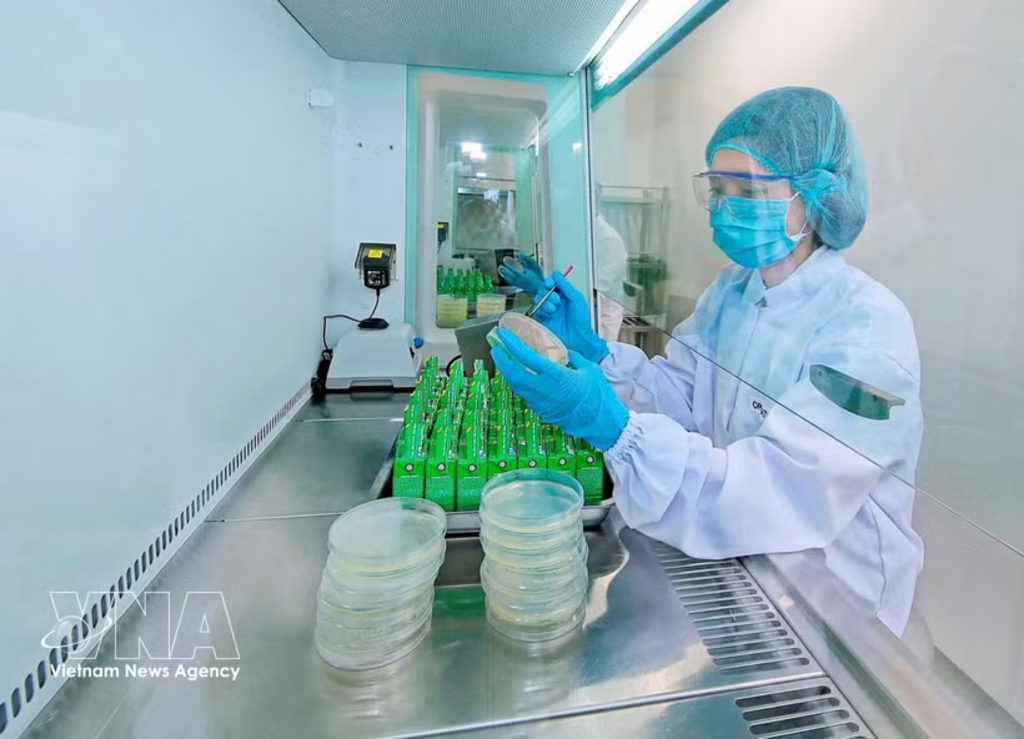
| Nestlé Bong Sen Factory in Hung Yen applies digital technology to green production __Photo: VNA |
Foreign direct investment (FDI) continues to maintain positive momentum as green production, high technology and sustainable development are increasingly becoming global investment standards.
This presents Vietnam with an opportunity not only to attract more FDI, but also to select high-quality projects that generate greater added value, promote technology transfer and help create new growth drivers.
After nearly four decades of international integration, the foreign-invested sector has become an important component of Vietnam’s economy. During 2021-2025, total registered FDI reached USD 184.2 billion, up 8.4 per cent from the 2016-2020 period. In the first seven months of 2026, the figure stood at USD 38.06 billion, up 58 per cent year-on-year. Disbursed FDI reached USD 15 billion, the highest figure recorded for the first seven months in the past five years and an 11.8 per cent increase year-on-year.
These results demonstrate Vietnam’s continued appeal to international investors. However, as the country targets double-digit economic growth and seeks to accelerate development, higher expectations are being placed on the FDI sector.
Nguyen Hoa Cuong, Deputy Director of the Institute for Policy and Strategy Studies under the Party Central Committee’s Commission for Policy and Strategy, said economic growth in 2026-2030 should be built on innovation, digital transformation, green transition and improved human resources.
Accordingly, businesses need to renew their production models, enhance competitiveness and adopt sustainable business practices. As domestic enterprises improve their technological, management and production-standard capabilities, their potential to link with the FDI sector will increase, strengthening the spillover effects of foreign investment on the broader economy.
At the same time, industrial parks are shifting towards more ecological and smart models, an important factor in meeting the demands of a new generation of investors.
The drive to improve FDI quality is clearly reflected in the Politburo’s Resolution No. 10-NQ/TW, dated June 8, 2026, on developing the foreign-invested economic sector. The resolution places particular emphasis on attracting FDI to the green and digital economies, and promoting technology transfer and stronger linkages with the domestic economic sector.
A notable new approach is to link investment incentives with the fulfillment of FDI enterprises’ commitments to technology, research and development, technology transfer, training Vietnamese workers, increasing domestic added value, developing local suppliers, and advancing green and digital transformation.
Nguyen Quang Vinh, Vice Chairman of the Vietnam Chamber of Commerce and Industry (VCCI) and Chairman of the Vietnam Business Council for Sustainable Development (VBCSD), said Resolution 10 reflects a significant shift in the approach to developing the foreign-invested sector, from attracting investment based on administrative boundaries to focusing on industry clusters, value chains and innovation ecosystems, with quality, efficiency, technology transfer, supply-chain participation and added value serving as key criteria.
Citing the OECD’s “FDI Qualities Review of Vietnam – Powering the Next Growth Phase,” released in June, Vinh noted that Vietnam’s next phase of growth would depend less on the volume of investment and more on its quality. Therefore, the country will prioritise projects that raise productivity, transfer knowledge, support Vietnamese enterprises and generate benefits for workers.
This provides substantial room for Vietnam to channel FDI into priority areas such as high technology, clean energy, the circular economy, energy-efficient manufacturing, digital infrastructure and other high-value-added sectors.
Resolution 10 also encourages credit institutions to provide interest-rate support and preferential loans for green and circular FDI projects, energy-efficient initiatives, sustainable resource use and the application of environmental, social and governance (ESG) standards.
However, turning these opportunities into actual investment flows requires Vietnam to further develop an ecosystem conducive to green investment. Vietnam currently has 425 industrial parks, 299 of which are operational with a combined area of more than 92,000 hectares. Yet only around 1-2 per cent are currently transitioning to ecological industrial park models.
High initial investment costs, limited access to green finance, inadequate resource-sharing and business linkages, slow technological transformation and shortages of sustainability professionals remain major bottlenecks.
Therefore, alongside improving institutions and investment procedures, localities need to accelerate the development of green industrial park infrastructure, energy systems, logistics and digital infrastructure, while preparing a workforce equipped for emerging technologies.- (VNA/VLLF)