 |
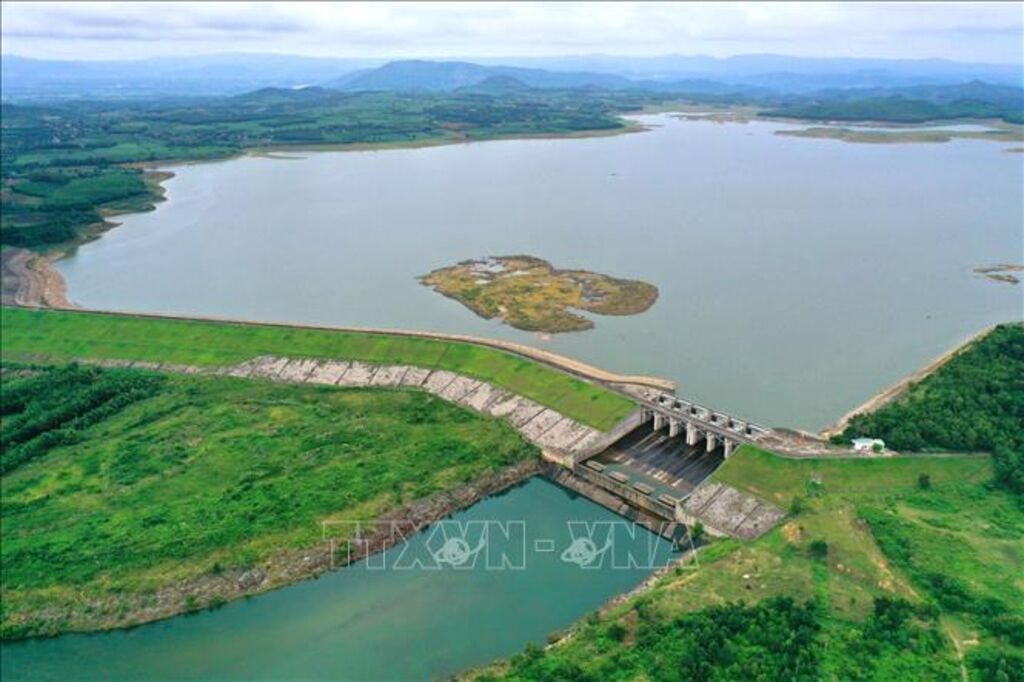
| Song Hinh hydropower reservoir in Dak Lak province __Photo: VNA |
The Ministry of Agriculture and Environment (MOAE) has proposed adding a draft law revising 10 laws relating to administrative procedures and business investment conditions to the National Assembly’s 2026 law-making programme for passage under fast-track procedures. Once approved, the draft law would take effect from the beginning of next year.
Accordingly, the draft law would revise 10 laws, namely the Law on Plant Protection and Quarantine, the Law on Crop Production, the Law on Animal Husbandry, the Law on Animal Health, the Law on Fisheries, the Law on Hydraulic Work, the Law on Dikes, the Law on Water Resources, the Law on Hydrometeorology, and the Law on Geology and Minerals.
According to the MOAE, the proposed amendments are closely interrelated in substance, focusing on administrative procedures and business investment conditions. They are expected to remove numerous obstacles facing businesses, reduce compliance costs, and provide fresh impetus for the development of the agriculture and environment sector in the coming period.
Abolishing unnecessary administrative procedures and business conditions
According to Phan Tuan Hung, Director General of the MOAE’s Legal Department, the draft Law proposes abolishing 31 administrative procedures and 14 business conditions that are no longer necessary, while also simplifying several administrative procedures in eight sectors under the ministry’s management.
In the field of animal husbandry and animal health, seven administrative procedures would be abolished, including those concerning the importation of breeding males, sperm and embryos of cattles; disclosure of information on domestically manufactured and imported supplementary feed products; and reissuance of certificates of eligibility for large-scale livestock farming establishments, among others.
Meanwhile, three business conditions would be removed, namely conditions for the provision of animal feed testing services and livestock breed testing services, and for trading in and importing animal feed.
Regarding fisheries and fisheries surveillance, the draft law proposes abolishing five administrative procedures, including those related to the issuance, reissuance and revocation of certificates of eligibility for fishing vessel building and renovation; testing of aquatic feed and aquaculture environment treatment products; and testing of aquatic breeds.
Four business conditions would also be abolished, including those applicable to facilities trading in and importing aquatic feed and aquaculture environment treatment products; facilities testing aquatic feed and aquaculture environment treatment products; fishing vessel building and renovation facilities; and aquatic breed testing facilities.
In the field of water resources, three administrative procedures relating to licences for groundwater exploration would be abolished. Two business conditions governing the provision of decision-support services for water resource regulation and allocation, and for the operation of reservoirs and inter-reservoir systems would be removed. In addition, two administrative procedures on modification and partial modification of procedures for inter-reservoir operation would be simplified.
The draft law also proposes abolishing four administrative procedures relating to seas and islands, including the extension of sea dumping permits and the extension of decisions permitting scientific research activities at both the central and provincial levels.
Regarding hydraulic works, procedures for reissuance of licences for activities within the protection corridors of hydraulic works would be abolished. In the field of dike management and disaster preparedness, the requirement to obtain ministerial opinions on flood discharge assurance and dike safety for construction investment projects located on riverbanks, alluvial grounds or islets where no construction works currently exist would also be removed.
Strengthening decentralisation to local authorities
In line with the Party’s and Government’s policy on delegation and decentralisation of powers, the draft law proposes the decentralisation of 24 powers and responsibilities in three sectors, namely crop production and plant protection; animal husbandry and animal health; and geology and minerals, from the Minister of Agriculture and Environment to chairpersons of provincial-level People’s Committees.
Accordingly, in the crop production and plant protection sector, the authority to conduct state inspection of the quality of imported plant protection products would be decentralised to provincial-level authorities.
In the animal husbandry and animal health sector, chairpersons of provincial-level People’s Committees would be vested with the authority to approve international exchange of domestic animal genetic resources on the List of domestic animal breeds banned from export for the purpose of scientific research, exhibition or advertising; and international exchange of Vietnamese precious and rare domestic animal genetic resources with third parties; issue permits for transport of aquatic disease specimens; register the transport of aquatic disease specimens; and settle applications for registration and issuance of animal quarantine certificates for terrestrial animals participating in fairs, exhibitions, sports competitions and art performances, as well as animal products displayed at fairs and exhibitions.
In the geology and minerals sector, powers to be decentralised to localities include the re-issuance, extension, modification and return of mineral exploration licences; decisions on closure of mineral mines; approval of mineral exploration and exploitation activities in areas where mineral activities are banned; approval of additional exploration to upgrade mineral resources and reserves; approval of amendments to mineral exploration schemes and determination of associated mineral reserves; and approval of additional exploration volume upon the expiration of mineral exploration licences.- (VLLF)