 |
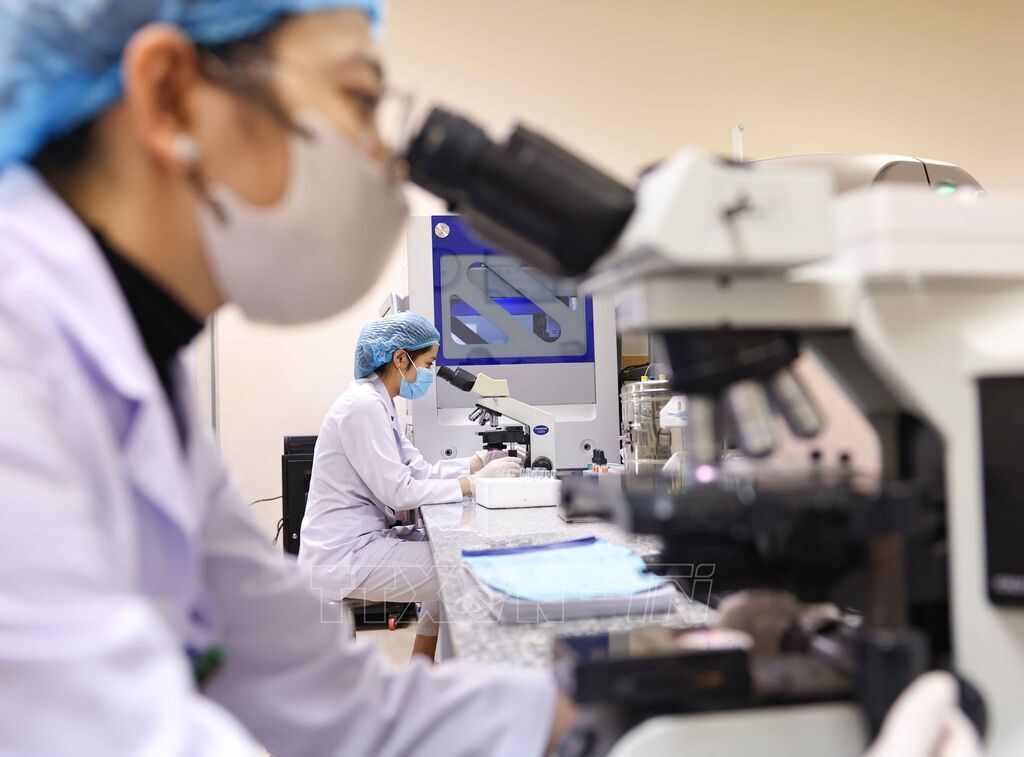
| Scientific research at the National Hospital of Endocrinology__Photo: Thanh Tung/VNA |
Vietnam plans to have around 20 research centres of regional or global stature by 2030.
This was announced in Prime Minister Decision 2813/QD-TTg approving the Program on building of capacity for public scientific research and technological development organizations in the 2025-2030 period.
Under the Program, five mathematics, physics, biology, materials science and earth science research institutes and 7-10 engineering and technology research institutes in the country will strive to stand among the top 30 percent of global leading institutions as ranked by the SCImago Institutions Rankings (SIR) or equivalent reputable international bodies.
The nation also plans to develop four excellent social sciences and humanities research institutions which will serve as the core pillars for providing scientific grounds for the Party and the State to formulate guidelines, strategies, master plans and policies for rapid and sustainable socio-economic development. At least one of these institutions will be rated as being of regional or international stature.
The Program also sets out specific targets for the second year of implementation on. Specifically, those institutions will attract reputable regional and international experts and scientists to participate in their research cooperation and training activities, seminars and academic exchanges and organize at least one regional or international scientific forum or seminar every year.
By 2030, a research team of at least 30 researchers (excluding staff on the state payroll), including contract-based researchers, science and technology collaborators (onsite or remote) and domestic/international PhD and Master’s students, will be formed and maintained. At least 15 percent of this team’s members must be foreigners or overseas Vietnamese.
Each mathematics, physics, biology, materials science or earth sciences institute will have to increase the number of their scientific articles published in international journals - Web of Science, Scopus or Scimago Q1 and Q2 by an average of 15 to 20 percent annually. Each institution must have at least two scientific and technological outcomes/products transferred or applied in practice annually.
The Decision states that the number of invention and utility solution patents, especially internationally protected ones, is expected to increase by 15 percent per year on average.- (VLLF)