 |
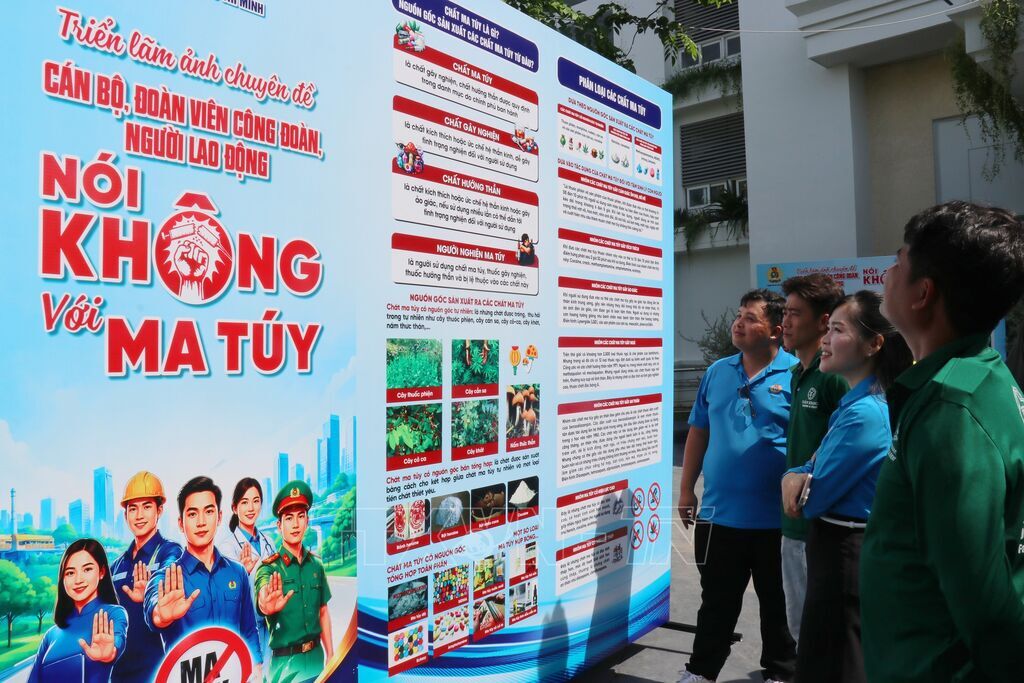
| Workers visit an exhibition on drug prevention and control among workers in Ho Chi Minh City __Photo: VNA |
Deputy Prime Minister Pham Thi Thanh Tra, head of the Central Steering Committee for the National Target Programme on Drug Prevention and Control through 2030, on August 10 signed Decision 147 issuing the 2026 Working Programme of the committee.
This document serves as a strategic blueprint to concretise the functions, tasks and powers of the committee, while establishing a robust legal foundation for ministries, central agencies and local authorities to coordinate the programme’s implementation throughout the year.
The core objective of the working programme is to ensure that all drug prevention and control activities nationwide are carried out uniformly, with clear priorities and focal points. This framework enables the central steering committee’s standing body to promptly synthesise, address or report operational bottlenecks to competent authorities for resolution.
Ministries and central agencies are required to direct the synchronised implementation of the programme based on the objectives, tasks and solutions assigned by the National Assembly, the Government and the Prime Minister, thereby enhancing inter-sectoral coordination efficiency from central to local levels.
To realise these objectives, priority will be given to institutional refinement and capacity building for officials. Ministries and central agencies are tasked to urgently review and finalise legal documents and guiding texts within their competence to ensure a comprehensive legal framework.
Notably, throughout 2026, the central steering committee will direct the pilot implementation of key initiatives in the provinces of Dien Bien, Nghe An and Tay Ninh. Concurrently, the programme emphasises strengthening organisational structures of the steering committees at all levels, providing professional training, and building capacity of personnel directly engaged in drug control work.
Another vital priority involves managing and efficiently utilising resources of the programme, while combating waste, loss and negative practices. Ministries, central agencies and local authorities must focus on allocating sufficient public investment amounts and recurrent expenditure funds in compliance with regulations, striving to achieve full disbursement of planned budget funds within 2026.
The programme’s resources will be integrated with other lawful funding streams, alongside a resolute policy to review and reallocate capital away from delayed projects or those behind the disbursement schedule.
Furthermore, information technology application and digital transformation are being accelerated to enhance the management, monitoring and supervision of the implementation of the programme. The synchronised information system and database are being completed to connect and share data seamlessly between central and local agencies, thereby improving statistical and reporting quality to support direction and administration work.
Finally, to guarantee strict compliance with and implementation efficiency of the programme, the central steering committee will dispatch inter-sectoral inspection delegations to monitor and review the implementation progress across ministries, sectors and localities, focusing heavily on capital disbursement and target achievement.
Public communication and public awareness improvement campaigns will also be intensified to foster community engagement, promptly commending and widely applying creative, highly effective models in drug prevention and control activities nationwide.- (VLLF)