 |
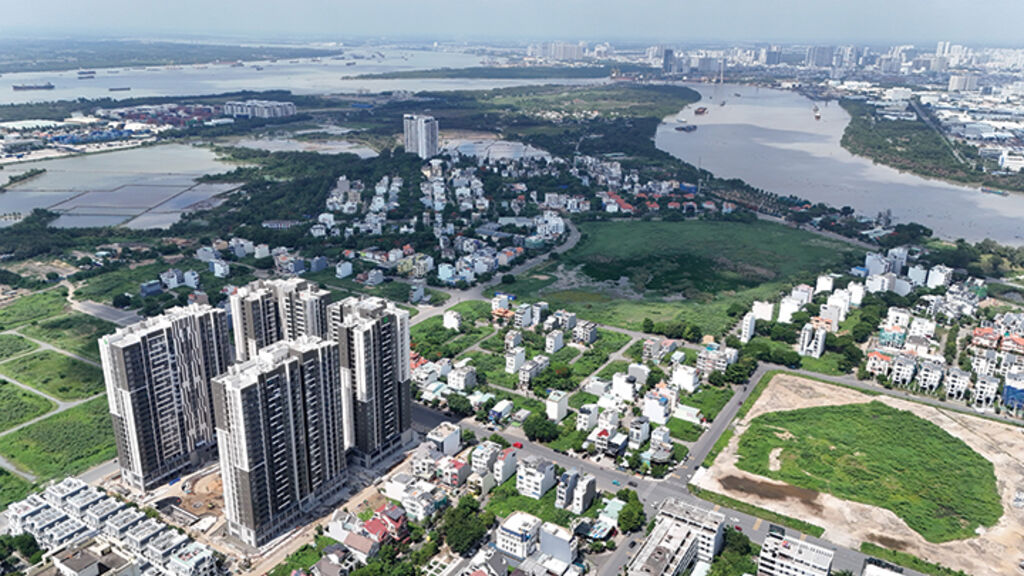
| An aerial view of Cat Lai ward, Ho Chi Minh City__Photo: Hong Dat/VNA |
The Ministry of Finance (MOF) has proposed a higher tax rate for unused land under a draft law amending and supplementing a number of articles of the Law on Corporate Income Tax, the Law on Non-Agricultural Land Use Tax and the Law on Personal Income Tax. The proposal seeks to implement the Party Central Committee’s Resolution 21, which sets a target of addressing wasteful land use and abandoned land by 2030.
According to MOF, the current Law on Non-Agricultural Land Use Tax already contains provisions aimed at promoting economical and efficient land use. Residential land is subject to progressive tax rates of 0.03 per cent for areas within prescribed land use quotas, 0.07 per cent for areas exceeding these quotas by no more than three times, and 0.15 per cent for areas exceeding the quotas for more than three times.
Land used for non-agricultural production and business activities is taxed at 0.03 per cent, while land used for improper purposes or not used in accordance with regulations is subject to a rate of 0.15 per cent. However, the law does not set a separate tax rate specifically for land left abandoned, unused or put into use behind schedule.
To address this gap, the draft law proposes a tax rate of 0.2 per cent for such land, regardless of area. This would be nearly seven times the current rate applicable to residential land within prescribed quotas.
By raising the cost of holding idle land, the proposed measure aims to discourage land hoarding and speculation while encouraging land users to put their holdings to productive use.
Can higher taxes discourage land hoarding and speculation?
The proposal has gained support from land policy and economic experts, who see higher taxation as a way to facilitate more efficient land use and channel capital away from speculative property investment towards productive economic activities. However, some have questioned whether the proposed rate of 0.2 per cent would be high enough to deter investors from holding land in anticipation of future price increases.
Professor Dang Hung Vo, former Deputy Minister of Natural Resources and Environment, has called for the early introduction of progressive land taxation, particularly on land left unused or underutilised.
“When the cost of holding land increases, capital will shift towards production and business activities instead of remaining tied up in land,” Vo told Tuoi Tre newspaper.
However, he questioned whether the proposed rate would be sufficient to bring about such a shift.
Vo argued that the tax should be considered in relation to the pace of property price increases. He cited social housing and low-cost commercial housing as examples, noting that prices in these segments had tripled, from around VND 11 million per square metre in 2014 to VND 33 million in 2024.
Meanwhile, official land price lists, which form the basis for calculating non-agricultural land use tax, are generally much lower than market prices.
Against this backdrop, Vo said that a tax rate of 0.2 per cent might do little to discourage speculative landholding, as the potential gains from rising property prices could far outweigh the additional tax burden.
Nguyen Duc Kien, former Vice Chairman of the National Assembly’s Committee for Economic Affairs, shared this concern, arguing that the proposed rate remained too low to effectively discourage speculation.
In his view, land taxation should be designed to make putting land to productive use considerably more attractive than holding it solely in the hope of future price increases.
“Taxes must be high enough to encourage those who have no need to use land to give it up, rather than continue hoarding it and waiting for price hikes to sell the land for profit,” Kien said.
Beyond the tax rate itself, Dr. Nguyen Ngoc Tu, a tax expert, highlighted the need to strengthen land management through a comprehensive national land database.
He said such a database would enable management authorities to identify the number, location and area of land parcels held by each land user, providing a firmer basis for monitoring speculative landholding and wasteful land use.
How can the proposed tax be implemented fairly?
Beyond concerns over the proposed rate, the prospect of higher taxation has raised questions among property developers and individual land users whose holdings remain unused because of planning restrictions or prolonged legal and administrative procedures.
Speaking to Tuoi Tre, a representative of a property developer in Ho Chi Minh City welcomed the proposal as a strong signal of the Government’s determination to strengthen discipline in land use.
The representative acknowledged that higher landholding costs could encourage businesses and individual investors to reconsider their investment decisions and make better use of their land. However, many property projects have been delayed for years by unresolved legal and administrative issues, despite developers’ efforts to obtain the necessary approval.
“If state authorities simply label any undeveloped land as ‘abandoned’ and impose the 0.2 per cent tax rate, businesses currently facing difficulties will be pushed into even greater hardship,” the representative warned.
Similar worries have been voiced by individual land users, particularly those whose property is affected by long-standing planning restrictions.
H.V., a resident of Ho Chi Minh City, said he had owned a land parcel affected by a long-delayed planning scheme for more than a decade. Restrictions on construction and renovation, coupled with difficulties in selling the property, have left him with little choice but to keep the land largely unused.
“Our land has been caught in suspended planning because of delays in project implementation, and we have suffered considerable losses. If it is now classified as abandoned and subjected to a tax nearly seven times higher, that would only compound our hardship,” he said.
Such cases point to the need to distinguish land deliberately held for speculative purposes from land that remains unused because of circumstances beyond the land user’s control.
Pham Nguyen Toan, Vice Chairman of the Viet Nam National Real Estate Association, stressed that the first step should be to establish a clear definition of abandoned land, supported by specific criteria for determining when the higher tax would apply.
“The important question is whether a land parcel remains unused because of the land user or the State,” Toan said.
He suggested that substantially higher taxes, potentially reaching 10 per cent, could be considered if enterprises were found to be deliberately holding land for speculative purposes.
The need for clear and fair implementation rules was also highlighted during the National Assembly’s discussion of the draft law on October 23.
Lawmakers generally supported the proposal’s objective of discouraging land speculation and wasteful land use, but called for clearer criteria to identify land subject to the proposed 0.2 per cent tax rate. They stressed the importance of distinguishing deliberate land hoarding from cases where land remains unused because of delayed site clearance, administrative procedures, planning adjustments or other circumstances out of land users’ control.
National Assembly President Tran Thanh Man emphasised the need to ensure consistency between the proposed tax provisions and land legislation, particularly those on the criteria for identifying unused land and the authority responsible for determining its status. He cautioned against situations in which land management and tax agencies might reach different conclusions about the same land parcel.
Ultimately, the proposed tax could become a useful instrument for discouraging speculation and making better use of land resources. Its effectiveness, however, would depend on an appropriate tax rate, clear and consistent legal criteria, and safeguards for land users affected by circumstances outside their control. Balancing these considerations will be essential if the policy is to promote more efficient land use while protecting lawful rights and interests of land users.- (VLLF)