 |
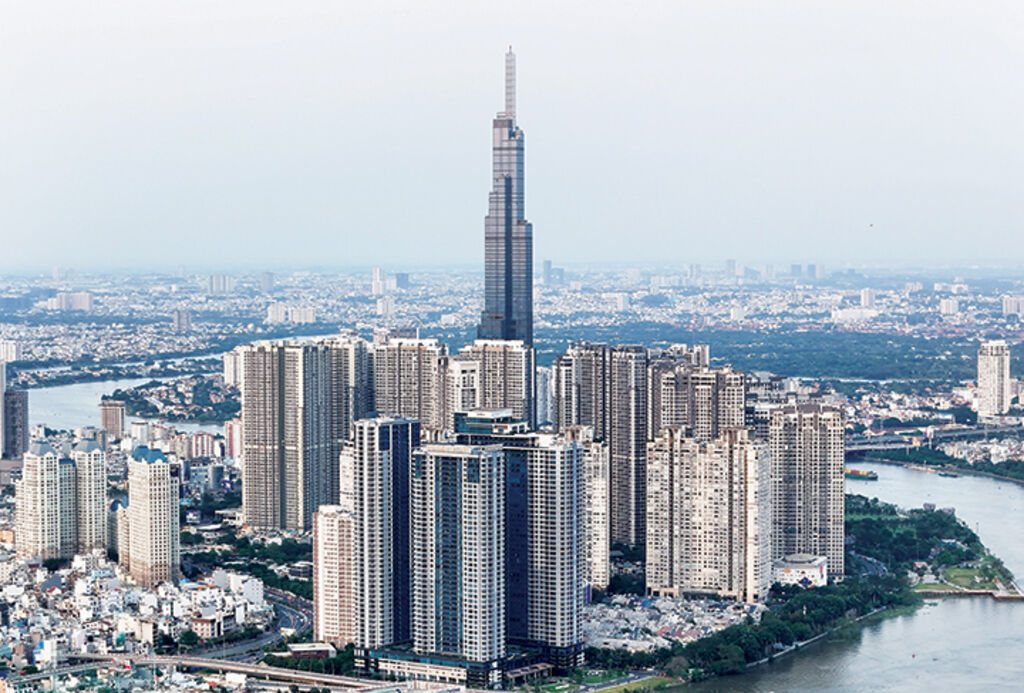
| A luxury apartment complex along the Saigon River near central Ho Chi Minh City__Photo: Hong Dat/VNA |
Resolution 21-NQ/TW has introduced a novel policy for newly built apartment buildings: The use period of individual apartments would be linked to the lifespan of the building itself.
Under the resolution, land for commercial housing projects for sale would continue to be allocated for long-term, stable use. For newly built apartment buildings, however, the period of apartment use would be determined according to the lifespan of the building. When that period expires, owners would fulfil financial obligations for the reconstruction of the building in accordance with law.
The proposal has quickly drawn public attention, particularly from apartment owners and prospective buyers who have long associated home ownership with permanence.
Tran Thi Phuong, an apartment owner in Ho Chi Minh City’s An Phu ward, told VnExpress that when she bought her apartment, she focused mainly on the land use period stated in the house ownership certificate and gave little thought to the lifespan of the building itself. The new policy has left her wondering what will happen to her ownership over the apartment once the building reaches the end of its useful life.
Her concern reflects the broader questions raised by the policy: If the use of an apartment is tied to the lifespan of the building, does ownership also end when the building can no longer be safely used? If not, what rights and obligations will homeowners retain when renovation, demolition or reconstruction becomes necessary?
Building lifespan does not mean ownership expiry
The above questions are now at the centre of discussions over revisions to the Housing Law.
On August 19, Minister of Construction Tran Hong Minh, as authorised by the Prime Minister, presented to the National Assembly a policy orientation for amending the law, including a proposal to introduce the concept of a “time-limited apartment building” linked to the lifespan of the construction work. The proposal is intended to institutionalise the direction set out in Resolution 21.
However, the National Assembly’s Committee on Legal and Judicial Affairs has called for the concept and its application to be clarified further. It noted that while the draft introduces the term “time-limited apartment building”, other provisions mainly refer to the “use period of an apartment building”, largely inheriting existing rules on apartment use, renovation and reconstruction under the 2023 Housing Law.
The Committee therefore suggested clarifying the terminology to avoid different interpretations of what the proposed time limit actually refers to.
At the heart of the issue is a distinction that experts say must be made clear in the revised law: the lifespan of an apartment building is not the same as the duration of the property rights held by its owners.
Pham Thi Mien, Deputy Director of the Vietnam Real Estate Market Research Institute (VARS IRE), said the new direction does not alter the long-term land use regime applicable to commercial housing projects. What changes is the way the period of apartment use is determined, with greater emphasis on the technical lifespan and safety of the building.
According to Dr. Le Ba Chi Nhan, an economic expert, the policy does not imply that the State takes away people’s property when a building reaches the end of its usable life. Rather, it seeks to establish a mechanism under which the value of property rights continues to be protected during renovation and reconstruction.
“The end of a building’s service life is not equivalent to the end of property rights. What comes to an end is the lifecycle of the building; the law must continue to protect the value of the property and the economic interests of homeowners,” Nhan told VietNamNet.
The distinction also reflects the physical nature of apartment buildings. Tran Quang Trung, Business Development Director at OneHousing, a real estate ecosystem, noted that every building has a finite life, determined by factors including design standards, construction quality, materials, maintenance and operation. Once a building deteriorates to the point that it no longer meets safety requirements, renovation or reconstruction becomes inevitable.
For this reason, the lifespan of an apartment building should not simply be treated as a fixed countdown. VARS IRE argues that it should serve as a management benchmark, with the actual period of safe use assessed on the basis of design documents, construction quality, maintenance history, operating conditions and independent inspection results.
The distinction between the life of the building and ownership rights also addresses another concern: whether apartments will gradually lose all their value as the building ages.
Dinh Minh Tuan, Southern Regional Director of Batdongsan property platform, rejected the view that apartments would become “depreciating assets” whose value falls towards zero, like cars or machinery.
He explained that the value of an apartment comprises two components, i.e., the physical structure and the rights associated with the land area on which the building stands. While the structure may deteriorate over time, land in well-located areas with developed infrastructure may retain or increase its value.
The end of a building’s service life, therefore, does not mean that homeowners automatically lose either their ownership rights or all the economic value attached to their property.
The harder question is what happens to those rights when the building must actually be renovated, demolished or rebuilt.
What happens when rebuilding becomes necessary?
For lawyer Truong Anh Tu, Chairman of TAT Law Firm, this is the issue the revised Housing Law will ultimately have to resolve.
The law, he said, should specify whether continued use will be allowed after a building reaches the end of its original lifespan, and when renovation or demolition is deemed compulsory, how reconstruction is carried out and how owners’ rights are protected throughout the process.
Such questions are particularly relevant in major cities, where redevelopment of ageing apartment blocks has often been delayed by disagreements over compensation, resettlement and the interests of individual owners.
Resolution 21 seeks to address this problem partly by clarifying responsibility. Rather than leaving redevelopment primarily to the State or developers, the policy envisages apartment owners fulfilling financial obligations to participate in rebuilding once the existing building reaches the end of its service life.
Le Hoang Chau, Chairman of the Ho Chi Minh City Real Estate Association, said apartment owners, like owners of detached houses or villas, should bear responsibility for maintaining, repairing and eventually rebuilding their property.
Although apartment buyers have been required since July 1, 2006, to make a contribution to maintenance funds that is equivalent to 2 per cent of the contract value, he said calculations by the Ministry of Construction suggest that such funds may cover only around 20 years of maintenance.
The policy could therefore encourage owners to pay greater attention to maintenance and management throughout a building’s lifecycle.
Clearer lifecycle rules could have wider effects on the housing market as well. VARS IRE argues that earlier preparation for reconstruction could help replace deteriorating housing stock and create new supply in established urban areas where available land is increasingly scarce, rather than allowing ageing apartment blocks to remain a long-running hurdle to redevelopment.
However, the policy’s social impact will depend heavily on how these principles are translated into law.
One of the most sensitive issues is financial responsibility. Resolution 21 refers to owners fulfilling financial obligations to participate in reconstruction, but detailed rules will still be needed on how those obligations are determined, how benefits are divided, and how cases involving owners who disagree with redevelopment or cannot afford the required contribution are handled.
Nguyen Van Dinh, President of the Vietnam Association of Realtors, has asked for clear criteria for determining a building’s service life on the basis of technical standards, in a manner that is transparent, consistent and easy to apply.
He also proposed specifying the mechanism for protecting owners’ property rights after the building reaches the end of its service life, particularly their right to participate in the redevelopment, their entitlement to housing after reconstruction, and the allocation of related rights and financial obligations.
For new apartment building projects, Dinh called for transitional provisions and an appropriate implementation roadmap to minimise public uncertainty and avoid disruption to the property market.
Ultimately, certainty will be crucial for homeowners. They need to know in advance what happens if their building is demolished, whether they may return to the rebuilt housing, how replacement housing will be arranged, what financial obligations they will bear and how their property rights will be protected.
The debate, therefore, should not be limited to how long an apartment lasts for. The real test of the policy will be whether homeowners can understand, from the time they buy, what rights they retain and what obligations arise when the building itself can no longer be safely used.- (VLLF)