 |
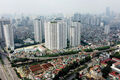
| A bird’s eye view of Ho Chi Minh City__Photo: VNA |
Effective as of October 1, the 2026 Law on Urban Development (the Law) provides a legal foundation for reforming urban development and management models, strengthening power decentralisation, mobilising social resources, developing integrated infrastructure, improving people’s quality of life, and boosting economic growth.
Comprising 66 articles arranged in five chapters, the Law introduces a series of breakthrough mechanisms that establish a new institutional framework, giving cities greater decision-making authority and broader development space.
The Law establishes a comprehensive system of mechanisms and policies to enable Ho Chi Minh City and other special-class urban areas to pursue coordinated development in terms of institutions, infrastructure, economy, culture, society, the environment, development resources, connectivity and regional development. Hanoi, meanwhile, is governed by the Capital Law.
For other cities, the Law allows certain mechanisms and policies to be applied within the regulated scope. Similarly, special economic zones may apply mechanisms and policies for their own development. Provinces and cities hosting special economic zones may implement certain mechanisms and policies designed to promote the development of special-class urban areas within such zones, with several specific exclusions.
Greater autonomy for municipal administrations
The Law gives cities greater authority to shape their own administrative structures, based on comprehensive decentralisation and a clearer division of powers.
Under the Law, municipal authorities are granted autonomy to independently determine their staffing quotas, allowing expansion of civil servant and public employee payrolls by up to 20 per cent beyond central government allocations. To exercise this right, local authorities must cover all additional salary expenses with their budgets while meeting practical workload demands.
Besides, cities may decide on their own organisational structures and determine the number of specialised agencies and other administrative organisations under their management as well as the establishment, reorganisation or dissolution thereof. Local governments are empowered to adopt supplementary income policies for the public sector’s personnel, funded entirely with local budget revenues.
They may also apply, on a pilot basis, new mechanisms and policies that differ from National Assembly laws or resolutions, or address issues not yet governed by law. This authority is not applicable to national defence, security, foreign affairs, religion and other areas directly related to national sovereignty. The pilot period may not exceed five years.
New urban development model
The Law provides a more integrated approach to city planning. Accordingly, each municipality will have to prepare a single integrated master plan, which has legal validity to replace both the provincial plan and the general urban plan. This master plan will help shape the entire urban landscape, and govern the municipality’s underground, low-altitude and high-altitude spaces.
In tandem, Transit-Oriented Development (TOD) moves from concept to statutory reality. By anchoring urban expansion directly to high-capacity transit routes, most notably urban railways, station hubs and interchange nodes, the Law ensures seamless public access to mass transit, optimises land efficiency, and drives the growth of emerging urban areas.
Municipal authorities are allowed to allocate their budget funds to independent compensation, support and resettlement projects for recovering land areas and creating clear land reserves surrounding railway stations and depots for public auction or investor payment under Build-Transfer (BT) contracts. To maximise the urban potential, land-use intensity metrics in these TOD zones are allowed to exceed statutory limits, while the transfer of planning land-use quotas is explicitly permitted.
In particular, the Law broadens the scope of modern marine economic models, permitting the implementation of advanced, green and smart reclamation projects with an operational duration not exceeding 70 years. The development of reclaimed urban areas must comply with fundamental principles concerning spatial planning, national defence and security, jurisdiction, and national maritime interests. Moreover, such projects may only be implemented following comprehensive assessments of natural and oceanographic conditions, ecological systems and coastal impacts, and capability to adapt to climate change and sea level rise.
Additionally, goods and services exchanged between functional zones satisfying non-tariff conditions will be eligible for tax incentives. Enterprises operating within free trade zones are authorised to quote prices, determine values, and make foreign-currency payments to one another by bank transfer.
Investment incentives
The Law provides a raft of incentives aimed to channel capital into sectors important to the cities’ socio-economic development.
Besides manufacturing, technology, energy and infrastructure, the incentives extend to education, healthcare, elderly care, cultural industry, social welfare, environmental protection, hi-tech agriculture and legal aid services.
Enterprises, organisations and individuals implementing eligible projects may be exempt from land rental under regulations adopted by municipal People’s Councils.
Innovative start-ups, science and technology organisations, and intermediary organisations supporting innovative start-ups may receive a 50-per cent reduction in rental for production and business premises at municipal innovation centres.
Project revenues will be entitled to preferential corporate income tax rate of 10 per cent, and tax exemption for up to four years and a 50 per cent reduction of payable tax amounts for no more than subsequent nine years.
Experts, scientists, individuals with exceptional talent and innovative entrepreneurs will enjoy a five-year personal income tax exemption on salaries and wages paid by innovative start-ups, science and technology organisations, innovation centres and intermediary organisations supporting innovative start-ups.
In particular, project owners or strategic investors are permitted to organise the formulation, appraisal and approval of construction designs and cost estimates immediately after investment is decided.
Strategic investors in projects with the total investment capital of VND 30 trillion or more, excluding commercial housing projects, may implement a project for up to 70 years. Foreign contractors engaged in major and important projects implemented by strategic investors will also be exempt from construction permit.- (VLLF)