 |
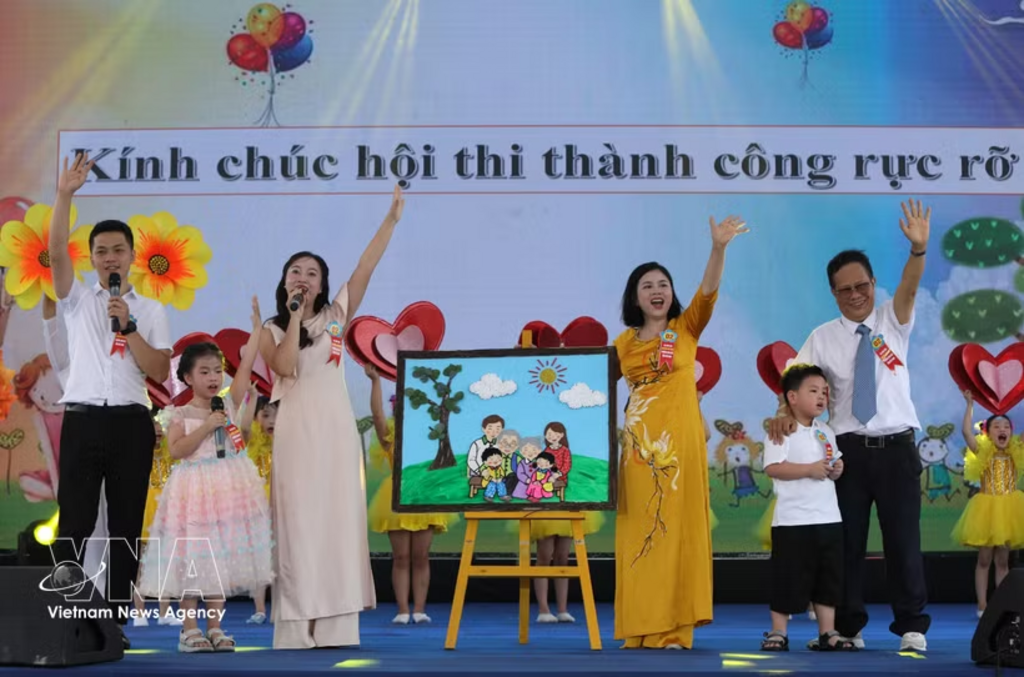
| Teams compete in the “Talented Family” contest at the 2026 Bac Ninh Family Festival__Photo: VNA |
As Vietnam Family Day (June 28) approaches, experts have highlighted strong families as a cornerstone of human capital development and national prosperity, stressing that nurturing resilient households also strengthens community cohesion, social solidarity and sustainable development.
Family structures undergoing transformation
According to Dr. Tran Thi Hong, Deputy Director of the Institute for Human, Family and Gender Studies under the Vietnam Academy of Social Sciences, Vietnamese families are undergoing profound changes driven by socio-economic development, industrialisation, urbanisation, digital transformation and international integration.
Nuclear families are becoming increasingly common, household sizes continue to shrink, and the number of households consisting solely of elderly members or with migrant workers is rising. In 2024, the average household size stood at 3.6 people, down from 4.6 in 1999, significantly reshaping patterns of care and intergenerational connection.
Family functions have also evolved, with responsibilities related to education, caregiving and economic development increasingly shared with schools, markets and other social institutions.
At the same time, family values are balancing tradition and modernity. Traditional values such as filial piety, affection and responsibility remain important, while concepts such as individual autonomy, gender equality and shared family responsibilities are gaining greater prominence.
To realise the goal of building “prosperous, happy, progressive and civilised” Vietnamese families, Hong said the country should shift from a mindset of “addressing family problems” to one of “investing in family development”. This includes improving family-related policies, expanding family support services, enhancing parenting and elderly care skills, promoting gender equality and fostering a healthy cultural environment.
She also recommended placing family development at the heart of broader human development strategies, while promoting national, cultural and family value systems, as well as standards of Vietnamese identity. In addition, she proposed launching a comprehensive research programme on Vietnamese families for 2026–2030 to monitor family trends and build a national family database.
 |
| Children enthusiastically browse books with their families at the Children's Book Fair, selecting their favourite titles__Photo: VNA |
Viewing families as unique cultural asset
Dr. Nguyen Thu Hanh, Director of the Centre for Research and Development of Vietnam Cultural Industry (SDCI), said the greatest challenge facing families today is not changing family structures but the widening emotional and communication gap between family members.
Despite strong family bonds, many households now live in separate “worlds” shaped by technology and global integration. The rapid expansion of digital information has placed traditional family education under pressure, as children increasingly turn to online sources of knowledge rather than learning from parents and grandparents.
Hanh argued that families should be recognised as a unique cultural and social asset of the nation – the first environment in which people are nurtured and core values are preserved. Stories of family affection, memories, lifestyles and traditions can become valuable resources for distinctive cultural, tourism and educational products.
To help spread the message that “Happy families create a prosperous nation,” she proposed viewing families as creators of content in their own right. Every family possesses valuable “living heritage” that should be shared through suitable creative platforms and spaces.
Initiatives such as S-Happy Café and O-Cafe Time Talks, developed by SDCI, have created opportunities for different generations to produce podcasts, short videos and family storytelling projects that preserve memories and strengthen family ties.
According to Hanh, such initiatives not only help culture adapt to the digital age but also foster greater understanding, connection and cohesion among family members.- (VNA/VLLF)