 |
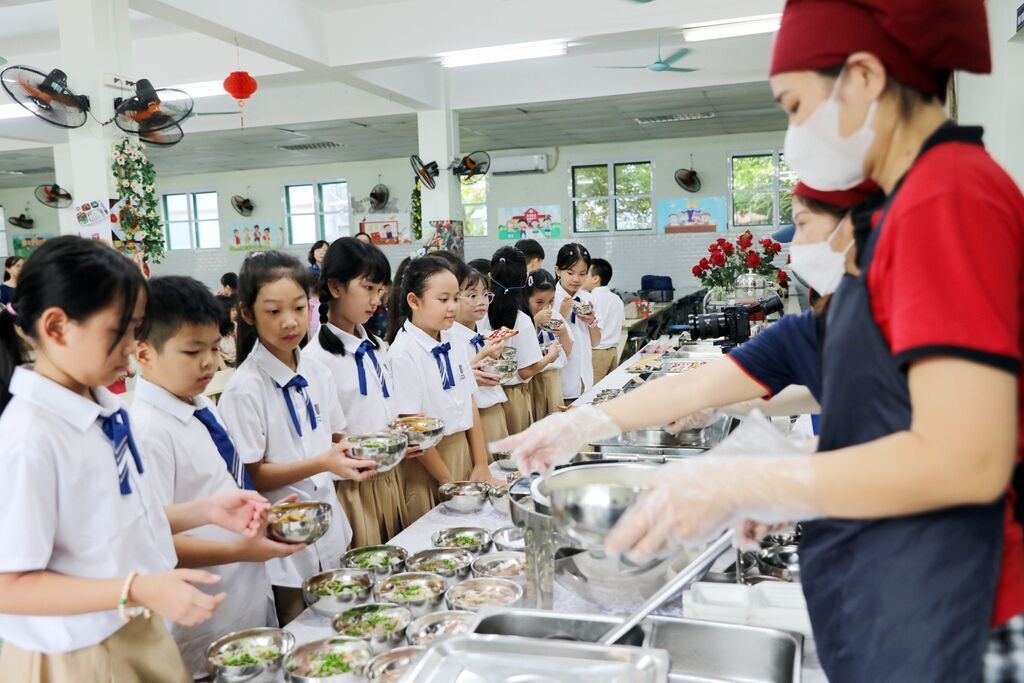
| Provision of school meal catering services at Ly Thai To primary school, Hanoi __Photo: VNA |
The Ministry of Health is finalising the draft revised Law on Food Safety, which sets out four key policy groups designed to comprehensively reform food safety management.
According to the ministry, the draft is intended to prevent diseases, improve public health and life expectancy, reduce pressure on the healthcare system, and limit economic losses resulting from reduced working capacity. It is also expected to strengthen consumer confidence and encourage producers and businesses to adopt cleaner, more sustainable and environmentally friendly production models.
Applying risk control-based management across the supply chain
As a cornerstone of the draft Law, the first policy group seeks to manage food safety throughout the entire supply chain, from primary production to delivery of products to consumers, bringing Vietnam’s regulatory approach closer to that of developed countries.
Management would cover every stage of the chain, including crop production, livestock production, aquaculture, harvesting, fishing, slaughtering, preliminary processing, processing, distribution, circulation and consumption.
The draft adds provisions on residue limits for veterinary medicines and pesticides, as well as maximum levels of contaminants in food. It also specifies conditions applicable to food production establishments and introduces management methods tailored to different categories of food.
Notably, state management agencies and laboratories would play a stronger role in inspection and supervision. They would proactively collect samples of food products on the market to identify food safety risks at an early stage.
Reforming food management and strengthening post-market inspection
The second policy group seeks to reform product management throughout the entire product life cycle, ensuring that all food products circulating on the market are supervised on the basis of risk assessment.
At the pre-market stage, management methods appropriate to each category of food would be applied.
Specifically, high-risk products, including health supplements, foods for special medical purposes and products intended for young children, would continue to be subject to registration of their product declaration forms before being placed on the market.
Processed food products, food additives and materials in direct contact with food would be subject to the declaration of applicable standards.
Meanwhile, certain categories, including fresh foods, products for research or export, and those intended for use in emergency situations, would be exempt from declaration procedures and instead subject to post-market inspection.
At the post-market stage, management agencies would monitor and analyse risks, take preventive measures, respond to incidents and conduct traceability through a unified food safety information system connecting central and local authorities.
Building a national food safety database
With the third policy group, the draft Law seeks to accelerate digital transformation in food safety management through the establishment of a unified national database.
The system would contain comprehensive information on food production and trading establishments, as well as data covering the entire life cycle of each product, from primary production, preliminary processing and processing to circulation and consumption.
Technology would be applied to the processing of administrative procedures, risk analysis, rapid alerts, traceability, inspection of food products circulating on the market, and the handling of food safety incidents.
To improve coordination and ensure that food safety incidents are handled promptly, the draft would grant management agencies at central and local levels access to relevant data based on their respective functions and responsibilities.
Tightening oversight of street food and institutional catering services
The fourth policy group retains the existing food safety requirements for street food businesses while extending them to institutional catering services.
The proposal is intended to reduce food poisoning linked to street food, institutional kitchens and establishments providing institutional catering services.
Under the draft, these establishments would be required to meet all applicable requirements concerning business premises, ingredients, food additives, processing equipment and personnel directly involved in food preparation and service.
They would also have to retain food samples, regularly update their food safety knowledge, and develop response plans for food safety incidents.
Organisations and individuals engaged in food trading would be responsible for keeping invoices, documents and other records proving the origin of ingredients for traceability purposes when necessary.
They would also be required to make commitments to comply with food safety requirements and provide relevant information to competent local authorities.
Commune-level People’s Committees would be responsible for compiling lists of businesses operating in their localities, inspecting food safety conditions, and proactively preventing and handling food safety incidents and food poisoning cases. Also, they would have to receive reports from residents, and update information on violations, warnings and violation handling outcomes to the national food safety information system.- (VLLF)