 |
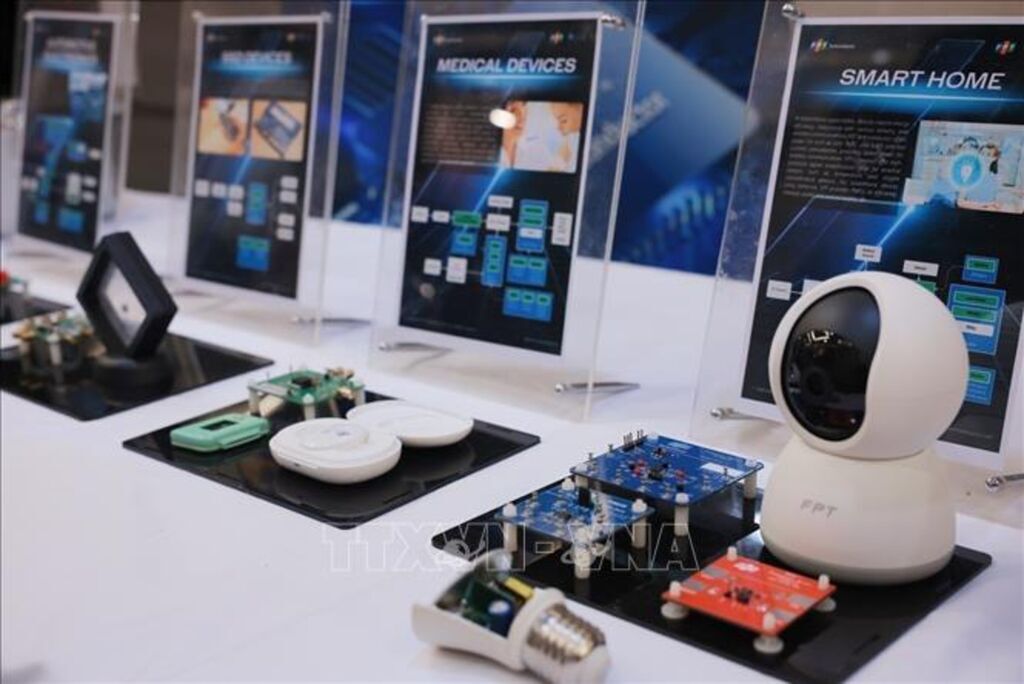
| Smart products, chips and semiconductor wafers showcased at the launch of the Vietnam National Multi-Project Wafer Coordination Centre in Hanoi __Photo: VNA |
The Ministry of Science and Technology (MOST) has drafted a decision setting out a list of specialised chips in selected sectors and fields to be prioritised for state orders. The proposed mechanism is intended to support the development of strategic integrated circuit products serving national digital transformation, artificial intelligence (AI), national defence and security, telecommunications and national digital infrastructure.
The list comprises 16 specialised chip categories covering a range of core technology fields, including AI, the Internet of Things (IoT), cybersecurity, telecommunications, robotics, energy and electronic devices.
Edge AI chips, including neural processing units, top the list. Chips of this category are capable of accelerating the processing, inference and training of AI models and can be optimised for Vietnamese large language models, speech recognition, optical character recognition, Vietnamese-language processing and specialised AI applications.
They may be deployed in edge devices, servers, data centres and AI computing infrastructure to support virtual assistants, public administrative service kiosks, healthcare, education, smart cities, AI factories and digital government infrastructure.
The list also prioritises AI system-on-chip products for cameras with edge-processing capabilities, serving smart traffic management, urban security, seaports and industrial parks.
Meanwhile, post-quantum cryptography acceleration chips are designed to accelerate both conventional and post-quantum cryptographic algorithms. They can support encryption, digital signatures, hardware authentication and other security functions for digital infrastructure, digital government, financial services, telecommunications and critical systems, while preparing for the transition to post-quantum cryptography.
In the telecommunications sector, the draft list includes baseband acceleration chips for 5G-Advanced networks that are also designed to be ready for 6G; smart radio chips supporting open radio access networks, small cells and smart antennas; and non-terrestrial network IoT modems for narrowband satellite connectivity in maritime zones, on islands and in remote areas, as well as for disaster preparedness applications.
The draft also covers chip categories serving automation and smart industrial ecosystems. These include global navigation satellite system and real-time kinematic positioning chips integrated with sensors; controller chips for unmanned aerial vehicles and robots; gallium nitride and silicon carbide power and electric motor control chips for robotics, smart manufacturing and high-voltage electrical equipment; battery management and battery energy storage system chips; sensor readout integrated circuits; secure identification chips; next-generation memory chips; and power management chips for electronic devices, electric vehicles, data centres and energy infrastructure.
Under the draft, MOST would take the lead and coordinate with relevant ministries and sectors in periodically reviewing and assessing socio-economic development in practice before proposing updates to the Prime Minister regarding the list of chip categories prioritised for state orders.
The formulation of the priority list represents an important step towards creating a market for products designed and manufactured by domestic semiconductor enterprises. Rather than dispersing support too broadly, the state-order mechanism would channel resources into chip categories of strategic importance to digital infrastructure, AI, next-generation telecommunications, cybersecurity and high-tech industries.- (VLLF)