 |
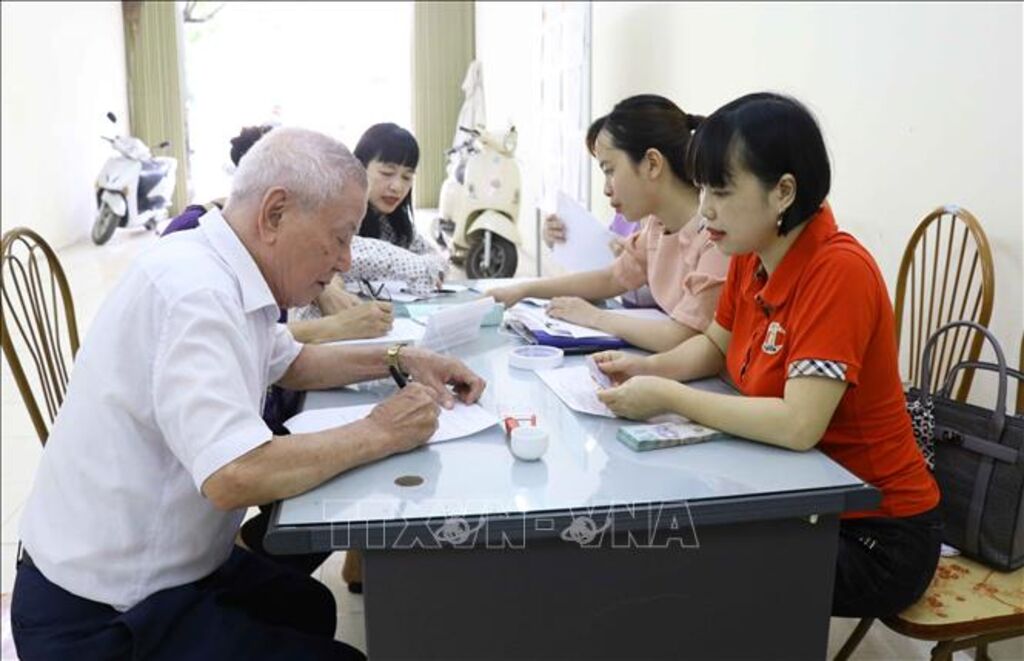
| Elderly people sign for social security support payments__Photo: VNA |
Publicised by the Ministry of Home Affairs, the draft Law revising the 2024 Law on Social Insurance proposes several notable changes. These include the State’s increased support for certain compulsory social insurance participants who pay premiums on their own; and revised methods for adjusting the salary used for premium calculation and for calculating premium payment periods. The draft also proposes a legal basis to gradually lower the eligibility age for social retirement allowance; and clearer rules on convalescence leave in workplaces without grassroots trade unions.
Subsidies for compulsory participants who pay premiums on their own
According the 2024 Law, employers and employees are required to contribute to social insurance funds at prescribed rates based on the salaries used for social insurance premium payment. However, four groups, while covered by compulsory social insurance, are required to pay their premiums entirely by themselves, without any employer contribution.
These groups include Vietnamese guest workers; spouses who are not salaried by the state budget and accompany staff members of Vietnam’s overseas representative missions on fixed-term assignments while receiving cost-of-living allowances; heads of registered business households; and managers of enterprises, supervisors, representatives of state capital or enterprise capital amounts, members of Boards of Directors, Chief Executive Officers, members of Boards of Supervisors or supervisors, and holders of other elected managerial titles in cooperatives and unions of cooperatives who are not salaried.
These persons are required to contribute to the retirement and survivorship fund at a rate of 22 per cent of an amount used as the contribution base, which must be at least equal to the statutory base salary and must not exceed 20 times that level.
In substance, although these groups are subject to compulsory social insurance, they pay premiums in a manner similar to voluntary social insurance participants. This makes them feel to be unequally treated, as voluntary participants receive state budget support for their contributions, while these groups do not.
The issue is particularly evident in the case of business household owners. Previously, they joined the social insurance scheme on a voluntary basis and were therefore eligible for contribution support. Once brought under compulsory social insurance, they no longer receive such support.
To close this policy gap, the draft law proposes revising Clauses 5 and 6 of Article 6 of the 2024 Law. Accordingly, the State would provide support for compulsory social insurance premiums paid by the four groups mentioned above.
Adjustment of salaries used for premium calculation
Under the proposed revision to Article 73.1.a, for an employee who began participating in social insurance before January 1, 2016, the salary used as the basis for calculating compulsory social insurance premiums would be adjusted according to the rate of increase in the reference level in each period. This would replace the current approach, under which the adjustment is based on the reference level applicable at the time the employee becomes entitled to retirement benefits.
To make the calculation of premium payment periods and benefit levels more accurate and better aligned with employees’ actual payment histories, the draft also proposes a more detailed method for converting odd months in social insurance premium payment periods.
Under the proposed amendment to Article 5.6, odd months would be converted as follows: one to three months would be counted as one-quarter of a year; four to six months as half a year; seven to nine months as three-quarters of a year; and 10 to 11 months as one full year.
This would replace the current rule, under which one to six months are counted as half a year and seven to 11 months as one full year.
Lower eligibility age for social retirement allowance
To expand social security coverage, the draft law proposes authorising the Government to decide on a gradual reduction in the eligibility age for social retirement allowance from the current 75 to 70, based on socio-economic development conditions and the state budget’s fund-balancing capacity.
However, any further reduction below 70 would still have to be submitted by the Government to the National Assembly Standing Committee for consideration and decision.
Convalescence leave decisions in workplaces without grassroots trade unions
The drafting agency proposes amending Article 46.2 and Article 60.2 of the 2024 Law, which govern convalescence and health rehabilitation after sickness and maternity leave.
Accordingly, the period of convalescence and health rehabilitation leave would be decided by the employer in coordination with the executive committee of the grassroots trade union. If the two sides hold divergent views, the employer would make the final decision based on the proposal of the executive committee of the grassroots trade union.
The draft law further provides that, where an employer has not yet established a grassroots trade union or is not required by law to establish one, the employer may decide the employee’s convalescence and health rehabilitation leave period on its own.
Notably, the draft law does not change the existing eligibility conditions, benefit levels or maximum number of convalescence leave days.- (VLLF)