Hoang Thi Hoa
Procuratorate University - Branch in Ho Chi Minh City
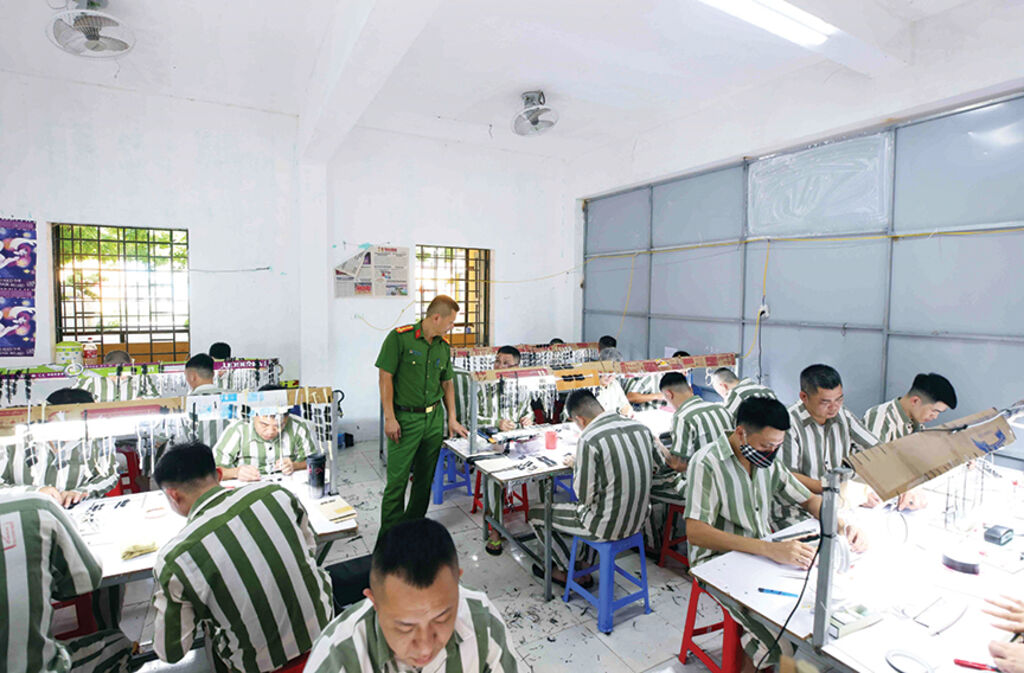 |
| Inmates at Nam Ha Prison in Ninh Binh province during a work shift__Photo: Pham Kien/VNA |
The Nelson Mandela Rules are considered a guidebook for building a civilised detention environment that respects human dignity. Vietnam has made significant progress in translating these rules into domestic regulations for implementation in the country, yet their practical implementation still faces certain difficulties. This article analyses the similarities between the Nelson Mandela Rules and Vietnam’s law in guaranteeing prisoners’ rights, and on that basis, makes recommendations to enhance the effectiveness of the Rules’ implementation in Vietnam.
The Nelson Mandela Rules
The Nelson Mandela Rules originated from the Standard Minimum Rules for the Treatment of Prisoners (SMRs) adopted by the United Nations in 1955. This was one of the first universal sets of standards governing the treatment of prisoners, setting basic criteria for detention conditions, healthcare, contact with the outside world, and the minimum rights to which detainees are entitled. However, over half a century, with the development of international human rights law and monitoring mechanisms, the SMRs revealed many shortcomings and were no longer suited to reality, with serious violations of detainees’ rights being reported, ranging from torture and inhuman treatment to poor medical care and living conditions within prisons. This reality created an urgent need to update and revise the existing detention rules to incorporate advancements in criminal justice, medical sciences, as well as contemporary moral and legal standards.
After years of discussion, the revised version was adopted by the United Nations General Assembly on December 17, 2015, named “The Nelson Mandela Rules” to honour the former South African President, who spent 27 years in prison.
The Nelson Mandela Rules (the Rules), formally known as the United Nations Standard Minimum Rules for the Treatment of Prisoners, consist of 122 detailed rules aimed at guiding humanitarian standards in the detention and rehabilitation of detainees. The Rules emphasise respect for human dignity, the prevention of inhuman treatment, and the assurance of the minimum rights of detainees.
Similarities between Vietnam’s law and the Rules in guaranteeing prisoners’ rights
Principles of humane treatment and non-discrimination
The 2013 Constitution of Vietnam (the Constitution) stipulates: “In the Socialist Republic of Vietnam, human rights and citizens’ rights in the political, civil, economic, cultural and social fields shall be recognised, respected, protected and guaranteed in accordance with the Constitution and law,” and “No one shall be subjected to torture, violence, coercion, corporal punishment or any other form of treatment that violates their body, health, honour and dignity.”[2] This provides the highest legal foundation demonstrating the Vietnamese State’s commitment to complying with and enforcing fundamental human rights, in line with international standards, including the Rules.
Specifically, the Rules clearly define: “No prisoner shall be deprived of human rights and fundamental freedoms, except reasonable restrictions in accordance with the law, which are an inevitable consequence of detention.”[3]
Article 20 of the Constitution, with the provision “No one shall be subjected to torture, violence, coercion, corporal punishment or any other form of treatment that violates their body, health, honour and dignity,” clearly reflects the prohibition against torture and inhuman treatment emphasised in the Rules. According to Rule 43 of the Rules, in no circumstances may restrictions or disciplinary sanctions amount to torture or other cruel, inhuman or degrading treatment or punishment.
Thus, both the Constitution and the Rules uphold the humanitarian principle, ensuring that even detainees’ human rights are respected. The inclusion of international human rights standards in the Constitution, particularly in the field of criminal judgment enforcement and detention management, represents a significant step forward in converting Vietnam’s international commitments into domestic regulations on the protection of human rights.
Directly related to the rights of prisoners in the execution of criminal judgments, the 2019 Law on Execution of Criminal Judgments (the Law) is the principal legal instrument governing the execution of prison sentences and the detention of prisoners. The Law not only aims to ensure the effective enforcement of criminal judgments but also clearly demonstrates Vietnam’s commitment to protecting human rights, especially the fundamental rights of detainees, in line with international standards, including the Rules.
One of the prominent principles laid down in the Law is the principle of respect for human rights and protection of prisoners’ dignity: “Sentenced persons have the right to have their life, health, property, honour, dignity and other lawful rights and interests guaranteed in accordance with this Law and relevant laws.”[4] This provision directly mirrors Rule 1 of the Rules, which emphasises: “All prisoners shall be treated with the respect due to their inherent dignity and value as human beings.”
The Law also contains specific provisions to prevent torture, abuse and cruel treatment, consistent with international standards prohibiting torture, such as: “All acts violating the life, health, property, honour and dignity of sentenced persons are prohibited; torture, corporal punishment, physical punishment, beating or any other cruel or inhuman treatment are banned.”[5] This provision is consistent with Rule 43 of the Rules in the spirit that any act of torture, cruel, inhuman or degrading treatment or punishment prohibited, and no circumstances may be invoked as a justification.
Right to health care
The Law stipulates: “Prisoners shall receive medical examination and treatment, and shall be transferred to medical facilities for treatment if they contract serious illnesses.”[6] This is an important provision in protecting the health of prisoners, ensuring that detainees have full access to healthcare services, especially in cases of serious illness. This provision is completely compatible with Rules 24 and 27 of the Rules, which require that all prisoners have access to timely, adequate healthcare services without discrimination.
The Law also provides detailed regulations on the food, accommodation, clothing, daily life conditions, and health care arrangements for prisoners; detention conditions to ensure minimum security for prisoners; the right to access information, education and rehabilitative labour; and the right to social contact and communication with relatives, which are broadly consistent with the Rules.
The aforementioned similarities not only demonstrate legal compatibility but also reflect Vietnam’s strong commitment to protecting human rights, especially in the context of judicial reform and deeper international integration.
Difficulties and challenges
Although Vietnam has made important strides in incorporating the Rules into the domestic legal system and the practical execution of criminal judgments, there are still many difficulties and challenges in their implementation.
Detention facilities
Despite significant improvements in building modern prisons and detention facilities, prisoner overcrowding and lack of living space remain common in Vietnam. At present, all prisoners are detained in shared wards, except those who are held separately in accordance with law.
Meanwhile, Rule 12 of the Rules recommends: “Where sleeping accommodation is in individual cells or rooms, each prisoner shall occupy by night a cell or room by himself or herself. If for special reasons, such as temporary overcrowding, it becomes necessary for the central prison administration to make an exception to this rule, it is not desirable to have two prisoners in a cell or room.” This provision clearly demonstrates a humanitarian perspective in guaranteeing human rights, especially the right to live under conditions that respect human dignity, personal safety and privacy. Separate overnight accommodation of prisoners not only helps improve their living conditions, limit conflicts and violence in prisons, but also contributes to creating an environment conducive to rehabilitation. Although the Rules allow exceptions in genuinely necessary cases, this exception must be strictly controlled and should not become a regular practice.
Therefore, to approach the guidelines of the Rules, Vietnam needs to gradually reduce the rate of shared detention, intensify the classification of prisoners, and improve physical foundations towards developing a humanitarian detention model that respects human dignity and guarantees the fundamental rights of persons deprived of their liberty.
Prisoners’ sleeping accommodation
The minimum sleeping accommodation for each prisoner under Vietnam’s law is two square metres. This provision aims to ensure minimum living conditions for persons serving prison sentences. Compared to the standards set out in the Rules, according to local or national standards, each prisoner must be provided with a separate bed and separate, adequate, clean bedding when issued, kept in good order and changed frequently to ensure hygiene.
To further align with international human rights standards, Vietnam needs to continue adjusting provisions on accommodation and living space for prisoners towards individualisation, improved physical conditions, and classification-based detention to suit the specific needs of each group of prisoners.
Labour, career guidance and vocational training for prisoners
The quality of labour and vocational training for prisoners in Vietnam remains limited; many labour and vocational education models are no longer suitable for labour market demand; and there is a lack of highly qualified vocational trainers. Not a few prisoners, upon completing their sentences, are unable to use their trained skills to find jobs, stabilise their lives and reintegrate into the community.
Lack of high-quality prison management staff
Although the Law clearly provides the rights of prisoners, there is still a lack of specific provisions on training for prison staff and medical workers at detention facilities, especially in identifying prisoners’ psychological issues or managing prisoners with serious illnesses. This leads to a situation where some prisoners have not received adequate healthcare or face difficulties in rehabilitation and reintegration into their community.
Recommendations for Vietnam
The Rules and relevant provisions of Vietnam’s law on the rights of prisoners (the Law and relevant legal texts) both aim to ensure human rights for prisoners. However, between these two systems, there still exist certain differences in detailed provisions, the approach to prisoners’ human rights, as well as the mechanism to guarantee the exercise of those rights. These differences pose requirements for Vietnam to gradually implement its international commitments and build a humane criminal justice system in conformity with international standards.
Firstly, it is necessary to formulate and improve implementing regulations providing detailed guidance on the exercise of detainees’ rights, ensuring that no legal gaps or inconsistent interpretation occur among criminal judgment enforcement bodies, which would be more aligned with international standards.
Secondly, as officers involved in the execution of prison sentences directly interact with prisoners and play an important role in ensuring the lawful rights and interests of prisoners, the professional development of prison officers should receive greater attention in order to improve their working capacity and their sense of responsibility in ensuring human rights for prisoners.
Thirdly, it is necessary to upgrade physical foundations, medical, educational and labour conditions within detention facilities, ensuring compliance with the provisions of the Law and the Rules, especially in prisons in remote and deep-lying areas facing many difficulties.
Fourthly, regarding the independent monitoring mechanism, Rules 83 to 85 of the Rules require inspection bodies independent of the prison administration to have the right to make regular or unannounced visits to prisons to check the treatment of prisoners and report publicly on their findings. Currently, Vietnam’s law provides prison oversight mechanisms through the activities of the People’s Procuracies through regular and unannounced inspections and direct supervision. In order to build a direct, regular and highly professional monitoring mechanism for supervising the execution of prison sentences, it is necessary to study the establishment of a dedicated procuratorate unit within detention facilities (usually known as a dedicated prison supervision unit) to help the procuracies conduct direct and regular inspections, thereby promptly detecting violations by the detention facilities in the management, detention, education and rehabilitation of prisoners.
Last but not least, it is essential to enhance the monitoring role of the Vietnam Fatherland Front and mass organisations in the execution of prison sentences, with a view to creating a mechanism that facilitates the effective exercise of prisoners’ human rights while remaining appropriate to Vietnam’s domestic conditions.-
[1] The full text of the Vietnamese version of this article is published on https://kiemsat.vn/bao-dam-quyen-con-nguoi-cua-pham-nhan-theo-bo-quy-tac-nelson-mandela-76640.html
[2] Articles 14 and 20 of the Constitution.
[3] Rule 1 of the Rules.
[4] Article 4.3 of the Law.
[5] Article 10 of the Law.
[6] Article 27 of the Law.