 |
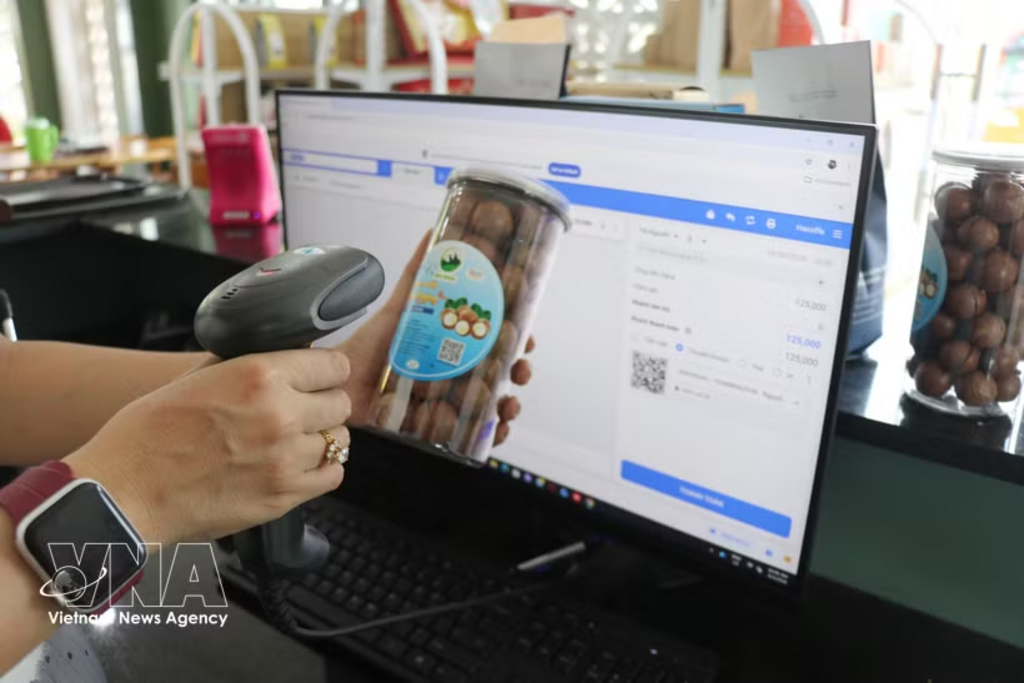
| Agricultural and OCOP products from Nhan Co commune in Lam Dong province have their information digitised, are labelled with QR codes for traceability, and put on e-commerce platforms__Photo: VNA |
Nearly one month after Vietnam's Law on E-commerce took effect, businesses, online platforms and digital content creators are adjusting to a new regulatory environment that places greater emphasis on transparency, accountability and law compliance.
Instead of focusing mainly on protecting consumers as previously, the law clearly defines the legal responsibilities of all participants in the digital marketplace, including e-commerce platforms, businesses, online sellers, key opinion leaders (KOLs), key opinion consumers (KOCs) and affiliate marketers.
Under the new rules, product promotion must be based on verified information and legal documentation rather than exaggerated marketing claims.
Vo Truong Duy, a content creator and affiliate marketer, said every product featured in a livestream session is now checked against product registration documents, labels, distributors and advertising regulations before being introduced to consumers.
Content creators also noted that absolute claims such as "100-per-cent effective" or "guaranteed cure" are no longer acceptable. Reviewing legal documents before each livestream session not only reduces compliance risks but also strengthens the credibility of both creators and businesses.
The changes extend beyond livestream sales. Companies say the new law has reshaped their entire e-commerce operations, from seller identification and product traceability to tax management and information disclosure.
Dang La Huy, head of e-commerce operations at Cocoon Vietnam, said compliance now begins during product development and continues through quality testing, packaging and product descriptions.
Previously, companies only needed to provide products to influencers for promotion. Today, both businesses and content creators must carefully verify every piece of information before publishing it online, he said.
Businesses have also welcomed stronger cooperation between platforms and regulators to combat counterfeit goods and intellectual property violations.
Nguyen Huu Tho, an e-commerce representative of Be' Balane Vietnam, said improved complaint mechanisms on e-commerce platforms and stricter legal requirements have made it easier to detect and remove counterfeit products while protecting legitimate businesses.
For his part, Nguyen Huu Tuan, Director of the E-commerce and Digital Technology Development Centre under the Ministry of Industry and Trade's Agency of E-commerce and Digital Economy, noted digital platforms have actively upgraded their systems to comply with the new law. Major platforms have strengthened product monitoring, enhanced seller verification, improved transaction data storage and introduced more transparent complaint-handling procedures for consumers.
He said the ministry is also stepping up public awareness campaigns so that platforms, businesses and consumers fully understand their rights and obligations.
Nguyen Lam Thanh, a representative of TikTok Vietnam, said seller and content creator verification is one of the law's key requirements. TikTok Shop and other major platforms have begun deploying technical solutions to verify millions of seller accounts in line with the law enforcement roadmap.
In addition to verifying sellers' identities, they are required to monitor product quality, handle consumer complaints and establish automated mechanisms to detect products that violate platform rules or Vietnamese law.
Thanh added that consumer trust in sellers and content creators is essential to the long-term growth of e-commerce, making efforts to eliminate counterfeit goods and misleading products both a legal obligation and a business necessity. Sellers who repeatedly violate platform rules or Vietnamese law may face sanctions, including permanent removal from the platform.
The regulatory changes come as Vietnam's e-commerce market continues to expand rapidly.
According to market research firm Metric, the sector grew by 20–22 per cent in the first half of 2026. Revenue generated by the country's four largest e-commerce platforms exceeded VND 291 trillion (USD 11 billion), up 44 per cent year-on-year. Although official brand stores account for fewer than 3 per cent of all online shops, they generated more than one-third of the market's total revenue.- (VNA/VLLF)