 |
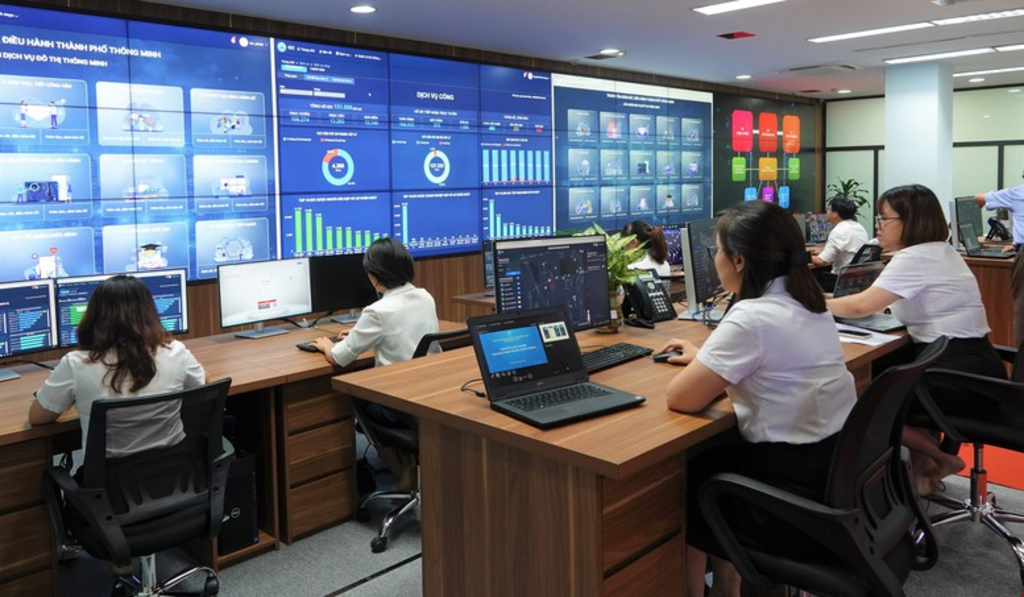
| Inside an intelligent operation centre (IOC) of Da Nang City__Photo: VNA |
Fines of up to VND 120 million for data collection violations involving sensitive information leaks
Effective on November 11, Government Decree 363/2026/ND-CP on administrative sanctions in the field of data introduces fines of up to VND 120 million for organisations whose violations of data collection or creation regulations result in the leakage of sensitive information.
Under Article 8.2.dd of the decree, individuals face fines of between VND 40 million and VND 60 million for such violations where the disclosure affects the lawful rights and interests of organisations or individuals, or national security.
Fines for organisations are twice those applicable to individuals, meaning that offending organisations may face fines of between VND 80 million and VND 120 million.
In addition to fines, violators may have their database management and operation activities suspended for six to nine months.
Foreign employers required to publicise recruitment of Vietnamese workers
Coming into force on November 15, Government Decree 371/2026/ND-CP requires foreign organisations and individuals in Vietnam seeking to recruit Vietnamese workers to publicise recruitment information through the National Employment Exchange at www.vieclam.gov.vn, another lawful employment portal or the recruiting organisations' official websites.
Under Article 6 of the decree, foreign organisations and individuals must notify the competent management authorities of their recruitment needs in writing, specifying the positions and number of workers to be recruited. Notifications may be submitted in person, by post, online or via the official email addresses of the competent agencies or organisations.
Foreign organisations and individuals may recruit Vietnamese workers directly or request assistance from competent management authorities in recruiting suitable candidates.
New procurement rules under major trade agreements
Taking effect on November 14, Government Decree 374/2026/ND-CP provides guidance on procurement under the Comprehensive and Progressive Agreement for Trans-Pacific Partnership (CPTPP), the EU-Vietnam Free Trade Agreement (EVFTA) and the UK-Vietnam Free Trade Agreement (UKVFTA).
The decree applies to procurement packages that meet the applicable value thresholds and requirements concerning procuring entities and covered goods and services, as specified in Appendices I, II and III. The packages must not fall into the cases of exclusion stated in Article 1 and the appendices.
Under the decree, eligible bidders may participate independently or as members of a consortium. They must meet the relevant eligibility requirements under the Bidding Law and must not be subject to a bidding ban currently in force that is imposed by a state agency or competent authority in any country or territory.
For open bidding, the minimum bid preparation period is generally 30 days, or 25 days where bids are submitted electronically. Under Article 9 of the decree, this period may be shortened to 10 days in urgent cases where the standard period is impracticable. The shorter period also applies to procurement packages valued at no more than VND 10 billion for commonly available goods with standardised technical specifications and equivalent quality, or for common, simple non-consulting services.
Updated securities settlement rules for foreign investors
Effective on November 16, Ministry of Finance Circular 145/2026/TT-BTC will replace Circular 119/2020/TT-BTC on securities registration, depository, clearing and settlement.
The circular sets out clearing and settlement arrangements applicable before and after the introduction of a central counterparty (CCP) mechanism for shares, fund certificates and covered warrants traded on the securities trading system. However, its entry into force does not necessarily mean that the CCP mechanism will become operational on the same date.
Under the CCP mechanism, clearing members will be responsible for assessing and determining initial cash margin requirements for purchases of shares and fund certificates by foreign institutional investors and certain domestic institutional investors.
For purchases of covered warrants, all investors will be required to provide an initial cash margin equivalent to the value of the intended transaction.
The circular also permits custodian banks other than clearing members to provide securities settlement services to their clients through coordination with general clearing members, subject to the registration and coordination requirements set out in Article 33.
Revised customs procedures for postal and express shipments
Coming into effect on November 16, Ministry of Finance Circular 142/2026/TT-BTC revise customs procedures for goods sent through designated postal operators and international express delivery services. The circular amends regulations on customs dossiers, declarations, shipment classification and the payment of taxes, charges and fees.
For international express shipments in Groups 1 and 2, which generally cover documents without commercial value and certain low-value goods, customs declarants must complete electronic identification and authentication procedures in accordance with relevant regulations. When carrying out customs procedures for Group 2 shipments on behalf of cargo owners, declarants must notify senders of exported goods or recipients of imported goods to enable them to coordinate with customs offices in completing electronic identification and authentication procedures.
Express delivery enterprises may pay taxes, fines, late-payment interest, assessed taxes, customs charges and transit fees on behalf of cargo owners. Where advance payments are made into the customs authority's deposit account held at the State Treasury where a declaration is registered, the amounts payable for that declaration will be deducted from the prepaid amount on such account's balance to facilitate customs clearance or release of the goods.
The circular also updates customs declaration forms and electronic data submission requirements.- (VLLF)