Vu Van Anh
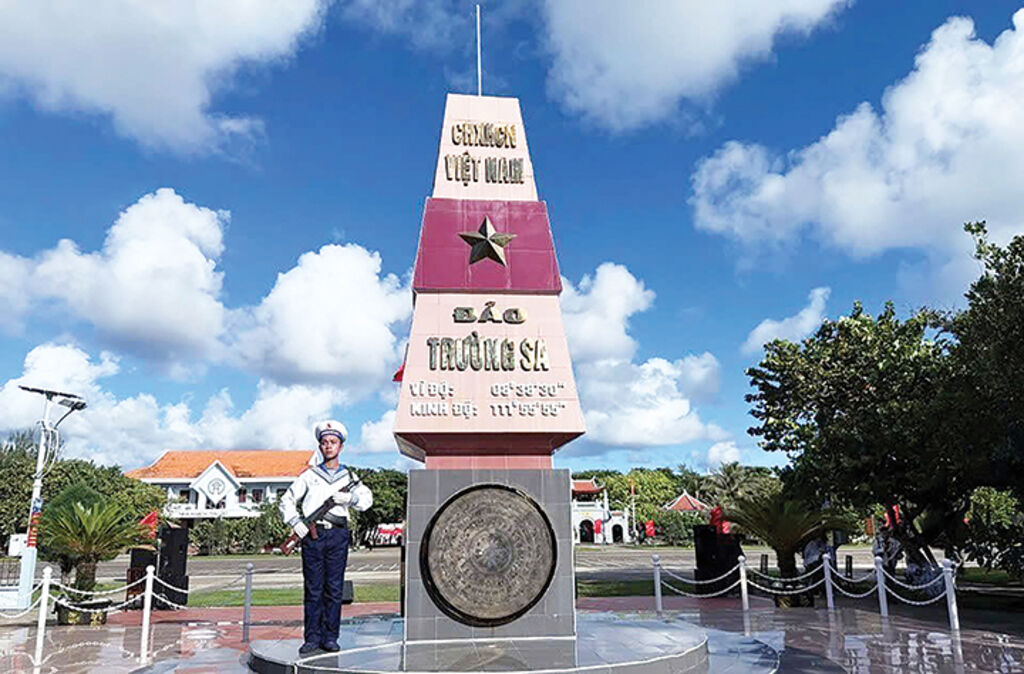 |
| A soldier stands guard at a sovereignty marker on Truong Sa island, Truong Sa special zone, Khanh Hoa province__Photo: VNA |
On July 28, 2026, the 14th Party Central Committee released Resolution 22-NQ/TW on the National Security Strategy (the Strategy), replacing Politburo Resolution 51-NQ/TW dated September 5, 2019. The new resolution reflects a significant expansion in the scope and approach to national security in the context of rapid economic, technological and global environment changes.
The Strategy is formulated through a holistic, comprehensive, proactive and inclusive approach, wherein security safeguarding is aimed not only at responding to traditional threats, but also at ensuring a stable environment for development, enhancing the country’s autonomy and resilience, and protecting citizens, data, technologies and new development spaces. As stated in the Strategy, Vietnam aims to complete several crucial platforms of a modern security system by 2030, and strives to comprehensively develop the capacity to proactively safeguard national security, addressing threats early and from afar by 2045.
Security linked with development
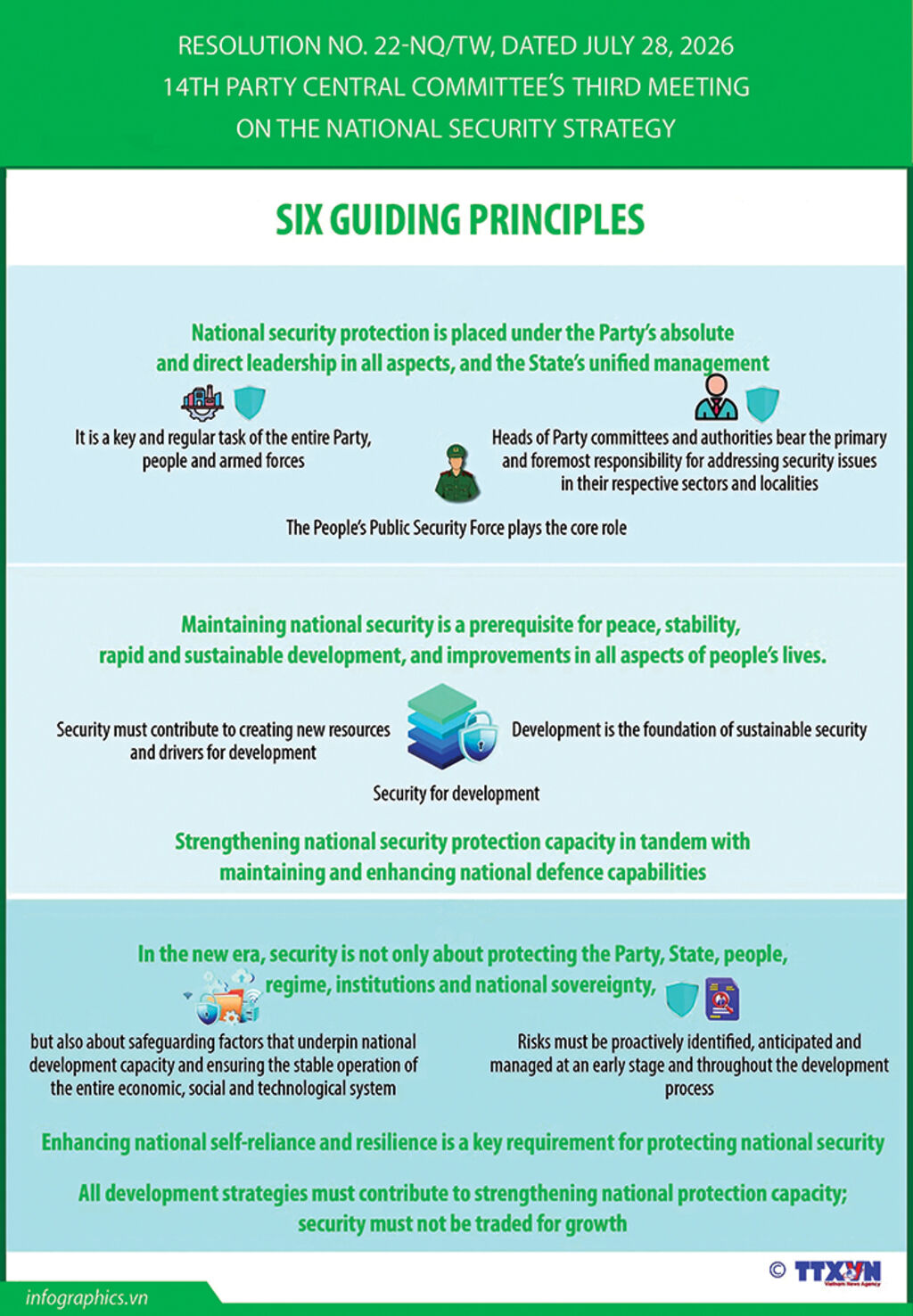
The Strategy gives a notable conception that security and development are closely intertwined and mutually supportive. As per the resolution, firmly maintaining national security is a prerequisite for peace, stability, and rapid and sustainable development, while development provides the foundation for sustainable security. Security requirements must therefore be incorporated from the outset into development strategies, policies, master plans and projects.
The Strategy affirms that national security must never be traded off for economic growth, while demanding higher national autonomy and resilience. Security in the new era encompasses not solely the protection of sovereignty, the political regime and social order, but extends to the fundamental components of national development capacity, ranging from economy, energy and science-technology to data, digital infrastructure and supply chains.
Overall, the resolution outlines an approach of comprehensive, proactive, inclusive and facilitative security. Within this framework, security of the political regime is designated as paramount; cultural, ideological and information-communication security holds special importance; economic, energy, environmental, water source and food security serves as basic foundations; cyber, data and technological security occupies a central position; and human security is defined as the ultimate goal.
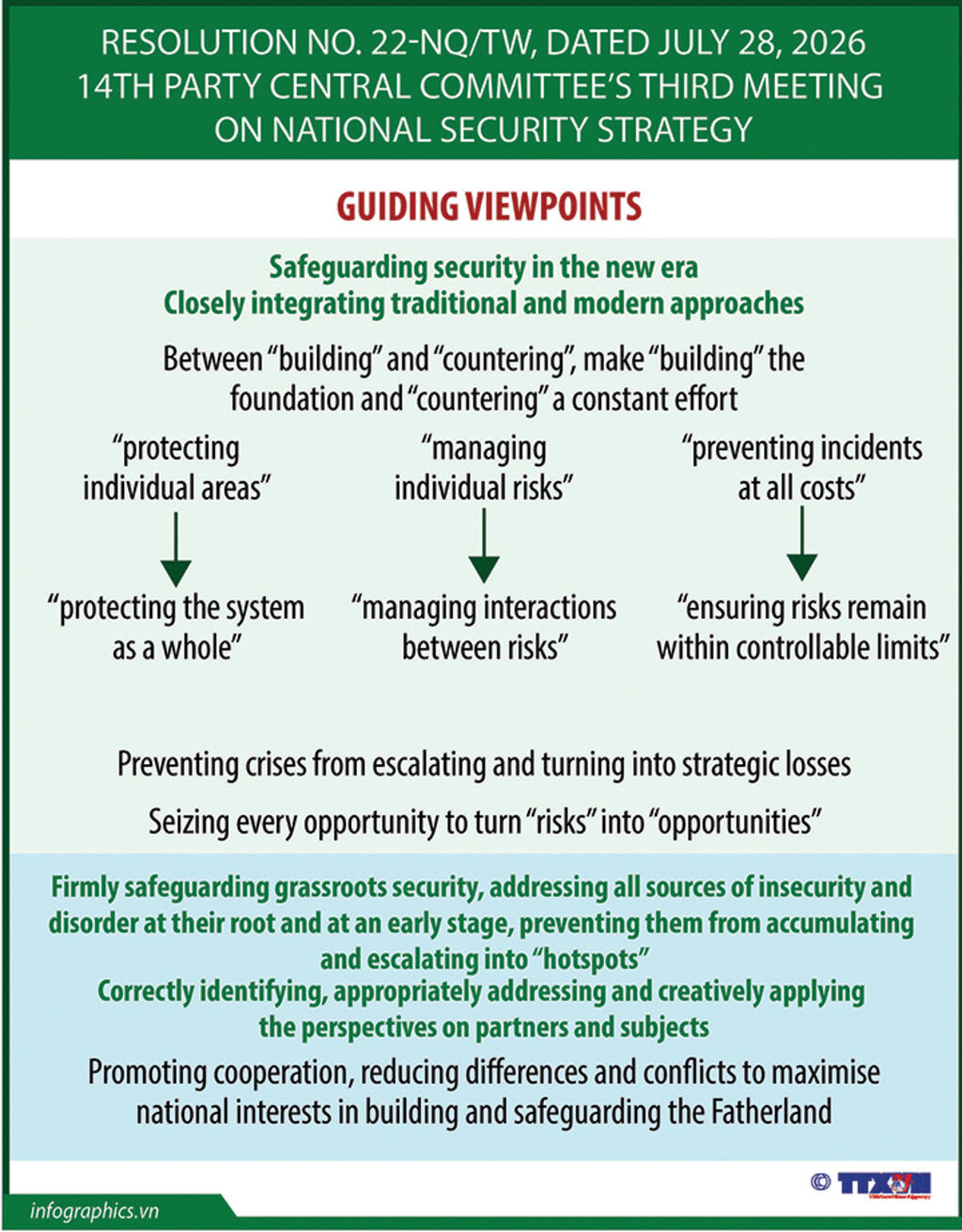
This approach also shows a shift from protecting individual sectors to safeguarding the entire system, and from managing separate risks to governing the interaction among multiple risks. The Strategy emphasises the requirement of preventing risks from exceeding manageable thresholds, and precluding crises from expanding and evolving into strategic losses.
 |
Protecting national interests, humans and development environment as an overarching goal
The overarching objective of the Strategy is to firmly safeguard revolutionary achievements and the supreme national interests; protect the Party, the State, the people, and the socialist regime; and protect, and provide a foundation for successfully implementing the cause of renewal, industrialisation and modernisation, and the Party’s strategic objectives and guidelines.
The Strategy broadens the scope of protecting national culture, prestige and international standing; firmly defending national security, human security, security of the political regime, institutional security, and security in various domains and spaces; and proactively repelling internal factors causing political instability, and those in cyberspace, aerospace, low-altitude spaces, and maritime and oceanic spaces.
It seeks to proactively respond to composite threats, non-traditional security issues, and emerging forms of security infringement; mitigate crisis risks; and defeat the sabotage plots and activities of hostile forces. Thereby, it contributes to building a disciplined, safe, civilised, harmonious and developing society, consolidating public trust, maintaining political and social stability, maintaining regional and global peace, and successfully fulfilling the mission of building and defending the socialist Vietnamese fatherland.
Another crucial objective is to organise security protection in adherence to the principle of “wherever development goes, security must follow”. That means, the guarantee of security must keep pace with the emergence of new industries, technologies, markets, and spheres of activity.
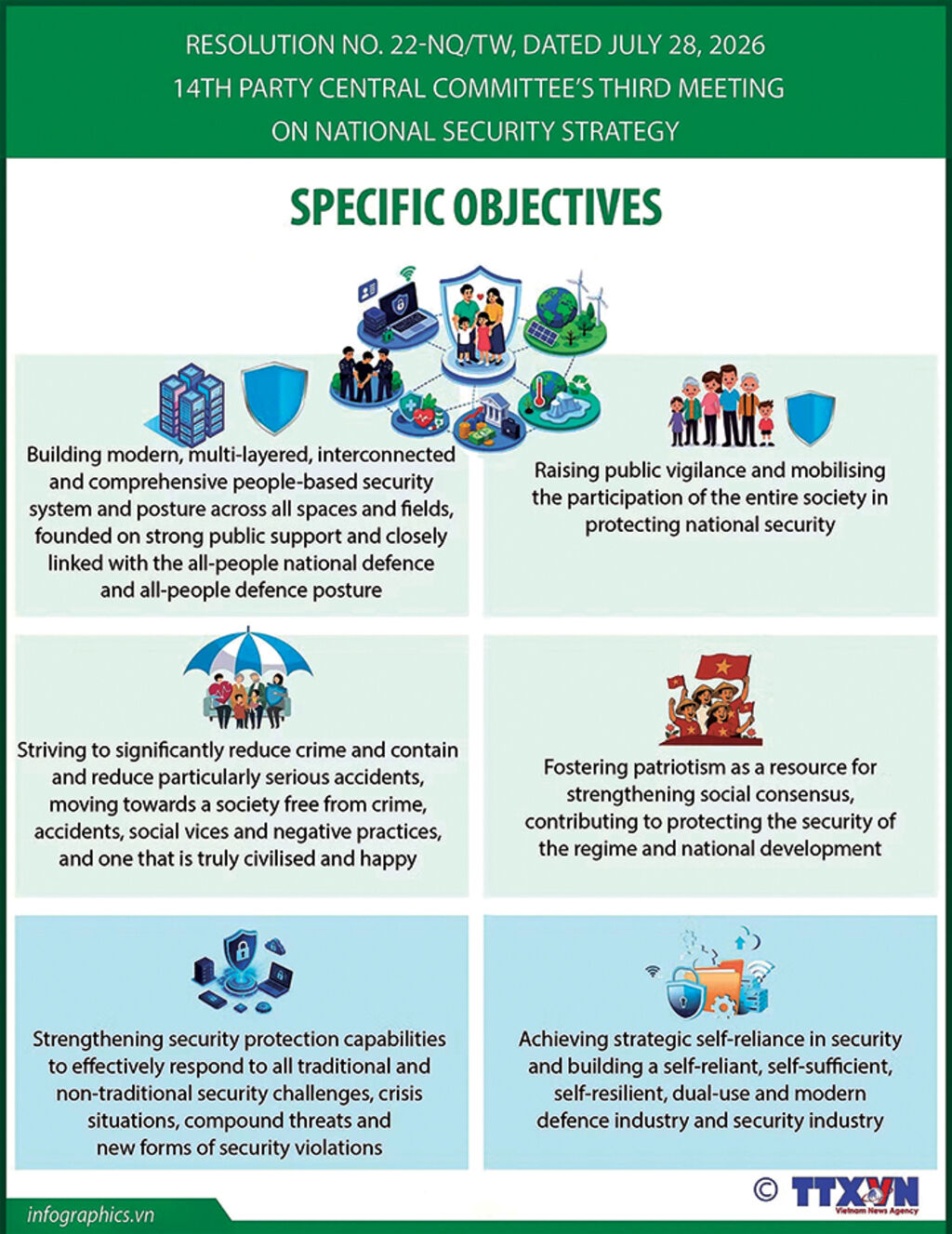 |
The resolution also sets the objective of building a modern, multi-layered and interconnected people’s security posture, tied with the all-people national defence, mobilising societal participation in safeguarding national security. Human security is linked with the objectives of sharply reducing crimes, accidents, and life-threatening risks, while increasing accessibility to social security policies and public services.
On the international plane, the Strategy aims to elevate security-related external relations and international integration to a new height. It promotes the pioneering role of security cooperation in consolidating and strengthening strategic trust between Vietnam and its partners, leveraging external resources, identifying potentials and opportunities, and expanding cooperation in other fields. It helps build the capacity to protect security from afar, enabling Vietnam to become a partner for peace, stability, cooperation and development.
Technologically, the objective by 2030 is to complete the transition to post-quantum cryptography for key digital infrastructure, building the national sovereignty network and protecting the communication network and data system with cryptographic technology capable of addressing the challenges posed by quantum technology.
By 2045, to comprehensive develop the capacity of the national security system; national security will be firmly protected against threats early and from afar in every field and space and eventually become an important resource and motive for development; the index of human security protection will reach the leading group of the region and the world.
 |
Major tasks and solutions
Strengthening the Party’s leadership and the State’s management of national security protection in new era
Efforts will focus on improving mechanisms to guarantee the absolute, direct and comprehensive leadership of the Party over the cause of national security protection. State management efficiency will be enhanced in conjunction with the operation of two-tier local administration system, alongside the strict enforcement of the Constitution and laws concerning national security, while incorporating security requirements from the outset into socio-economic, cultural, environmental and foreign affairs development strategies.
Party Committees and local authorities at all levels will have to strengthen leadership, inspection and oversight of the implementation of the Strategy as suitable to each locality and field, clearly defining the responsibilities of heads of agencies and organisations, and Party members in protecting national security.
Firmly protecting political regime and institutional security
Under the Strategy, protecting security of the political regime is defined as a strategic, vital task, focusing on safeguarding leadership, ideological foundation and strength of the Party and the State, alongside the leadership over socialist-oriented market economy, law making and enforcement, the armed forces.
The Strategy aims to ensure the absolute safety for leaders and dignitaries, tighten the management of strategic-level cadres and elite personnel, and promote regular screening and elimination of risks to political regime and institutional security.
It entails building transparent and adaptive institutions capable of preventing and addressing corruption, abuse of power, conflicts of interest and external impacts; enhancing the safeguarding of the Constitution and law; stepping up the prevention and combat of corruption, waste and negative practices; and raising effectiveness of inspection, supervision, and handling of violations, and addressing ethics deterioration.
It promotes the reform of mass mobilisation and public communication work and the role of the people in detecting and providing information about acts threatening security of the political regime.
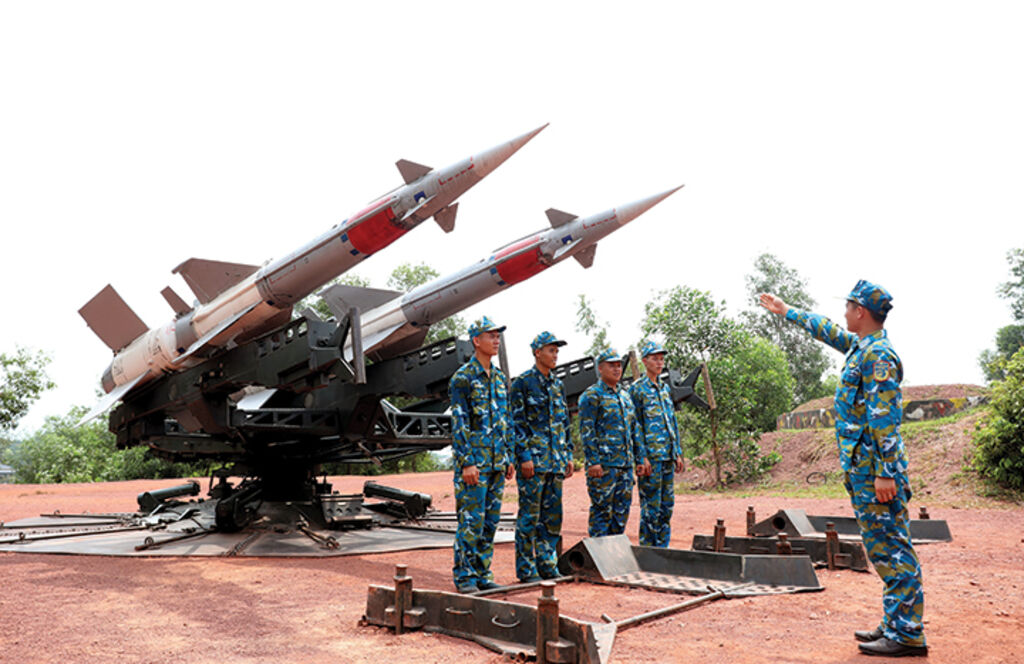 |
| A joint operations training exercise at Battalion 124, Missile Regiment 284, Division 365 Photo: Danh Lam/VNA |
Enhancing strategic forecasting capacity and proactively preventing security risks
The country should remain steadfast in its foreign policy of independence, self-reliance, multilateralisation and diversification, consistently upholding the “no-alignment” principle and the “Four-Nos”[1] national defence policy and keeping balance in external relations. Diplomatic, legal, external media tools will be prepared to maintain the proactiveness in national interests-related issues.
The Strategy requires establishment of modern information collection and analysis systems integrating multi-sectoral, multi-layer data to identify global strategic shifts early and forecast security risks. This involves building strategic reserve zones and reserves for pivotal manufacturing industries in order to maintain core national capabilities during crises.
Proactively addressing complex factors at the grassroots level
The nation will elevate counter-espionage work, from traditional political, military and diplomatic spheres to technology, critical infrastructure and scientific research.
The Strategy necessitates the strict implementation of regulations on internal political protection; enhanced protection of confidential and essential forces and cadres who personally give advices on guidelines and policies; and tightened control of smart devices used by these forces. It aims at enhancing cyber, data and information security at state agencies and Vietnamese overseas missions and in technological products with latent risks; and regularly screening and addressing loopholes in important information systems and databases.
It aims to consolidate the security posture in strategic regions, border areas and islands, intensify counter-terrorism, immigration management and border-gate control; ensure religious and ethnic security in adherence to the “four on-the-spot” motto[2]; prevent and combat reactionism and instigation of secession and autonomy; and proactively safeguard security and social order in unexpected circumstances.
Ensuring security for emerging spaces and fields
Priority will be given to investment in confidentiality infrastructure and national cybersecurity systems to protect critical technical and information infrastructure, digital and data sovereignty, and cross-border data flows. The country will develop cyber offensive and defensive capabilities, establish the post-quantum internal network and sovereign network, and complete regulatory framework governing security of AI research, development and application through their lifecycles. Early warning systems, online anti-fraud centres and emergency asset freezing mechanisms will be established.
Mechanisms for coordination among security, military and civil forces in cyberspace will be improved; the National Cybersecurity Steering Committee and the taskforce will play a more proactive role in preventing cyber warfare and protecting important digital infrastructure; post-quantum cryptography will be commissioned for e-government, financial and banking sectors, and key infrastructure.
Security protection strategies will be formulated for new spaces such as outer space, low-altitude space, subterranean space, and sea and ocean space. At the same time, it is necessary to reinforce cultural-ideological security to prevent cognitive and information warfare; and adopt national strategies for digital communication, information verification platforms, and dialogue and accountability mechanisms.
Proactive response to crises will rest with the Crisis Coordination Centres and the Emergency Response Forces under the civil-security-military cooperation mechanism, while ensuring secure and uninterrupted communication and coordination among state media, press and social media. Post-crisis resilience and response to mixed and non-traditional security threats will be enhanced with a flexible and adaptive security management mechanism.
Safeguarding economic, energy, water and environmental security
Economic security will be consolidated by strengthening strategic autonomy, maintaining macroeconomic stability, preventing crises, and maintaining financial-monetary security. A national reserves strategy will be formulated to mobilise resources from enterprises in the state and private sectors, combining physical reserves, emergency procurement and resource coordination.
It is a need to renovate the development model for increasing economic resilience. The state economy will be developed into an anchor for economic security and sovereignty, positioning the private economy as a crucial driver and making science, technology, innovation and digital transformation the primary growth drivers. At the same time, technology and data security will be ensured in strategic industries.
Energy security thinking will shift from mere “adequate supply” to “safety, stability, autonomy and sustainability”; reducing dependence on fuel imports, technology and supply chains; and prioritising exploration of advanced nuclear technologies like small modular reactors.
The risk of resource depletion will be managed; water, food and agricultural security protected; rare earths strictly managed; new materials developed; and marine and island resources sustainably exploited in alignment with national defence, security and sovereignty. The legal framework for the space economy, low-altitude economy and aviation industry will be improved.
It is also necessary to improve the implementation efficiency of trade agreements; and expand cooperation with intertwined economic interests on the basis of international law and mutual benefit, while paying attention to workers’ welfare. It is required to prevent the abuse of economic cooperation for policy profiteering, creation of dependency and instigation of instability together with proactive response to trade wars. Meanwhile, strategic assets, supply chains, state-owned and flagship businesses will be protected against financial risks, economic espionage and foreign takeovers.
Better protecting human security and fostering the people’s support
A comprehensive national framework on human security will be completed to guide policy coordination, identifying priority fields and including the content on human security in development strategies.
Human protection will be enhanced in response to non-traditional security challenges and in cyberspace; and flexible societal protection mechanisms will be implemented. Human security will involve mitigating crimes, traffic accidents, food and pharmaceutical safety risks, and environmental pollution; developing national social network platforms; and strictly handling acts infringing upon human security and cultural security in cyberspace.
The social security system will be improved to cover vulnerable groups, with more and more expenditures for social welfare, pension and human investment. Integrity within the political system will be fostered, capable of combating waste and corruption. Every citizen will become a “security link” through mass mobilisation and the “All People Protect National Security” movement.
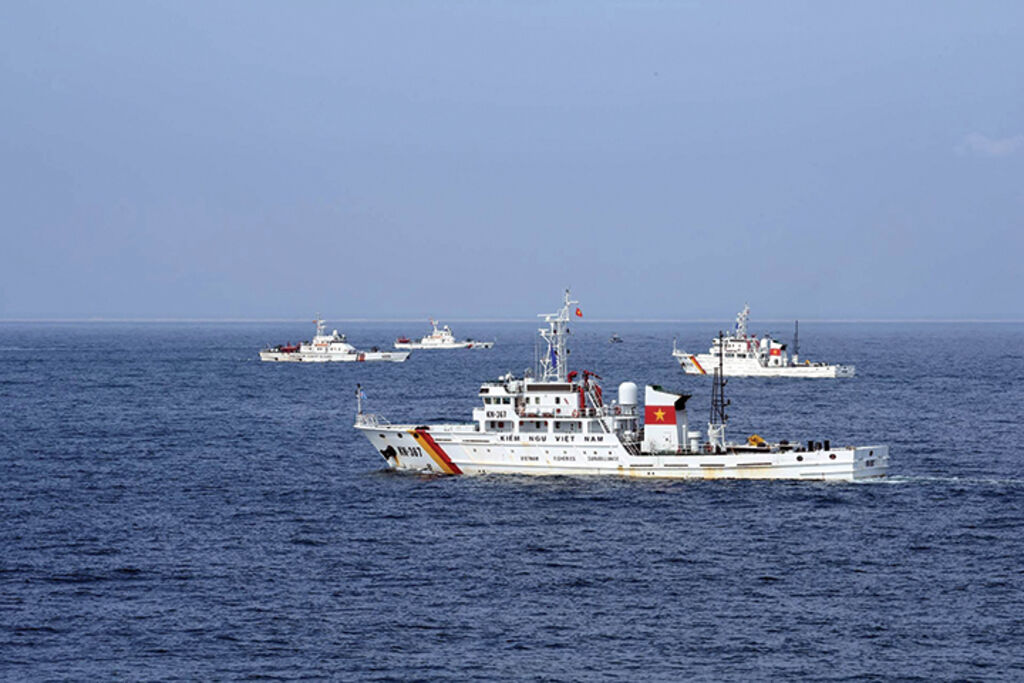 |
| Vessels of Coast Guard Region 2 conduct training at sea during a tactical exercise and live-fire drill held on September 14-22__Photo: VNA |
Promoting security-related foreign relations and international integration
The country will expand balanced and flexible security cooperation with important partners, maintaining security dialogue, and actively engaging in regional and global security mechanisms and forums, with priority given to non-traditional security.
National defence, security, intelligence and police cooperation will be promoted to elevate Vietnam’s role in preventive diplomacy, crisis control, mediation and conciliation in areas where Vietnam holds strengths such as cybersecurity, search and rescue, and peacekeeping. Solutions will be devised to enhance ASEAN’s capacity to respond to regional security challenges.
Vietnam will coordinate with ASEAN member states in proposing initiatives on emerging security issues; and promoting rules and standards on AI, cyberspace, digital transformation, cross-border data sharing, and technology ethics. Other cooperation activities will cover organising international cybersecurity dialogues and drills; participating in cyber defence cooperation; and building a regional security and political coordination centre in Vietnam as well as “co-leading” and “indirectly leading” models within ASEAN.
More military, civilian and public security forces will be deployed to participate in peacekeeping and multilateral cooperation activities. Cooperation in combating transnational organised crime and cybercrime will be expanded. International legal frameworks will be promoted to protect the interests, security and safety of Vietnamese citizens abroad. In addition, international resources will be exploited to enhance national security potential and develop the security industry.
Modernising specialised forces and developing the security industry
The country will improve the system of laws, mechanisms and policies on national security and human security; revise existing legal documents and formulate new ones to fully institutionalise the Party’s viewpoints on the National Security Strategy.
It will build the people’s armed forces that are revolutionary, regular, elite and modern, embodying the motto “most disciplined - most loyal - closest to the people”; develop specialised forces to protect security in new spaces and domains. Breakthrough mechanisms will be established in training high-quality human resources, especially in cybersecurity, data and core technologies.
Resources will be mobilised to modernise specialised forces and increase security potential; mechanisms that enable allocation of local budget funds for modernisation projects will be implemented, focusing on reforming expenditure structures and promoting investment in physical foundations.
Security protection tools will be modernised, focusing on intelligence, cybersecurity, data, financial risk monitoring, early warning, and crisis management. Priority will be given to multi-layered warning, biometric control, border monitoring, anti-fraud technology, cyber defence, building of “in-depth logistics”, and provision of appropriate equipment for specialised forces.
An autonomous, self-reliant, dual-use and modern national defence and security industry will be built to serve as a spearhead of national industry and participate in the global value chain. Shipbuilding industry and supporting industries will be developed to serve maritime and ocean security. Investment incentives will be provided for national defence and security products and services. Particularly, the National Strategy for Dual-Use Infrastructure will be issued to define priorities and roadmaps for integrating national defence, security and civilian sectors, with more and more resources provided for dual-use technology and equipment.
Great importance will be attached to the summarisation of practical experience, development of theories, and completion of the doctrine of national security protection. Especially, it is required to clarify scientific grounds for addressing non-traditional security challenges, threats, and emerging forms of security infringement, and for designing solutions.-
[1] Four Nos include: not joining military alliances; not collaborating with one country to oppose another; not allowing foreign countries to set up military bases or use the territory of Vietnam to oppose other countries; and not using force or threatening to use force in international relations.
[2] “Four on-the-spot” motto in disaster preparedness means on-the-spot command, on-the-spot forces, on-the-spot equipment and supplies, and on-the-spot logistics.