 |
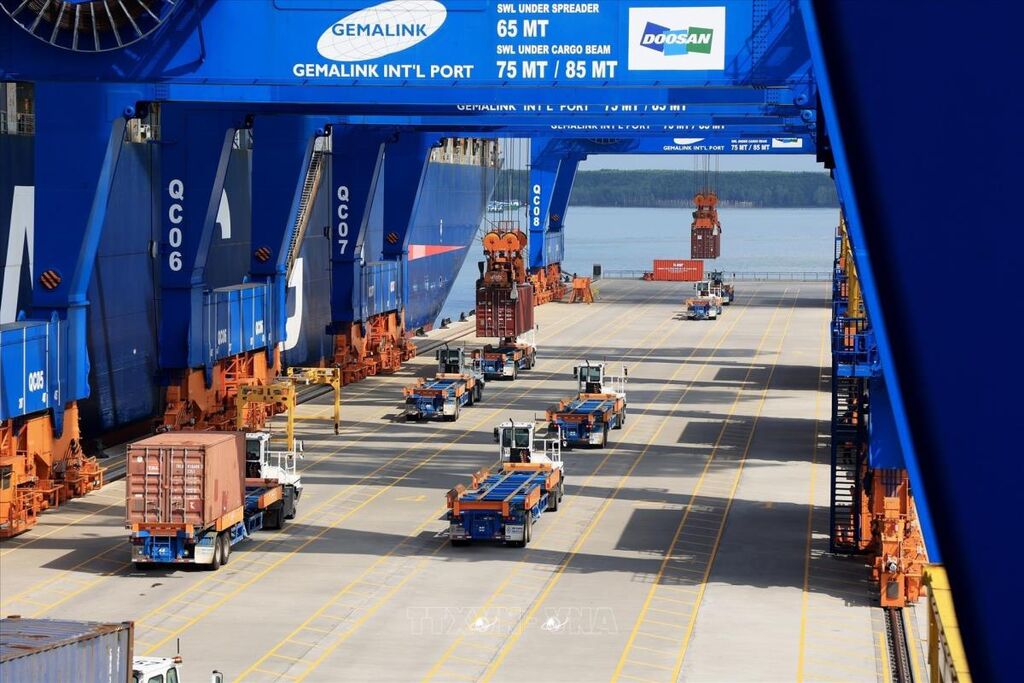
| Articulated lorries carrying import and export goods at Gemalink International Port __Photo: VNA |
Revised regulations on cross-border trade
Replacing Decree 69 of 2018 guiding the Law on Foreign Trade Management, Decree 292/2026/ND-CP introduces revised provisions for import and export businesses, including temporary import for re-export; temporary export for re-import; border-gate transfer; transit; and goods processing involving foreign elements, which come into force on September 5.
The decree says that provincial-level People's Committees are vested the authority to issue licenses for temporary import, re-export and border-gate transfer. Specifically, the licensing agencies must issue a license within five working days after receiving a complete and valid dossier, or state the reason for refusal of the issuance.
As for businesses, Vietnamese enterprises are permitted to carry out goods processing for foreign traders and may also rent or borrow machinery and equipment from the processing-ordering partners to support production activities.
In order to help complete the legal framework on cross-border trade activities, the decree allows enterprise to provide the service of transporting goods in transit if they have registered business lines in freight forwarding.
Fines of up to VND 200 million for crypto market-related violations
From September 1, individuals and organisations committing violations in the field of crypto assets and crypto asset market in Vietnam will face administrative fines of up to VND 100 million and VND 200 million, respectively.
Such penalties are specified in Government Decree 284 issued on July 16.
Under the decree, the unauthorised collection, storage, exchange, trading, donation or disclosure of crypto asset account data and information may be fined VND 150-200 million. In addition, violators may face suspension of their crypto asset trading activities for between one month and three months and must refund all illicitly obtained profits.
Those failing to identify, update or verify customer information will face fines of VND 100-120 million. The fine level of VND 200 million will apply to those failing to issue internal regulations against money laundering.
Alongside fines, additional sanctions and remedial measures may be applied, including revocation of licences, cessation of offering or trading activities for up to 12 months, compulsory recall and cancellation of issuance tranches, refund to investors, and return of all illegal profits.
Stricter penalties for delayed payment of salaries
Taking effect on September 10, Decree 283/2026/ND-CP releases penalties for violations related to late payment of wages, under which businesses delaying payment of salaries to employees will face fines of up to VND 100 million.
Under the decree, employers who fail to pay wages on time, fail to pay wages, pay wages lower than the agreed amounts, or fail to pay for overtime, night work or work cessation will be fined based on the number of affected workers. Fines applicable to organisations are double those imposed on individuals, ranging from VND 10 million for violations involving one employee to 10 employees to a VND 100 million for cases involving 301 or more employees.
The decree also sets specific fines for enterprises paying workers below the minimum wage. Accordingly, organisations will be fined VND 40-60 million for violations involving one employee to 10 employees, VND 60-100 million for violations involving 11-50 employees, or VND 100-150 million for violations involving 51 or more employees.
In addition to fines, non-compliant enterprises are required to pay all outstanding wages and interest on late-paid or underpaid amounts.
Amended provisions on management of cottage industry zones
 |
| Diem Thuy industrial park in Thai Nguyen province __Photo: VNA |
Under Decree 303/2026/ND-CP, which will take effect on September 15, every cottage industry zone must cover an area of between 5 hectares and 75 hectares.
The decree standardises definitions of new types of cottage industry zones, e.g., craft village, specialised cottage industry zone, supporting cottage industry zone, hi-tech cottage industry zone, and ecological cottage industry zone. Crucially, it introduces incentives and investment attraction policies for small- and medium-sized enterprises, hi-tech firms, innovative start-ups, and polluting industrial facilities subject to relocation.
Conditions for establishing commodity exchanges
Effective as of September 15, Decree 302/2026/ND-CP, which details a number of articles of the Commercial Law, introduces stringent rules for commodity exchanges in Vietnam.
Under the new regulations, an enterprise wishing to establish a commodity exchange must possess a charter capital of at least VND 1.5 trillion, with the foreign holding cap at 49 per cent. It must also have information technology infrastructure that meets requirements for management, confidentiality and safe operation.
In addition, the decree tightens the requirement on charter capital for trading members and brokerage members, which must be at least VND 75 billion and at least VND 5 billion, respectively.
Notably, the decree requires a clearing centre to have a minimum capital of VND 500 billion, and sets out regulations on international transactions and management measures in emergency situations to ensure market safety and transparency.
Abolition of 25 tax-related legal documents
The Ministry of Finance has issued Circular 110/2026/TT-BTC, officially abolishing 22 Circulars and three Decisions issued by the Minister of Finance in the tax sector.
Accordingly, the circular abolishes guiding documents on tax incentives that are no longer appropriate, including tax incentives for software enterprises; support policies for raw-material areas and the processing of agro-forestry-fishery products; as well as previous regulations on agricultural land-use tax and royalty tax.
It also annuls legal documents on temporary tax exemption, reduction and extension, alongside tax debt write-offs for former individual business households.
The circular also abolishes documents on enforcement of tax-related administrative decisions, issuance of enterprise identification numbers and imported alcohol stamps.
Recognition of foreign diplomas
 |
| All procedures for recognising diplomas awarded by foreign education institutions will be conducted entirely online __Photo: VNA |
From September 26, all procedures for recognising diplomas awarded by foreign education institutions will be conducted entirely online via the National Public Service Portal, under Circular 65/2026/TT-BGDDT issued by the Ministry of Education and Training.
Noteworthily, the circular provides stricter criteria for the recognition of foreign doctoral degrees. Accordingly, a doctoral degree awarded for a person trained at a foreign education institution and conducting field research in another country will be recognised if it complies with regulations and the study period at the foreign education institution is at least 12 months throughout the course.
Expanded foreign-currency account transactions for foreign credit institutions
State Bank Circular 39/2026/TT-NHNN, to be effective on September 19, introduces updated regulations on accounts opened by residents and non-residents at authorised banks in Vietnam.
Accordingly, non-resident foreign credit institutions may use foreign-currency and Vietnam-dong accounts to make payments and international transfers for customers under written agreements with authorised banks, while conducting collection and payment transactions under regulations.
Authorised banks must retain supporting documents, ensuring that transactions are conducted for proper purposes and compliance with regulations on cashless payment, foreign exchange management and money laundering prevention.- (VLLF)