Vu Van Anh
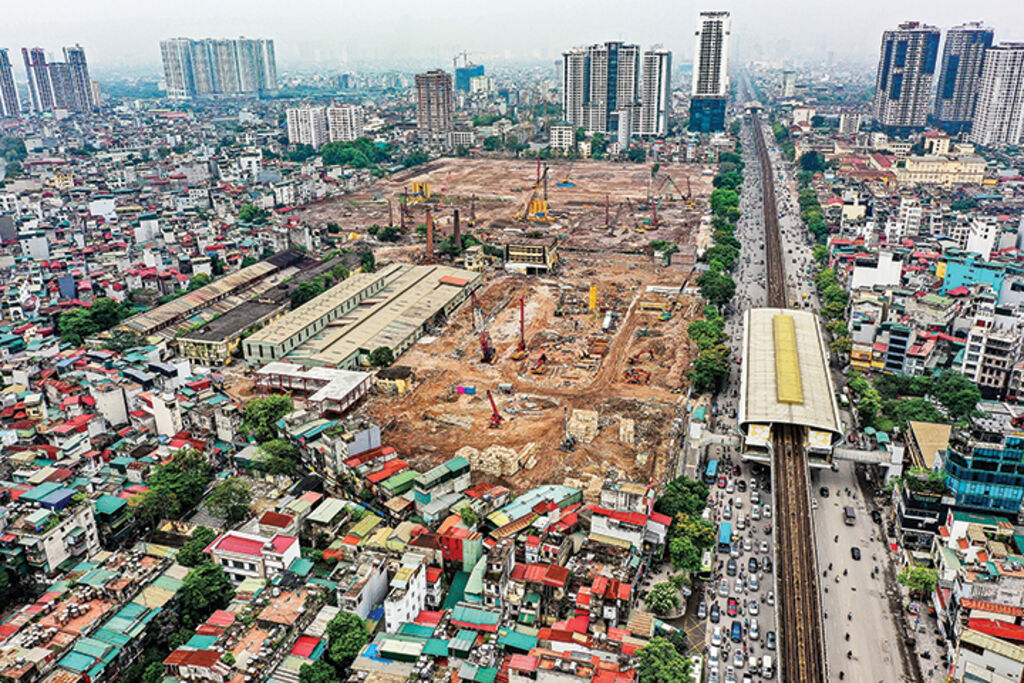 |
| A former industrial site in Hanoi is being redeveloped into a high-rise commercial, service and residential complex__Photo: Trung Nguyen/VNA |
On July 28, the Central Committee of the Communist Party of Vietnam issued Resolution 21-NQ/TW, setting out key policy directions for revising the Land Law and related legislation.
The resolution replaces Resolution 18-NQ/TW dated June 16, 2022, of the 13th Central Committee, on continuing to renew and improve institutions and policies, and enhancing the effectiveness and efficiency of land management and use, thereby creating momentum for Vietnam to become a high-income developed country.
Over the past four years, many policies under Resolution 18 have been institutionalised in the Land Law, the Housing Law, the Law on Real Estate Business and other laws. These reforms have helped improve state management work, strengthen the protection of lawful and legitimate rights and interests of land users, and unlock land resources for development.
Despite this progress, land remains one of the most challenging spheres of management, with persistent bottlenecks and continued risks of complaints and denunciations, losses, waste, corruption, misconduct and vested interests. Some mechanisms and policies remain inadequate and have yet to fully unlock land as a development resource.
Against this backdrop, Resolution 21 reaffirms the fundamental principles established under Resolution 18. The 14th Central Committee upholds the principle that “land belongs to the entire people, with the State acting as the owner’s representative and uniformly managing it”. It also states that “land may absolutely not be privatised” and that “foreigners may neither acquire nor transfer land use rights in any form, except persons of Vietnamese origin residing abroad”.
These principles set a clear policy direction on land use rights in Vietnam, particularly the distinction between the rights of Vietnamese citizens and those of foreigners, and are expected to guide the forthcoming revision of the Land Law and relevant legislation.
At the same time, Resolution 21 introduces new approaches that signal a significant shift in the State’s thinking on land governance as Vietnam enters a new stage of development.
Reforming land valuation
Perhaps the most significant change introduced by Resolution 21 is its approach to land as a source of national competitive advantage that should be effectively governed, rather than simply a resource to be exploited. From this perspective, land prices are not merely a measure of asset value but also an important input cost for the economy.
The resolution sets out a clear direction for reform: The State is to regulate, control and determine land prices based on development objectives in each period, with a view to keeping input costs for production and business at reasonable levels and improving the economy’s competitiveness. Land valuation, appraisal and price determination must be based on reliable data and scientific methodologies and carried out in an open and transparent manner. Land data are also to be integrated with relevant sectoral databases to prevent price manipulation and the creation of artificial prices.
This marks a switch away from viewing land valuation primarily through the lens of market prices. Resolution 21 instead calls for a more data-driven, transparent valuation mechanism that supports the efficient use of land resources while narrowing the scope for speculation.
Commenting on the change, Prof. Dang Hung Vo, former Deputy Minister of Natural Resources and Environment, said Resolution 21 takes a different approach to land pricing from Resolution 18.
While Resolution 18 focused on abolishing the land price framework and developing land price tables that more closely reflected market prices, Resolution 21 places greater emphasis on using land price tables together with adjustment coefficients to determine land value in line with socio-economic development requirements, he said.
According to the professor, the shift partly shows a weakness in Vietnam’s real estate market: the lack of a comprehensive and reliable database of actual transactions. Transfer prices stated in contracts do not always reflect the prices actually paid, leaving market-price data incomplete even though such information is a key input for land valuation. Without reliable transaction data, he noted, even widely used market-based valuation methods may fail to produce accurate results.
To support the new approach, Resolution 21 requires the national land information system to be developed in a centralised, unified, modern and multi-purpose manner and connected with databases on planning, taxation, notarisation, banking and real estate.
Protecting people’s interests in land recovery and resettlement
Resolution 21 asks for a balance of interests, fewer complaints and disputes, stable livelihoods for people affected by land recovery, and faster project implementation with regard to cases involving land recovery. It also requires clearer criteria and scope for land recovery in case it is genuinely necessary for national defence and security, or for socio-economic development in the national or public interest.
Notably, the resolution allows the State to recover the remaining land area needed for a project if the investor has reached agreements covering most of the project area and secured the consent of the vast majority of land users within it.
At the same time, Resolution 21 signals a significant change in the approach to compensation and resettlement. Rather than focusing solely on “compensating for recovered assets”, the policy direction is towards “rebuilding people’s lives when the State recovers land”, with better conditions for livelihoods, housing and infrastructure.
The aim is to strengthen public confidence and ensure that affected people can rebuild stable and sustainable lives after relocation. Compensation, support and resettlement projects are also to be implemented as separate projects in advance, helping speed up the overall progress of investment projects.
To put these orientations into practice, the revised Land Law should clearly define criteria for land recovery; the ratio of land area and the proportion of land users whose consent is required before the State may recover the remaining land area of a project; relevant procedures, decision-making authority and implementation responsibility; the principles and measures for rebuilding affected people’s lives; and the responsibilities of local authorities for providing infrastructure, essential services and livelihood support in resettlement areas.
Clear rules in these areas will be essential to remove bottlenecks in project implementation and safeguard the lawful and legitimate rights and interests of affected people, while reducing the risk of further complaints and disputes.
Curbing speculation and regulating land value gains
While the provisions on land recovery demonstrate a stronger focus on protecting people’s interests, anti-speculation measures provided in Resolution 21 highlight the State’s broader role in regulating the land market.
Previously, Resolution 18 had called for higher taxes on those who use large areas of land, own multiple homes, speculate in land, delay putting land into use or leave it unused. Resolution 21 now retains this approach but goes further by combining taxation with other economic instruments so that the cost of holding land for speculative purposes outweighs the potential gains.
Resolution 21 also seeks to regulate increases in land value generated by planning decisions, infrastructure investment, land repurposing and urban expansion. These land value gains are to be channelled back into infrastructure, social housing and social welfare.
In this respect, Resolution 21 goes beyond the emphasis in Resolution 18 on unlocking land resources by putting greater weight on the fairer distribution of increases in land value.
Land data will play a central role in this regulatory approach. Information on planning, valuation, taxation, inspection and supervision is to be integrated through shared data platforms, helping curb discretionary decision-making and strengthen oversight of the exercise of power.
Measures to curb speculation are also closely linked to housing policy. Resolution 21 demands better conditions to enable citizens to secure housing, with priority given to rental housing and apartment developments in major cities.
A notable new proposal is to pilot a mechanism under which the State may purchase commercial housing projects from developers that are no longer able to complete or transfer them. The purpose is to create a stock of state-owned housing to meet people’s housing needs, with the purchase price covering the developer’s full and reasonable input costs, but excluding any differential land value gains.
Streamlining land repurposing, allocation and lease
Resolution 21 calls for simpler administrative procedures for land repurposing, while tightening the management and control of land areas for rice cultivation, protection forests, special-use forests and natural forests classified as production forests. This aims to ensure economical, efficient and sustainable land use, while safeguarding national food security and environmental protection.
For land areas managed by the State, land allocation and lease should primarily be carried out through auctions of land use rights or bidding for projects involving land use. These mechanisms are intended to ensure openness, transparency and competition, enable the selection of investors capable of using land effectively, and ensure equal access to land for the public and private sectors.
At the same time, Resolution 21 points to the need to set out clearer rules for cases in which auction or bidding is mandatory and those in which substitute methods may be used, including cases in which investors negotiate directly with land users to acquire land use rights. Whichever method is applied, the conditions, criteria, procedures, responsibilities and oversight mechanisms must be clearly defined and transparent. The resolution also asks for consideration of grouping land into broader, more rational categories under the national land-use master plan, helping reduce administrative costs associated with land repurposing.
Accordingly, amendments to the relevant laws will need to specify when auction or bidding is required and when alternative methods are permitted; the conditions, procedures and responsibilities of the parties involved; control mechanisms and sanctions for unlawful land repurposing; and the principles and conditions governing repurposing between land categories. The objective is to facilitate investment while maintaining strict control over important land resources.
More broadly, Resolution 21 seeks to unlock land resources without weakening state management work, and to promote development without causing loss of public assets, widening inequality or adversely affecting the lawful and legitimate rights and interests of people, organisations and businesses.
The revised Land Law will therefore need clear and feasible provisions, an appropriate implementation roadmap and effective mechanisms for decentralisation and oversight of the exercise of power. It must also be closely aligned with the legislation on investment, bidding, housing, real estate business, and taxation.
Ultimately, the effectiveness of the revised Land Law will depend on how the orientations on land valuation, land recovery and land repurposing set out in Resolution 21 are translated into clear and enforceable rules. The goal is to remove long-standing bottlenecks and turn land into a strategic resource for national development.
Advancing data-driven land governance
Advances in science and technology and the acceleration of digital transformation are also reshaping the Party’s approach to land governance. Resolution 21 calls for “a robust shift from an administrative management mindset to modern governance”, underpinned by digital platforms, digital data and the wider application of science, technology, digital transformation and artificial intelligence.
Under the resolution, data are treated not simply as a technical tool but as a core part of the institutional infrastructure for land governance.
The land information system should be developed in adherence to the principles of being “accurate, complete, clean, up-to-date, unified and shared”, and connected with databases on planning, population, taxation, notarisation and finance, and other national databases. Such connectivity is expected to help establish land use rights more clearly, improve market transparency and make important decisions easier to monitor, verify and trace.
The significance of digital transformation in the land sector therefore goes beyond replacing paper records with electronic ones. More fundamentally, it is intended to change the manner in which land is governed. With comprehensive, up-to-date and interconnected data, authorities will be able not only to handle administrative work more quickly but also to identify potential problems earlier, including land speculation, delays in putting land into use, loss of public assets and abnormalities in land valuation and allocation.
This move towards data-driven governance is accompanied by changes in the exercise of state power. Resolution 21 promotes greater decentralisation and delegation of authority while requiring intensified oversight and clearer accountability. The underlying principle is that greater authority must come with clearer responsibility. Decentralisation does not mean diffusion of responsibility; rather, it should make responsibility more clearly attributable.
The resolution’s success will ultimately be judged by whether land is put into use more quickly and efficiently, people and businesses gain easier access to land, disputes, complaints and waste decline, and land resources are truly translated into national development capacity.
To support this shift, Resolution 21 sets several specific targets. By the end of 2026, digital databases are to be completed for all land parcels for which data and information have been collected. By the end of 2027, Vietnam aims to substantially complete cadastral surveying and mapping, cadastral records and land databases for areas not yet covered. By the end of 2030, the legal framework on land is expected to be completed in a coherent and unified manner, consistent with the institutional framework for developing a socialist-oriented market economy.
To achieve these targets, six groups of key tasks and solutions are to be implemented in a coordinated and consistent manner.
First, there should be a shared understanding of land management and use in the socialist-oriented market economy.
Second, it is necessary to improve institutions and policies on land management and use in line with the institutional framework for developing the socialist-oriented market economy.
Third, administrative reform and digital transformation need to be accelerated and the land management capacity strengthened.
Fourth, inspection, examination and supervision should be strengthened, together with the handling of violations and the settlement of land-related disputes, complaints and denunciations. Discipline should also be tightened, and stronger efforts must be made to prevent and combat corruption, waste and misconduct.
Fifth, it is required to give priority to resolving long-standing shortcomings, weaknesses and obstacles in land management and use.
Sixth, the Party’s leadership and the State’s management should be enhanced, while further promoting the role of the Vietnam Fatherland Front, socio-political organisations and the people in land management and use.
Conclusion
Resolution 21 marks a significant shift in Vietnam’s approach to land governance, with greater emphasis on data, transparency, accountability and more efficient use of land resources. The resolution seeks both to address long-standing bottlenecks and to align land management more closely with the country’s development needs in the digital era.
The next step is to translate these policy directions into clear, coherent and workable legal provisions. How effectively they are institutionalised and realised will be crucial to improving land governance, safeguarding lawful rights and interests of land users, and making land a more productive strategic resource for national development.-