 |
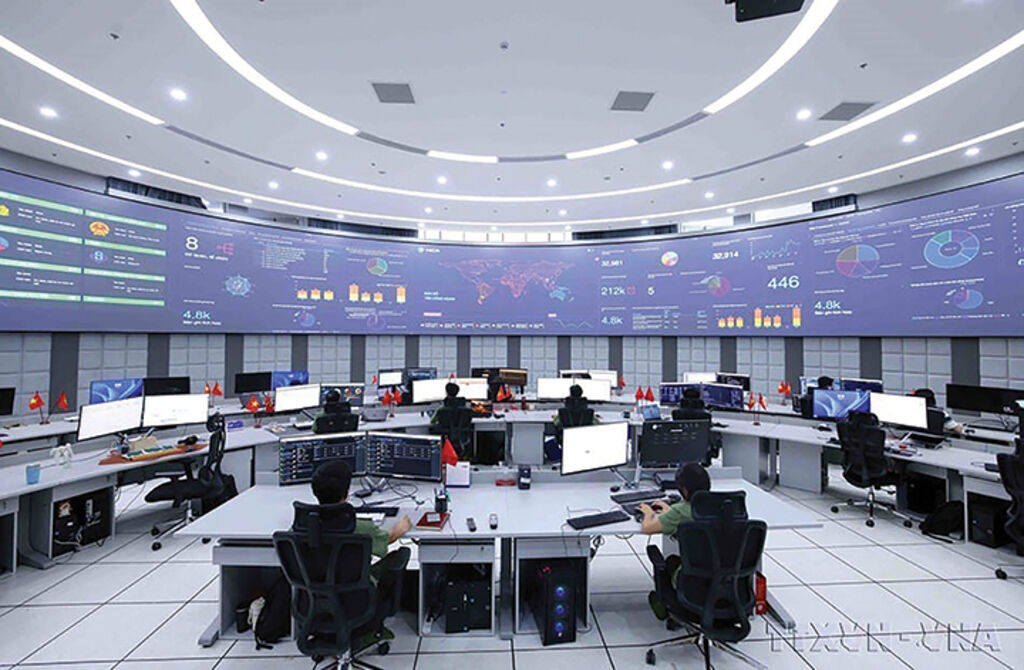
| Inside the Ministry of Public Security’s Security Operations Centre__Photo: Pham Kien/VNA |
Resolution 22[1] broadens the scope of national security protection across all sectors and domains, while harnessing the combined strength of the entire political system and the entire people to firmly safeguard the Vietnamese Fatherland in the new era, according to experts and scholars.
They said the resolution is viewed as marking a new development in strategic thinking on national security - one that is more forward-looking, broader in scope, more proactive and more comprehensive. Accordingly, early prevention is placed at the centre, while the concerted strength of the entire political system and the entire population serves as the foundation for building a robust “shield” that enables the country to embark on rapid, sustainable and self-reliant development in the new era.
From response to proactive prevention
Major General, Assoc. Prof. Dr. Nguyen Van Sau, Deputy Director of the Vietnam Institute of Defence Strategy and History, was cited by vov.vn as saying that Resolution 22 represented a substantial shift in security thinking, from an approach primarily centred on “protection and response” towards one that is proactive, integrated, comprehensive, inclusive, and development-oriented. Actually, it expands both the domains and scope of national security.
Protection is no longer limited to the Fatherland, the Party, the State, the people, the political system and national sovereignty. It also encompasses economic, energy, environmental and data security, while extending proactive protection to emerging domains such as cyberspace, outer space, seas and oceans, and low-altitude airspace.
The resolution lays greater emphasis on the requirement for “early and from afar” prevention, with threats to be identified and contained while they are still latent. It also calls for proactive response to compound and non-traditional threats, as well as new forms of security infringement. At the same time, the resolution highlights the importance of combined national strength, identifying the protection of national security as a key and regular task of the entire Party, the entire people and the entire army, placed under the Party’s absolute and direct leadership in all respects and the State’s unified management.
Dr. Sau said the core novel point of Resolution 22 lies in the decisive shift from merely protecting security to ensuring security for development; from responding to threats to proactively preventing them; and from a focus on traditional security issues to the comprehensive protection of all sectors, all spaces and all factors that help consolidate the strength of the country.
He was also quoted by chinhsachcuocsong.vnanet.vn, a Vietnam News Agency’s portal on policy and law, as saying that after seven years of implementing Resolution 51-NQ/TW of 2019 on the national security protection strategy, emerging issues have occurred in practice, requiring a higher level of strategic thinking and a more advanced approach.
To address this, Resolution 22 responds to the urgent demands arising from a security environment that is changing rapidly and becoming increasingly complex and unpredictable. Challenges stem from traditional and non-traditional security threats, cyberspace, emerging technologies, the economy, energy, the environment, epidemics and other areas. Protecting national security can, therefore, no longer be confined to responding to risks that have developed into actual problems. This requires a decisive shift towards proactive forecasting and prevention, risk management, and strengthening of national resilience.
One particularly significant point of the resolution is the linkage of security and development. Security helps not only maintain socio-political stability and safeguard national independence, sovereignty and interests, but also create a peaceful, stable and secure environment conducive to rapid and sustainable development and to improving the living standards of the people. This represents a major shift from the mindset of “protection for development” to one in which “security safeguards conditions for development”.
In addition, the resolution provides an important political foundation for harnessing the combined strength of the entire political system and the entire people, closely integrating national defence, security, foreign affairs, the economy, culture, science and technology; and building a strong people’s security posture in conjunction with the all-people national defence posture and a solid “people’s hearts and minds” posture.
Resolution 22 links the safeguarding of national security with the creation of a peaceful and stable environment that facilitates national rapid and sustainable development, thus helping successfully realise the objectives set out in the Resolution of the 14th National Party Congress, and achieve the two centenary goals, Sau said.
Security assurance requirements in digital era
Speaking at the nationwide training conference for key officials following the 8th National Congress of the Vietnam Veterans’ Association, held in August, Senior Lieutenant General Pham The Tung, Deputy Minister of Public Security, said the global security landscape remained complex and tense, with instability tending to spread around the world, adversely affecting the global economy and the momentum of recovery and growth.
Notably, science and technology, particularly dual-use technologies, AI, quantum technology and biotechnology, are advancing rapidly, reshaping the structure of productive forces, the drivers of development, and the thinking and governance methods of many countries. Those technologies have become important components of national comprehensive strength, providing countries with opportunities to advance and achieve development breakthroughs.
Alongside the opportunities brought about by emerging technologies, non-traditional security threats are becoming increasingly complex. Senior Lieutenant General Tung highlighted challenges that are becoming more severe in nature, scale and impact, including cyber security, transnational crime, water and food security, environmental pollution, climate change, disasters and epidemics.
In particular, sovereignty and security in emerging domains - including cyberspace, low-altitude airspace, outer space, underground space, and seas and oceans - are becoming persistent challenges. Among them, the threat of large-scale cyberattacks on critical infrastructure, information and data theft, and online fraud has created an urgent need to strengthen preventive capabilities.
Domestically, cyber security challenges have become intense as Vietnam accelerates its national digital transformation. Cyberattacks and cyber espionage targeting government agencies and businesses have become increasingly serious, while hacker groups are stepping up cyberattacks and spreading malware in order to steal classified information and documents. Data-encryption attacks targeting information systems are also becoming more sophisticated, while security vulnerabilities remain in not a few organisations.
Cyberspace is also being exploited to facilitate various forms of crime, including fraud, the illegal trade in drugs and weapons, money laundering and gambling. At the same time, it is being used to disseminate fake news and false information, causing information disorder and adversely affecting security and order.
These developments command that safeguarding national security “early and from afar” must begin with the ability to identify threats at their earliest stage. Rather than waiting until a cyberattack has paralysed systems, data has been stolen or false information has spread widely before taking action, authorities must proactively detect abnormalities and address risks at their source.
Meanwhile, Major General Sau noted that safeguarding national security must be one step ahead, rather than allowing technology to advance and only responding to threats once they emerge. All critical digital systems, databases and AI platforms must be developed in adherence to the principle of ensuring “safety and security by design”, which are capable of identifying threats, giving warnings, responding to incidents and recovering from disruptions.
At the same time, it is essential to master strategic technologies and data. Taking early action means, first and foremost, proactively building self-reliance in core technologies, AI, big data, cloud computing, semiconductors, cryptography and cyber security solutions. Digital sovereignty cannot be securely protected if the country excessively depends on foreign technologies, platforms and infrastructure. The country therefore needs to develop its own cyber security technology ecosystem, with priority given to the research, development and mastery of key technologies.
Another key priority is to make a decisive shift from “passive defence” to “proactive defence”. This requires strengthening intelligence and early warning capabilities, as well as data analytics, to identify threats before they develop into incidents. Regular drills should also be conducted to prepare for scenarios involving cyberattacks, data leakage, information manipulation and attacks on critical infrastructure. This approach is consistent with the requirement of building a proactive and comprehensive cybersecurity posture capable of prematurely addressing risks.
Dr. Sau stressed that, technology, no matter how advanced it becomes, cannot replace people. It is therefore necessary to improve digital capabilities, strengthen awareness of data protection, and equip officials, businesses and the public with the skills needed to identify misinformation, deepfakes and fraudulent schemes. Efforts should also be exerted to foster a healthy information environment and reinforce public trust.
In addition, national governance capacity and interdisciplinary coordination must be strengthened. Digital security should not rest solely with the responsibility of specialised forces; instead, it must become a regular responsibility of the entire political system, technology companies and the public. This requires close combination of national defence, security, diplomacy, science and technology, and economic development.
Protecting national security “early and from afar” in the AI era requires anticipating risks, building capacity in advance, taking preventive action before vulnerabilities become crises, and acting before events force a reactive response. The ultimate goal is to safeguard national sovereignty and interests while creating a safe and trusted digital environment for rapid and sustainable national development, Sau emphasised.
Building permanent prevention capacity
To safeguard national security, one of the foremost priorities is to build technological and data self-reliance, said Major General Sau. He noted that critical data, digital infrastructure and essential information systems must be strictly protected, while domestic platforms, core technologies and AI capabilities should be developed to reduce dependence on foreign technologies in strategic sectors.
Another priority is to strengthen the institutional and governance framework for AI. Vietnam needs to develop a legal framework that is sufficiently responsive, flexible and risk-based, with clearly defined responsibilities of organisations, businesses and individuals. Testing and safety assessment should also be intensified for high-impact AI systems, especially in areas directly related to national defence, security, finance, energy and critical infrastructure.
At the same time, the country needs to develop a multi-layered “digital defence” capability based on connectivity and data sharing among agencies, alongside monitoring and early warning systems capable of rapidly detecting and addressing cyberattacks, AI-enabled impersonation, information manipulation and non-traditional security threats.
Dr. Sau said this approach should be translated into a process comprising “early identification - accurate forecasting - timely warning - prevention at source - rapid response - effective recovery”. Action should not be delayed until risks evolve into crises, and abnormal signs in data, technology, markets and cyberspace must be detected at an early stage.
“The key is to build an “all-people digital security posture”, in which the State plays a facilitative role, specialised forces form the core, technology companies serve as an important component, and every citizen is an active participant in safeguarding security. This is how the principle of prompt action can be transformed into a permanent national prevention capability,” Sau said.
Promoting the role of veterans at the grassroots level
In building the people-based security posture, veterans are among the forces playing an important role, Colonel Do Phu Tho, Editor-in-Chief of Vietnam Veterans Newspaper, talked to chinhsachcuocsong.vnanet.vn. He said that veterans always set an example for others and therefore are respected by their communities. They are directly involved in safeguarding political security, mediating disputes, providing valuable information to the authorities, and promoting the “All People Protect National Security” movement in their localities. They are also a trusted force of the Party and the State, taking a pioneering role in combating erroneous viewpoints and “peaceful evolution” schemes, thereby helping maintain political stability from the grassroots level.
Over the recent years, many veterans have provided important information that has enabled the public security forces to respond promptly to complex security and order matters. They have also actively participated in community mediation teams, helping educate and rehabilitate people who have committed offences or made mistakes, as well as young people in need of guidance, and supporting their reintegration into the community. A number of veteran-led initiatives have proved highly effective, e.g., “Self-Management Teams for Security and Order” and “Veterans Supporting Road Traffic Safety”.
The editor-in-chief said his newspaper seeks to raise awareness among officials, members of veterans’ associations and readers about emerging security risks and challenges, particularly those arising in the digital environment. It also provides guidance on identifying harmful and malicious information and strengthening the ability to counter erroneous and hostile viewpoints.
Highlighting that Resolution 22 sets out a range of new orientations aimed at strengthening national security capabilities amid deeper international integration and growing non-traditional security challenges, Colonel Tho expressed his hope that the resolution would help raise awareness among officials and members of veterans’ associations about building a people-based security posture in conjunction with digital transformation.
This, in turn, will help further promote the exemplary role of veterans in protecting the Party’s ideological foundation, maintaining security and order, and contributing significantly to the “All People Protect National Security” movement, right from the grassroots level.
Conclusion
Resolution 22 identifies the safeguarding of national security as a critical and regular task of the entire Party, the entire people and the entire army, among them, heads of units bear the prime responsibility for addressing security-related issues within their respective units, Nguyen Quang Truong, Deputy Secretary of the Executive Committee of the Central-Level Party Agencies, told vov.vn.
To perform this task effectively, it is required to strengthen strategic forecasting capabilities and proactively respond to emerging forms of security infringement. At the same time, greater attention must be paid to human security and to bringing into play the strength of the people as a key pillar of national security, thereby enhancing the country’s capacity to respond to traditional and non-traditional security challenges.
It is also a need to strengthen political and ideological education, foster political steadfastness and revolutionary vigilance, and take a proactive, resolute and persistent approach to countering erroneous and hostile viewpoints as well as harmful and malicious information in cyberspace. This should go hand in hand with building capacity of personnel engaged in internal political protection, information security, information technology and cyber security, Truong said.-
[1] Resolution 22-NQ/TW on the national security strategy was released on July 28, 2026, at the 3rd plenum of the 14th Party Central Committee.