Nguyen Thi Phuong - Nguyen Thi Phuong Anh - Bui Thi Minh Trang
People’s Court of Region 1, Khanh Hoa province
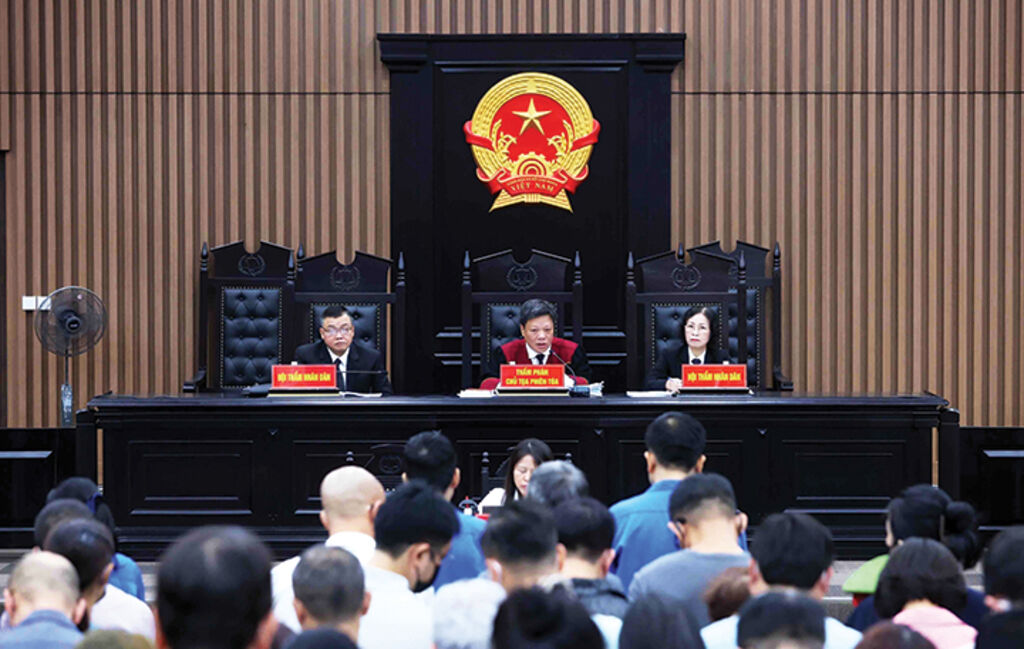 |
| A hearing at the Hanoi People’s Court__Photo: Pham Kien/VNA |
Introduction
In judicial practice, the application and enforcement of suspended sentences for foreign offenders in Vietnam face significant difficulties due to statutory requirements. These challenges include determining the offender’s place of residence, establishing mechanisms for supervision during the probation period, and ensuring the effective enforcement of the sentence. As a result, courts may impose an immediate custodial sentence rather than grant a suspended sentence, even where an offender satisfies most of the statutory conditions.
Drawing on both legal theory and judicial practice, this article analyses the provisions of Vietnamese criminal law regarding the application of suspended sentences to foreign offenders, identifies gaps in the current legal framework, and proposes recommendations to improve the consistency and feasibility of the law.
Vietnamese legal provisions on suspended sentences
Article 65 of the 2015 Criminal Code (as revised in 2017) (the Code) provides that, when imposing a prison sentence of not more than three years, if deeming it unnecessary to compel the offender to serve the sentence, the court may grant the offender a suspended sentence along with a probation period of between one year and five years. During the probation period, the offender must fulfill all obligations prescribed by law and remain subject to supervision and education by competent authorities.
The application of suspended sentences is guided by Resolution 02/2018/NQ-HDTP (Resolution 02) of the Judges’ Council of the Supreme People’s Court. The management, supervision, and education of offenders serving suspended sentences are governed by the 2019 Law on Enforcement of Criminal Sentences (the Law). Accordingly, one of the prerequisite conditions for enjoying a suspended sentence is that the offender must have a clear place of residence or a stable workplace to facilitate supervision and education during the probation period.
In essence, a suspended sentence is not a penalty but a conditional exemption from serving a prison sentence. It reflects the State’s humanitarian policy by allowing the offender to rehabilitate within the community under the supervision by competent authorities. However, current regulations were primarily designed for Vietnamese citizens with stable residences in Vietnam. As a result, their application to foreign nationals presents practical difficulties, particularly in satisfying the residence requirement (having a clear place of residence or a stable workplace).
Practical difficulties in applying suspended sentences to foreign offenders
Inconsistencies in determining a foreigner’s clear place of residence
Article 65 of the Code and Resolution 02 lay down conditions for granting suspended sentences that apply generally to all offenders, regardless of their nationality. In practice, however, foreign nationals present distinct issues relating to residence, capacity for supervision, and conditions for securing the sentence execution that have not been addressed through specific legal criteria.
A key condition for granting a suspended sentence is that the offender must have a clear place of residence or a stable workplace to ensure supervision and education during the probation period. Applying these general provisions to foreign nationals, however, has proved problematic.
Article 2.4 of Resolution 02 provides: “Having a clear place of residence or a stable workplace is to enable competent agencies or organisations to conduct supervision and education.
A clear place of residence means a temporary or permanent residence with a specific address determined in accordance with the Law on Residence, where the offender regularly resides and lives regularly after being granted a suspended sentence.
A stable workplace means a location where the offender works under an employment contract with a term of one year or more, or pursuant to a decision of a competent agency or organisation.”
Accordingly, a clear place of residence must be a temporary or permanent residence with a specific address where the offender regularly resides following the grant of the suspended sentence. Regarding this condition, courts have in some cases granted suspended sentences when the offender possessed a temporary residence card, labour contract, or lawful residence. In other cases, however, courts refused to grant suspended sentences on the grounds of lacking residential stability required for supervision and education.
Current legislation provides no detailed guidelines for offenders who are foreign nationals residing in Vietnam under fixed-term visas or temporary residence cards. In many cases, at the time of trial, a foreign national holding a valid temporary residence card with a clear address and stable living status in Vietnam may be considered satisfying the condition for a suspended sentence. Nevertheless, shortly thereafter (around four to five months) after the judgment becomes legally effective, the temporary residence card may expire or the offender may leave Vietnam during the probation period. In such circumstances, competent authorities are unable to continue supervising the offender, while the law provides no mechanism to ensure continued supervision. This legal loophole creates enforcement difficulties and results in inconsistent application among courts.
Moreover, regarding foreigners’ overseas residences, Vietnam has not concluded mutual legal assistance treaties in criminal matters with many countries, leaving no legal basis to verify whether a foreign offender maintains a stable residence abroad.
Difficulties in supervising foreign offenders during probation
Under the Law, offenders granted a suspended sentence are supervised and educated by commune-level People’s Committees in localities where they reside or by organisations where they work throughout the probation period. However, for foreign nationals, practical difficulties arise once the judgment becomes legally effective. They may leave the country or lose their residence status in Vietnam following the expiry of their visas or temporary residence cards. In these cases, the agencies assigned to supervise them are no longer able to monitor the offenders’ compliance with probation obligations, making effective enforcement of the sentence extremely difficult.
Current laws also do not expressly specify whether foreign offenders serving suspended sentences are subject to temporary exit bans. If they are permitted to leave Vietnam freely, the objectives of supervision and education underlying the suspended sentence cannot be achieved. Furthermore, there is no specific legal ground for restricting their departure from Vietnam during the probation period. This presents another legal loophole requiring further examination and improvement to ensure the effective enforcement of suspended sentences for foreign offenders.
Recommendations for legal improvement
The above analysis demonstrates that Vietnam’s current legislation governing suspended sentences is relatively comprehensive but was primarily developed for Vietnamese citizens with stable domestic residences. Significant legal gaps remain regarding their application to foreign nationals residing and working in Vietnam.
To ensure that suspended sentences can be applied to foreign nationals consistently and effectively in practice, the following measured are proposed:
First, specific, Resolution 02 should be supplemented with provisions specifically addressing foreign nationals. These provisions should establish clear criteria for determining whether a foreign offender satisfies the requirement of having a clear place of residence or a stable workplace.
Accordingly, a foreign national should be regarded as satisfying this requirement when meeting the following basic criteria: holding a lawful residence status in Vietnam under a valid visa, temporary residence card, or permanent residence card; having a specific, clear residence address registered in accordance with regulations; having a remaining duration of lawful residence sufficient to allow supervision and education during the probation period; having a stable workplace or grounds proving his/her planned long-term residence in Vietnam; and undertaking to fully discharge all obligations during the probation period, including notifying authorities upon changing residence or leaving the country. Adding these criteria would provide courts with a clear legal basis for deciding whether to grant suspended sentences while promoting consistency and feasibility in trial and judgment enforcement practice.
Second, a formal coordination mechanism should be established between criminal judgment enforcement agencies and immigration authorities in managing and supervising foreign offenders under probation as mandated by the Law. Under this setup, criminal judgment enforcement agencies should take prime responsibility for monitoring the serving of the sentence; immigration authorities should provide updated information regarding the offender’s residence, exit, and entry status; and the assigned supervising and educating agencies should directly manage the offender throughout the probation period.
At the same time, a mechanism permitting the extension of the residence period for foreign offenders serving suspended sentences should be studied to facilitate continued supervision and education. Where an offender diligently fulfills all of his/her obligations, a residence period extension may be considered and granted in accordance with law.
Finally, detailed guidance should be provided regarding cases where foreign offenders leave Vietnam during the probation period to ensure the practical enforceability of suspended sentences and reduce practical complications.
Conclusion
The recommendations proposed above aim to improve the legal provisions on granting suspended sentences to foreign offenders in Vietnam. Any amendments should be aligned with the overarching objective of ensuring consistent, proper and feasible application of suspended sentences. This will serve as an important foundation for improving judicial efficiency, better protecting human rights and the lawful rights and interests of involved parties, and meeting the requirements of the judicial reform and international integration in criminal justice.-
[1] The full text of the Vietnamese version of this article was published on the online People’s Court Magazine on July 2, 2026.