Vu Thanh Tuan, LL.D., and Vu Cao Nguyen, LL.M.
People’s Court of Ward 13, Hai Phong city
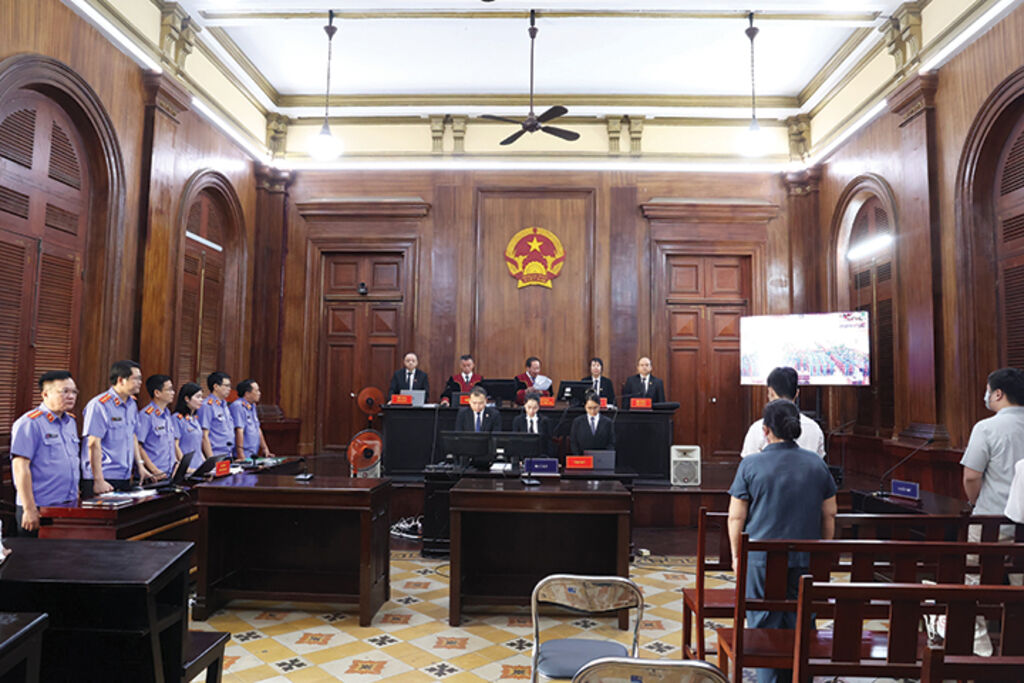 |
| The trial of 227 defendants in the VN10 drug trafficking case is held in a hybrid format in Ho Chi Minh City__Photo: Hong Dat/VNA |
Introduction
The 2015 Civil Procedure Code (the Code) was adopted at a time when judicial activities still relied heavily on paper-based records and direct procedural interactions. Since then, Vietnam has accelerated national digital transformation, administrative procedure reform and judicial procedure reform, while also shifting to the two-tier local government model.
These developments have significantly changed the practical requirements of civil proceedings. However, several provisions of the Code remain tied to manual case management and paper-based procedures, creating difficulties in the use of electronic documents, digital data and technology-based judicial processes.
A more comprehensive legal framework is therefore needed to support electronic procedures, clarify the legal validity of digital data and ensure better coordination among relevant agencies throughout the litigation process.
Improving procedures for receiving and processing lawsuit petitions
Statutory limitations
First, while the Code recognises the online submission of petitions (Article 190), it lacks explicit provisions regarding the authentication method for electronic petitions, the exact time of receipt by the court, and the burden of proof concerning the transmission and receipt of petitions. The 2023 Law on Electronic Transactions (effective as of July 1, 2024) establishes a general legal framework regarding the validity of data messages, electronic signatures, and electronic transactions in activities of state agencies. Accordingly, the legal validity of electronic documents should not be denied solely because these documents are presented in the form of data messages.
In civil procedure, these principles should be concretised, particularly with regard to plaintiff authentication, data integrity, timestamps, and the storage and verification of electronic petitions.
Since petition filing triggers the procedural responsibilities of the court and affects the statute of limitations as well as the rights and obligations of litigants, the provisions on online petition filing must be coupled with mechanisms for identification, authentication, and transmission timestamping.
Second, electronic procedures have not been designed on the principle of comprehensive digitalisation.
The Code fails to clearly determine whether petitions filed online and electronic documents are managed entirely as electronic case files or whether they must be converted into physical copies for further processing. Digital transformation in litigation requires not only converting paper documents into electronic files but also stipulating workflow processing based on digital databases. Each case file requires a unique identifier; operations such as receiving, transferring, returning or accepting petitions must be logged; plaintiffs must be granted the right to track the processing status of their petitions; and the processing history must be archived for monitoring and complaint resolution.
Third, the Code lacks a comprehensive mechanism for the court to exploit state data to verify petitions. The Code does not explicitly stipulate the court’s responsibilities when accessing data on residence, civil status, enterprise registration, or assets. Plaintiffs are currently required to gather by themselves information that already exists in databases. However, granting the court unlimited access to such data may infringe upon the plaintiff’s privacy. Therefore, data utilisation must be purposeful, authorised, and subject to verification and traceability.
Fourth, there is an absence of an adequate legal mechanism to guarantee citizens’ right to choose to sue online and their equal access to judicial proceedings. Digital transformation in litigation does not mean mandatory electronic filing, as this may erect barriers for older persons, persons with disabilities, or individuals residing in remote areas or lacking access to digital tools. Therefore, the appropriate model is one that allows citizens to choose electronic or online filing, while the court assumes responsibility for digitising and managing files within a unified digital system.
Finally, the current provisions concerning the petition processing time limits are no longer aligned with electronic methods. Article 191 of the Code provides a three-day time limit for the chief justice to assign a judge and a five-day period for the judge to consider a petition. While shortening these time limits must still be contingent upon workload, case characteristics and digital infrastructure, priority should be given to mechanisms for automatically recording the time of receipt, assigning petitions for processing, requesting petition modifications, notifying processing results, and allowing tracking of the processing status.
Recommendations for revision of the Code
From the above analysis, Articles 190 and 191 of the Code should be revised to establish comprehensive electronic petition-filing procedures, rather than merely supplementing an online filing channel.
To begin with, multiple methods of filing petitions should be permitted while mandating unified file management within a digital environment. Article 190 may be supplemented as follows: “Petitions and accompanying documents and evidence may be submitted in person, by post or by electronic means. The court shall digitise petitions and accompanying documents and evidence received in person or by post to establish a unified electronic case file.” Accordingly, digitisation constitutes a responsibility of the court rather than a condition for exercising the right to file a lawsuit, with all files managed on a single platform.
Next, provisions on the legal validity of electronic petitions should be added. An electronic petition must clearly identify the plaintiff, ensure accessibility and data integrity, and be lawfully authenticated. Article 190 may add the following provision: “Petitions submitted by electronic means must have the same legal validity as paper petitions provided that plaintiffs are identified, the integrity of their content is ensured, and they are authenticated by electronic signatures, electronic identification accounts, or other lawful electronic authentication methods.” This provision aims to align with the 2023 Law on Electronic Transactions.
In addition, the exact time of receipt of electronic petitions by the court must be clearly specified to determine the statute of limitations and processing responsibility. The time the court confirms the receipt of adequate data should be considered the time of petition receipt. The system must automatically issue a notification containing the file code, time of receipt, and list of documents. In the event of system failure, plaintiffs may prove that the petition was submitted on time using system data, error notifications, timestamps, or other electronic evidence.
Beyond this, Article 191 should be revised to provide for the digitalisation of the entire petition processing process. Upon receipt, petitions must be assigned an identification code, with the assignment of judges, any requests for modification or supplementation of petitions, the transfer or return of petitions, and the acceptance of petitions clearly tracked in the system; and plaintiffs must be enabled to track the processing status of their case files. This article may be supplemented as follows: “Upon receipt of a petition, the court shall issue an electronic identification code for the petition. All petition processing activities must be updated in the case management system and notified to the plaintiff by registered methods. The system must make it possible to determine the time, the officer responsible, and the content of each processing stage.”
Moreover, provisions on the court’s authority to access and use data, together with personal data protection requirements, should be added. The court should be granted the right to query data on population, civil status, enterprise registration and assets in order to verify information about litigants, jurisdiction, and the conditions for accepting petitions, provided that such authority is appropriately decentralised and traceable. The proposed addition is as follows: “The court may exploit data from national databases and specialised databases to inspect and verify information necessary for receiving and resolving civil cases. Data exploitation must be duly authorised, purposeful, remain strictly within necessary limits, and ensure the safety and confidentiality of personal data.”
Lastly, a solution should be formulated to build a unified portal for the electronic receipt of petitions to facilitate the identification of courts with jurisdiction and the transfer of files to those courts. Should a petition be submitted directly to a court that does not have jurisdiction, the court may assist with the digitisation and transfer of the file.
Improving procedures for issuance, service and notification of procedural documents in the digital environment
In the context of digital transformation, the electronic service of procedural documents directly affects the progress of case settlement, the right to be informed, the right to participate in litigation, and the parties’ right to adversarial proceedings. It helps save time and reduce costs, and even alters the ways of proving procedural claims and transmitting procedural information. Three requirements must be satisfied: identifying the correct recipient, proving the time of service and the content of the document served, and ensuring practical access to the document.
Some limitations of the Code regarding service procedures
Initially, the Code lacks a comprehensive institution for electronic service. Article 173 lists electronic means as a method of service but fails to clearly define the conditions for valid electronic service, the time of service, and the data evidencing delivery and receipt. In litigation, valid service provides a basis for taking subsequent procedures steps, conducting adjudication in the absence of a party, or calculating time limits for appeals. Since the mere dispatch of an email or message cannot be automatically deemed valid service, this mechanism must generate reliable evidence regarding identities of the sender and the recipient, the content of the document, time of dispatch, and accessibility.
Subsequently, the current service model remains heavily reliant on residential addresses and the recipient’s cooperation. When parties refuse to accept documents, fail to cooperate, or are absent, the court has to post public notices or even entrust the posting of the notice to another court. Electronic service does not inherently resolve these issues (as individuals may not regularly check their accounts, may change phone numbers, or may not access their accounts), yet it becomes reliable when linked to personal identification systems.
Additionally, the procedures for public posting at the court’s premises, the commune-level People’s Committee, or the last known residence of the party concerned are no longer practical because they amerely satisfy formal procedural requirements rather than effectively safeguarding the parties’ right to participate in litigation. Therefore, physical posting must be combined with publication on the court’s electronic portal and notifications via electronic identification accounts and authenticated communication channels.
Furthermore, the Code fails to clearly distinguish between “sending a document” (an act of the court), “receiving a document” (data arrival at the recipient’s system), and “being deemed duly served” (a legal conclusion leading to procedural consequences). In practice, a reasonable legal presumption is required: if a document is successfully transmitted to a registered electronic identification account accompanied by notifications also sent through supplementary channels, it may be deemed duly served after a specified period, unless a force majeure event or system error occurs.
At the same time, adequate mechanisms for protection of personal data and procedural confidentiality during the electronic service of procedural documents containing information on personal identity, assets, marital relations, health status, business secrets, and other sensitive data are also lacking. Electronic service requires systems to prevent unauthorised access, ensure document integrity, log operations such as opening, downloading and forwarding, and store data in accordance with the type of case files.
Finally, electronic service has not been fully linked to the parties’ right to choose a method of service. Compelling all parties to receive electronic documents may place individuals lacking digital devices or skills at a disadvantage. Consequently, mandatory electronic service may be introduced gradually for state agencies, enterprises, professional practice organisations and authorised representatives frequently engaging in litigation. Individuals should be encouraged to register voluntarily to receive documents electronically, unless otherwise provided by law.
Recommendations for revision of the Code
At the outset, Article 173 should be amended to designate electronic service as an independent method with the same legal validity as traditional methods of service, specifically: “The issuance, service and notification by electronic means shall be carried out via the court’s electronic portal, electronic identification accounts, litigation information systems, or other electronic methods capable of authenticating the recipient, ensuring document integrity, and recording the times of sending and receipt.”
Subsequently, a separate article should be added concerning the conditions for valid electronic service, requiring documents to be sent from the court’s official information system; identification of recipients through electronic identification accounts, electronic signatures or lawful authentication methods; system recording of the time of sending, successful delivery and access status; registration or confirmation by recipients of their electronic communication channels; and archive of sent and received documents in electronic case files.
Furthermore, the precise time of completion of electronic service should be defined with the following provision: “Service by electronic means shall be deemed completed at the time the recipient accesses the document on the system. Where the system records that the document has been transmitted to a registered electronic account but the recipient fails to access it within the law-specified time limit, it shall be deemed served, unless the recipient proves that such failure resulted from a force majeure event, an objective obstacle, or a technical system error.”
In addition, electronic service should be combined with multi-channel notifications. When documents are dispatched to a party’s electronic account, the system should simultaneously send alert text messages or emails. For important documents such as decisions to bring cases to trial, judgments, rulings to suspend litigation or notices of the time limits for appeal, the court may concurrently utilise both methods of service during the transitional period.
Meanwhile, posting procedures should be reformed by combining physical and electronic posting. In addition to locations specified under current legal provisions, necessary documents or information must be publicly posted on the court’s electronic portal. A provision should be added: “Public posting shall be carried out simultaneously at locations specified by this Code and on the court’s electronic portal. Electronic publication must ensure the right to access information while complying with the law on the protection of personal data, privacy, family secrets and business secrets.”[2]
Lastly, a management mechanism for electronic addresses for service should be established. Upon filing a petition or submitting the first procedural document, parties are obliged to provide contact addresses and choose a method for receiving documents. Electronic addresses for service may include accounts in the court information system, electronic identification accounts, or other authenticated electronic addresses. Litigants are obliged to notify the court of any address changes. Otherwise, documents sent to the previously registered electronic addresses will be deemed valid, unless litigants prove their inability to access those documents for objective reasons. This mechanism is similar to the responsibility to notify the court of changes in residence addresses but is better suited to the digital environment.
Conclusion
Digital transformation and the establishment of electronic courts necessitate the revision of the Code’s provisions concerning the acceptance of petition, procedural document service, evidence collection, taking statements, on-site inspection, and asset valuation. This will help improve the electronic litigation mechanism, guarantee the legal validity of electronic data, enhance integration with national databases, and safeguard the right of access to justice, the right to adversarial litigation, and the right to personal data protection. This also serves as the foundation for increasing the efficiency of civil litigation and building a modern and transparent electronic court system.-
[1] The full text of the Vietnamese version of this article was published on the People’s Court Magazine Online on July 31, 2026, https://tapchitoaan.vn/
[2] The principle of protection of personal privacy, family secrets, and lawful rights and interests of individuals upon the announcement of court judgments and rulings, set out in the Supreme People’s Court’s Council of Justices’ Resolution 03/2017/NQ-HDTP on announcement of court judgments and rulings on the courts’ electronic portals, may be referred to during the formulation of this mechanism.